
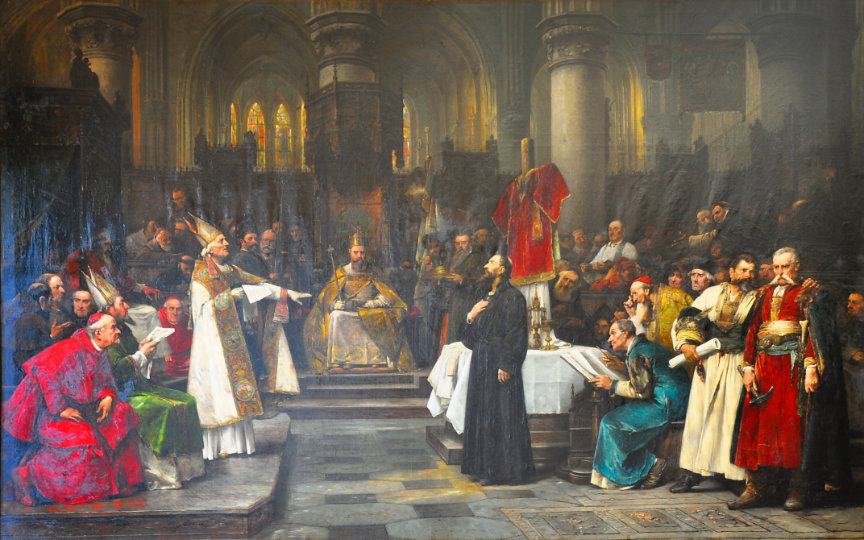
by Václav Brožík, 1883, Wikipedia, Public Domain
Over the past few months, the cessationists have become very active in promoting their views that the spiritual gifts ended with the death of the last apostle, John, around 100 AD.
Continuationists, on the other hand, believe that the spiritual gifts that emerged on the Day of Pentecost for the church were not only at work in the Old Testament, but continue today.
There is no argument, that as the historical church became more authoritarian and less spiritual, the usage of the gifts fell off. Nevertheless, they were still important to those during this time who held the Bible in high regard, such as early Protestant reformer Martin Luther.
This includes an interesting prophecy that was apparently given by Jan Hus, a Czech priest, who was born around 1372. He saw the error of the Roman Catholic Church and began to call for reform and a return to the scriptures as the final authority.
Hus opposed the sale of indulgences, which involved buying your way into heaven. Furthermore, he claimed that the church was built on Christ, not Peter (the first pope according to Catholic tradition), and that people were subject to the Bible, not papal edicts and church traditions.
Hus even produced a booklet outlining the six errors of the Catholic Church and tacked them on the door of His church in Bohemia, a move that would be copied by Martin Luther a hundred years later with his 95 Theses.
The Catholic Church demanded that Hus stop teaching and when he refused, he was excommunicated in 1412. Though a wanted man, because of the reluctance of local authorities to detain him, Hus would not be arrested until 1414 after he was conned into attending a Church meeting to discuss his views with false assurances of safety.
Church authorities stated that they were not obligated to abide by any promises given to a heretic.
After his arrest, Hus was brought before a jury in Constance, Germany, where he was tried and condemned to death and burnt as a heretic on July 6, 1415.
During the trial, Hus was encouraged numerous times to recant his views to save his life but said he would only do this if they could find Bible verses that proved his opinions were wrong. Of course, no Biblical evidence was or could be presented.
The court found him guilty and as soon as the trial was over, he was immediately taken out and executed by fire.
Several ancient records suggest that as his executioner was setting the fire, he reportedly stated now we cook the goose (Hus’s name means goose), Hus replied stating to effect, “You may burn a goose, but there will come an eagle in a hundred years that you will not reach.“
This was fulfilled by Martin Luther (1483-1546) who built on Hus’ teaching and called for similar reforms in the Roman Catholic Church.
In fact, Wikipedia reports that Hus’ prophecy was cited both at Luther’s funeral and as well in Luther’s biography written by Johannes Mathesius, in 1566, twenty years after Luther’s death.
Some dispute the prophecy’s legitimacy, mostly on the presumption that prophecy isn’t real and, therefore, it couldn’t have happened.
Unlike Hus, Luther escaped a similar heresy trial by the Roman Catholic Church where he was also promised safety, because of the intervention of Prince Frederick of Saxony. This allowed him to successfully promote his Biblical protestant views.
This series of events reveals that as they embraced the Bible’s authority, the reformers accepted spiritual gifts as legitimate in their day.
In fact, one of the lines from the fourth stanza in Martin Luther’s worship song, A Mighty Fortress is Our God, reveals just how accepted they were:
That word above all earthly pow’rs, no thanks to them, abideth;
The Spirit and the gifts are ours through Him Who with us sideth;
Why would Luther include a line on the spiritual gifts in this hymn about the protection of God? It wasn’t necessary. Luther could easily have written something else.
Obviously, the spiritual gifts were considered important expressions of the Holy Spirit among the reformers.



 OpentheWord.org
Leave a comment