
While I am not convinced that God will allow the Jews to rebuild the temple in Jerusalem, many Orthodox Jews believe it will be.
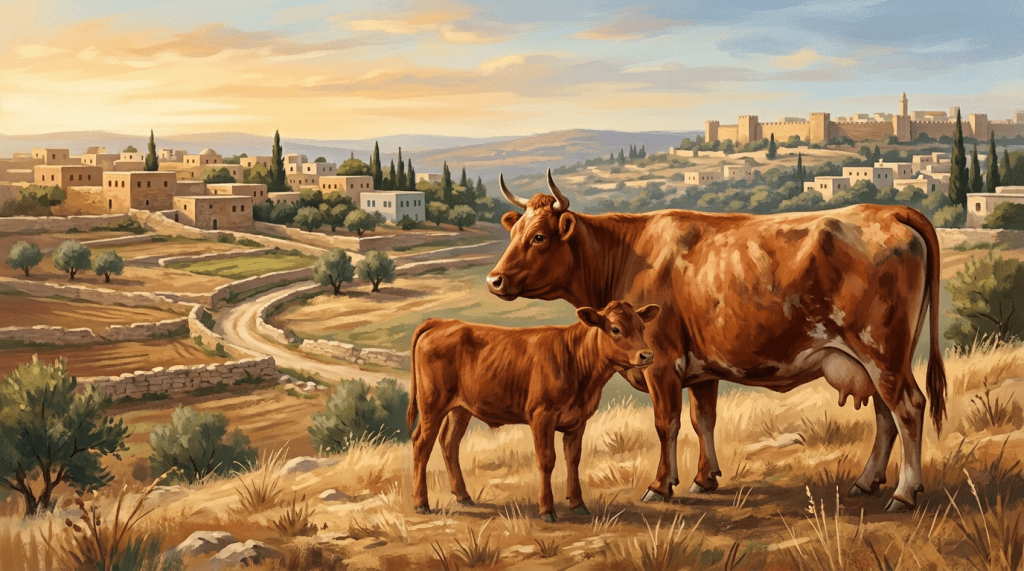
The recent birth of a second red heifer in Jerusalem has convinced some Orthodox Jews that God has given a sign to pursue a third temple, Israel365 News reports.
The Red Heifer sacrifice is necessary for a functioning temple, as it is needed to purify the priests. Without the sacrifice they would not be able to perform the rituals.
The National Red Heifer Institute [NRHI] recently announced that two red heifers were born in Israel over the past couple of months.
But the second one was significant because it occurred around the reading of the Parshat Chukat. This is the name of the 39th weekly reading of the Torah, that includes a portion from the Old Testament on the Red Heifer sacrifice in Numbers 19.
The heifer was born on the farm of Shai Givon who believed the birth’s timing was timely.
“The team at the Institute [NRHI] expected potential heifers to be born this season, but her birth so close to Tisha B’Av gives the strong sense that God is pressing us to accelerate the path toward building the Temple,” Givon said.
Givon is part of the NRHI Network which means that he follows certain procedures to maintain the purity of his animals since the Law required Red Heifers to be unblemished. This includes not inserting name tags in the calf’s ears as this would create a blemish, disqualifying the heifer for use.
The red heifer born a month and a half earlier had been tagged, but it was subsequently removed. The area where the tag was inserted has grown over and is nearly indiscernible. But it is still uncertain if it meets the unblemished qualifications.
Givon’s calf also has a problem. It was a twin that was in the womb with a male calf. In cattle, the two share the same blood and the higher testosterone in the male often affects the development of the female’s womb rendering the heifer infertile.
The Beit Midrash, a group of Rabbis who advise the NRHI, will be meeting at the farm to discuss whether this potential invisible infertility constitutes a blemish.
But Givon is undeterred. Because of the number of people who contacted him about the calf’s birth, he is convinced that interest in the construction of a third Jewish Temple is growing among Jews worldwide.
Did Jesus Curse the Temple When He Cursed the Fig Tree?
But despite the desire for a Temple, I am not convinced it will be rebuilt. Not only did Jesus prophesy the destruction of the Temple in Matthew 24, but the Lord’s cursing of the fig tree may have permanently sealed its fate.
There are incidents throughout the Bible that seem totally out of place with what is going on in the chapter. But scholars have developed a way of dealing with these passages.
Referred to as the sandwich theory, it suggests that if what took place before the incident and immediately after have the same theme, then the unrelated story in the middle is about the same thing.
In Matthew 21 we have the story of Jesus cursing the fig tree. The Lord went to the tree looking for figs, but it had none because it was out of season. Yet for some unknown reason Jesus cursed the tree and it died.
But immediately before this account, Jesus had just cleansed the Temple. This resulted in Jesus and the disciples deciding to spend the night in Bethany to escape the heat.
It was on this journey they encountered the fig tree.
The next day they returned to the temple and were immediately confronted by the priests over what Jesus had done the previous day.
So if the incident before and after involved the temple, then the Fig tree story is also about the temple.
If this was the case, then Jesus was actually cursing the temple.
Matthew noted that Jesus cursed the Fig tree with these words, “No longer shall there ever be any fruit from you.” (Matthew 21:9)
Mark’s version repeated the curse, but he added that the fig tree was “withered from the roots up” (Mark 11:20). This meant there was no chance of regrowth. It was permanently killed.
So if the fig tree was substituted for the Temple, this suggests it will never be rebuilt.
Just my opinion of course.




Leave a Reply