
FOLLOW OUR PODCAST ON (search opentheword):
Podcast Notes:
ESPAÑOL: 148 | What Ancient Non-Christians Had to Say About Jesus
Hi my name is Dean Smith and in this podcast I want to discuss several mentions of Christ made by ancient secular sources.
Incredibly there are people today who will claim that Jesus did not exist. They are certainly a minority, fringe group, because we have nearly 6,000 fragments (some complete) of the New Testament with many such as the Gospels providing first hand reports on Christ’s ministry.
There are also archaeological evidence of Christ’s influence in the Roman Empire.
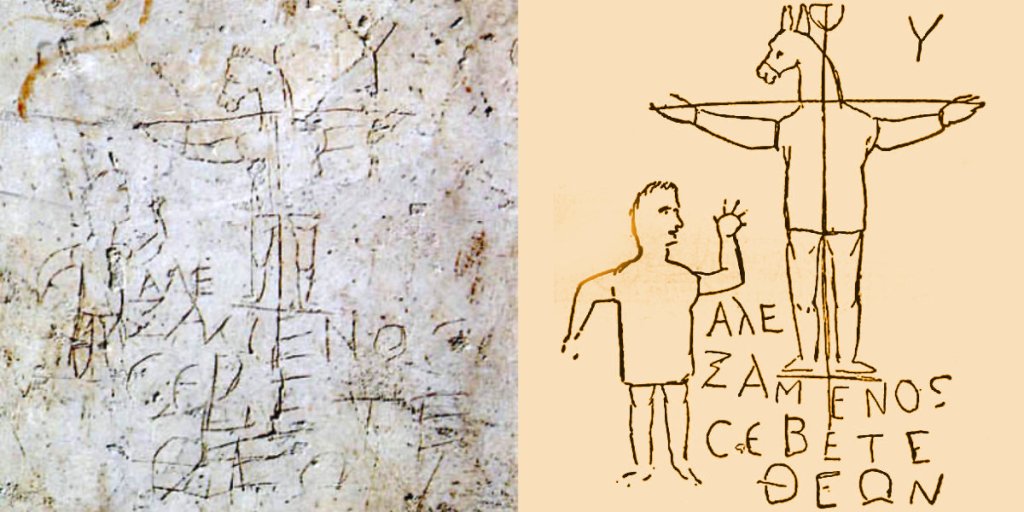
The Alexamenos Graffito
One of my favorite archaeological finds provides a negative spin in how Christ was often portrayed. It is called the Alexamenos Graffito.
As its name implies, it involves graffiti scrawled on a wall near Rome’s Palatine Hill. It is dated between the first and third century.
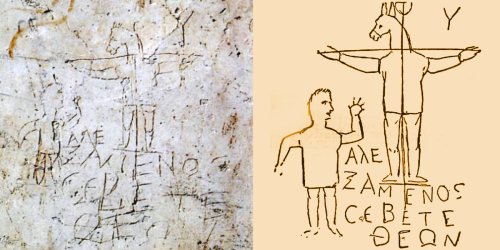
It portrays a man with the head of a donkey and his arms stretched out on a cross.
Below and to the left of this image is a figure of man looking up at the cross with one hand raised. The words, “Alexamenos worships his God” are roughly scrawled on the right.
Though it is mocking the Christian faith, It is believed to be one of the earliest known depictions of Jesus. It was found on the wall of a boarding school that once stood at this location used to train messengers for Imperial palace and Nobles.
The building was originally built by the Emperor Caligula as part of the palace complex, but was converted to the boarding school called Domus Gelotiano after Caligula’s death in 41 AD.
It’s suspected that one of the messenger trainees etched the image into the plaster to mock Alexamenos, a fellow student, who was obviously a Christian.
The individual who created the image showed a remarkable insight into Christianity. He knew that Christ died on the cross, and Christians believed that Jesus is God. This may suggest Alexamenos had been sharing his faith.
Ancient Christian historian Tertullian noted in his book Ad Nationes that the Romans often portrayed Christ as a donkey as a way of disparaging Christianity.
Intended as an insult, the graffiti has become a testimony of Christianity’s growing influence in a world hostile to the Christian faith.
The Jesus Cup
My second favorite archaeological find about Jesus involves a cup found in the ancient harbor of Alexandria, Egypt in 2008. It was discovered on the now submerged island that once held Queen Cleopatra’s palace.
The near fully intact cup had the words, “Through Christ the enchanter” which could also be translated magician inscribed on it.
Known as the Jesus cup, it is dated to the first century. The cup was used in fortune telling ceremonies where oil and water were poured into the cup. The practitioner interpreted the oil as at dispersed on the surface.
The owner was obviously not a Christian but was trying to incorporate what was believed to be Christ’s magical powers into ceremonies.
It was obvious that the magicians who flourished at this time, were keenly interested in the miracles being performed by the disciples through Jesus.
We see our first hint of this in the Book of Acts, when Simon the Magician became a Christian while Philip was preaching in Samaria. The story is recorded in Acts 8.
Simon was amazed by the miracles that were taking place at the hands of Philip.
But things turned when Peter and John came to Samaria and began filling people with the Holy Spirit. Of course, this came with the usual displays of power: speaking in tongues and prophesying.
When Simon saw what happened at the hands of Peter and John, the magician offered money so he could do the same feats.
He ended up being soundly rebuked by Peter. But it shows that magicians were intrigued by this belief in Jesus.
With first century magicians already incorporating Christ in their clairvoyant rituals, it’s obvious that Christ’s reputation was spreading rapidly across the Roman Empire.
But aside from these archaeological finds, there are many written accounts about Jesus from secular sources that speak of Christ.
What Roman Historian Tacitus Had to Say About Christ
One of my favorite references to Christ from a non-religious source was made by Tacitus a Roman historian and senator. He wasn’t a Christian and lived between 55AD to 118AD
In his book entitled Annals he mentioned Jesus in a couple of paragraphs. One was written while he was discussing the Roman Emperor Nero who lived between 37AD and 67AD.
When people began to blame Nero for the Great Fire of Rome that took place in 64 AD, Nero deflected this by accusing the Christians of arson. This resulted in a horrific persecution of believers.
Tacitus writes:
[neither] human effort nor the emperor’s generosity nor the placating of the gods ended the scandalous belief that the fire had been ordered [by Nero]. Therefore, to put down the rumour, Nero substituted as culprits and punished in the most unusual ways those hated for their shameful acts… whom the crowd called “Chrestians.” The founder of this name, Christ [Christus in Latin], had been executed in the reign of Tiberius by the procurator Pontius Pilate… Suppressed for a time, the deadly superstition erupted again not only in Judea, the origin of this evil, but also in the city [Rome], where all things horrible and shameful from everywhere come together and become popular.”
In this paragraph, Tacitus refers to both Jesus (Christus) and the Chrestians. He also reveals his disgust for Christianity, by referring to it as a deadly superstition and evil.
But he also uses the word erupted to describe the rapid growth of Christianity across the empire.
When Nero blamed the Christians for the Great Fire, it led to a brutal persecution of Christians that included crucifixion and soaking them in oil, setting them on posts and burning them alive. They were also thrown into the Colosseum to be torn apart by animals
Tacitus provides this horrific description:
“Accordingly, arrest was first made of those who confessed [to being Christians]; then, on their evidence, an immense multitude was convicted, not so much on the charge of arson as because of [their] hatred for the human race. Besides being put to death they were made to serve as objects of amusement; they were clothed in the hides of beasts and torn to death by dogs; others were crucified, others set on fire to serve to illuminate the night when daylight failed. Nero had thrown open his grounds for the display, and was putting on a show in the circus, where he mingled with the people in the dress of charioteer or drove about in his chariot. All this gave rise to a feeling of pity, even towards men whose guilt merited the most exemplary punishment; for it was felt that they were being destroyed not for the public good but to gratify the cruelty of an individual.”
But Tacitus called Pilate a procurator while the Bible describes him as a ‘prefect’ or governor in Luke 3:1.
Immediately the critics claimed the Bible was wrong.
That was until Italian archaeologist Antonio Frova found a limestone inscription in Caeserea describing Pontius Pilate as a prefect, confirming the Biblical title.
The terms “prefect” and later “procurator” reflect a title change instituted by Roman Emperor Claudius (41 AD to 54 AD). Basically it was the same job, just a different title.
The earlier term ‘prefect’ reveals that the Gospel writers were writing before Claudius’ instituted the change, while Tacitus was writing after. The usage of prefect meant the Gospel writers were the eye-witnesses that they claimed to be.
Mara Bar Serapion Writes About the Jewish Wise King
Another of my favorite written references to Jesus by an ancient secular writer involves a stoic philosopher, named Mara Bar Serapion.
Some believe his mention of Christ in 73 AD, about 40 years after Christ’s crucifixion, is the earliest written reference to Christ from Non Biblical sources.
Serapion refers to Christ in a letter that he wrote to his son encouraging him to embrace wisdom. Serapion was in prison at the time after Rome conquered his homeland, Samosata, in 72 AD. It is located in modern Turkey.
After the invasion, the Romans arrested hundreds of residents and relocated them to prisons across the empire.
Though, he doesn’t specifically mention Christ, Serapion refers to a Jewish ‘wise king’:
What else can we say, when the wise are forcibly dragged off by tyrants, their wisdom is captured by insults, and their minds are oppressed and without defense? What advantage did the Athenians gain by murdering Socrates, for which they were repaid with famine and pestilence? Or the people of Samos by the burning of Pythagoras, because their country was completely covered in sand in just one hour? Or the Jews by killing their wise king, because their kingdom was taken away at that very time? God justly repaid the wisdom of these three men: the Athenians died of famine; the Samians were completely overwhelmed by the sea; and the Jews, desolate and driven from their own kingdom, are scattered through every nation. Socrates is not dead, because of Plato; neither is Pythagoras, because of the statue of Juno; nor is the wise king, because of the new laws he laid down.
Though he doesn’t specifically reference Jesus by name, most researchers are convinced this is who the Jewish wise king is referring to.
Throughout the Gospels, the gentiles looked up Jesus as a Jewish King. Pilate and the Roman guards referred to Christ as the “king of the Jews” in Luke 23:3 and Matthew 27:27-29.
At the Lord’s crucifixion, the Romans put a sign on Christ’s cross, that read “Jesus of Nazareth, the king of the Jews” (John 19:19). The Romans used these signs to inform people what the person was being executed for.
There was only one person in the first century who was referred to as both a king of the Jews and faced execution by the Jews and that was Jesus.
Because of this reference to Christ some suggest that Serapion was a Christian. We know he wasn’t, because he talks about people being separated from ’our gods’ when they were hauled off to foreign prisons. This was reference to the pagan gods that permeated Roman life.
Serapion also mentions God judging the Athenians for murdering Socrates. This is not a belief that Christians would have held.
But then Serapion does another things, he ties the sacking of Jerusalem and the destruction of the Temple in 70 AD to God’s judgment on the Jews for killing their wise king.
This may indicate that stories about how Christ prophesied the destruction of the temple in Matthew 24 were also in circulation.
Though Jesus had died only four decades earlier, Serapion was already including Christ with famous people of influence like Socrates and Phythagoras (a famous Greek mathematician). All who died centuries earlier.
Serapion finished this section writing that this wise king is not dead because of the new laws he laid down. It was a reference to the growing influence of the early church, empowered by the Holy Spirit.




 OpentheWord.org
Leave a comment