
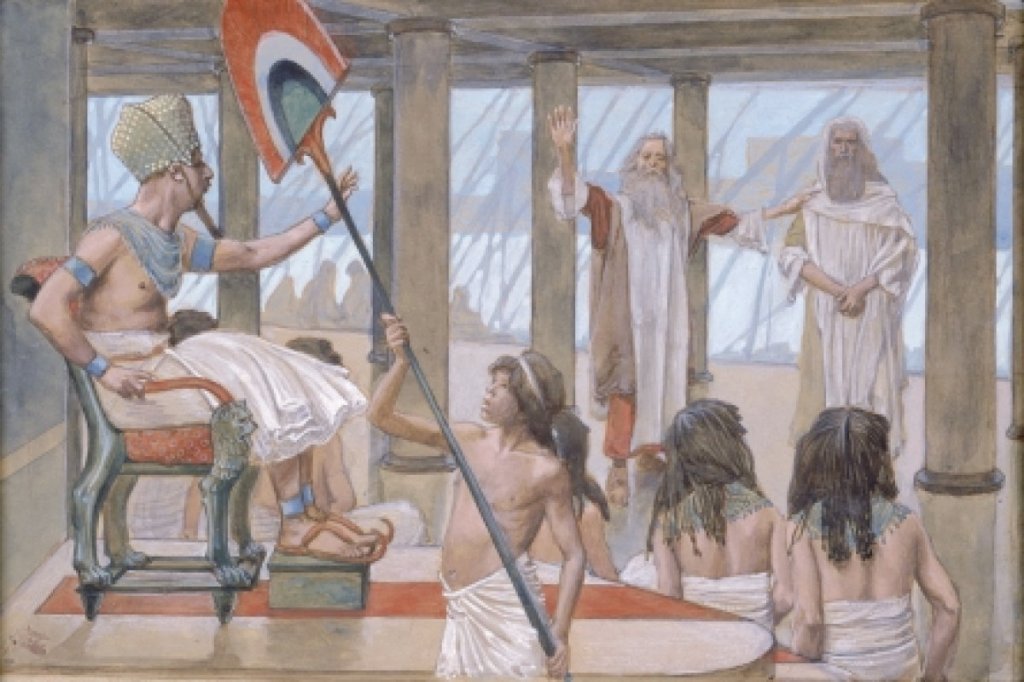
Credit: by James Tissot Moses circa 1896-1902/Wikipedia/Public Domain
“[Moses] understood that turning the Hebrews around, transforming them from embittered and small-minded slaves into an inspired nation committed to becoming a holy people and a kingship of priest/teachers would require nurturing, small talk, listening to paltry concerns and petty complaints until—step by step—he would succeed in convincing them, elevating them until they became a ‘God enthused’ nation.”
By Teresa Neumann
(Israel)—Shlomo Riskin, chief rabbi of Efrat and founder and chancellor Ohr Torah Stone Colleges and Graduate Programs, has published a commentary in The Jerusalem Post addressing the issue of Moses’ speech “impediment” and why he was not allowed to enter the Land of Israel before he died.
Quoting Deuteronomy 3:26, “But the land was angry with me because of you and would not hearken to me…” Riskin asks, “Why does Moses blame the Israelites, saying ‘”because of you’?’ Was it not because Moses struck the rock rather than speaking to it? (Numbers 20:12).”
“I believe,” says Riskin, “that a deeper insight into Moses’s character and personality will explain precisely what Moses meant when he said it was because of the Israelites that he was prevented from entering the Land of Israel.”
Not only had Moses been reluctant from the very beginning to accept his leadership position, but, the rabbi asserts, contrary to conventional wisdom, he may not have stammered. Riskin quotes Exodus 4:10—”from the time when You first spoke to Your servant; heavy of speech and heavy of tongue am I”—and contends that if he did stutter God, according to Exodus 4:11, promised to cure him of it.
Rather, says Riskin, “when Moses called himself ‘heavy of speech,’ he wasn’t referring to a speech defect; he was rather referring to his prophetic personality. He understood that turning the Hebrews around, transforming them from embittered and small-minded slaves into an inspired nation committed to becoming a holy people and a kingship of priest/teachers would require nurturing, small talk, listening to paltry concerns and petty complaints until—step by step—he would succeed in convincing them, elevating them until they became a ‘God enthused’ nation.
“In the end,” concludes Riskin, “[Moses] fails; he listens to the kvetching, he suffers the rebellions and revolutions, but eventually loses patience. He realizes that he hasn’t brought his people to God, he hasn’t elevated them to higher values—and he loses patience. He calls them rebels and wishes to strike this stiff-necked nation! He loses the ability to speak to them, to teach them, to nurture and guide them. As a consequence he cannot continue to lead them and bring them into the Promised Land.”
To read Rabbi Riskin’s commentary in its entirety follow the link provided.
____________________________________________
Used by permission www.breakingchristiannews.com / Shlomo Riskin – The Jerusalem Post
http://www.jpost.com/servlet/Satellite?cid=1248277932717&pagename=JPost%2FJPArticle%2FShowFull


 OpentheWord.org
Leave a comment