
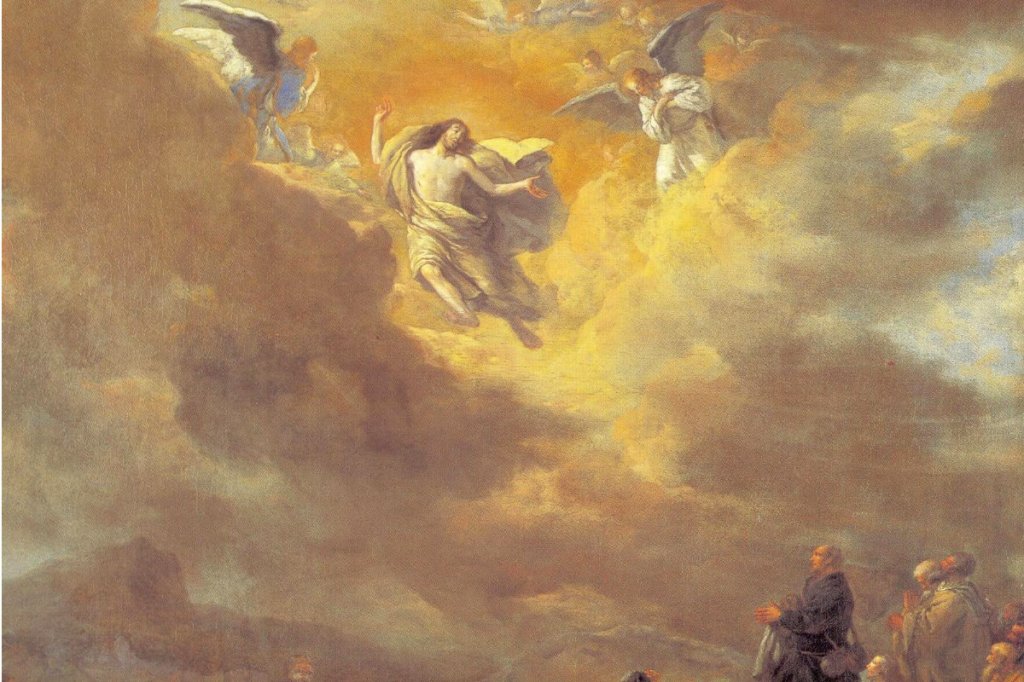

by Philips Wouwerman, 1660, Wikipedia, Public Domain.jpg
- ESPAÑOL: Por qué el Sumo Sacerdote Acusó a Jesús, el ‘Hijo del Hombre’, de Blasfemia
After Christ’s arrest in the garden, Jesus was dragged before the Jewish High Priest and several experts of the law (Mark 14:53-64).
Mark writes that several witnesses brought false accusations against Christ. But their testimonies were so confusing and even contradictory that the Jewish leaders had no solid grounds to convict Christ.
When the exasperated High Priest asked Christ, if He would like to offer a defense, the Lord said nothing.
Then the High Priest asked, “Are You the Christ, the Son of the Blessed One?” (verse 61).
Look at how Jesus responded.
“And Jesus said, ‘I am; and you shall see the Son of Man sitting at the right hand of power, and coming with the clouds of heaven.”
As soon as Christ uttered those words, the High Priest ripped his clothes. He said no more witnesses were needed and accused Christ of blasphemy (Mark 14:63-64).
What did Jesus say that caused such a reaction?
Jesus was alluding to a heavenly vision that the prophet Daniel had recorded in Daniel 7.
It starts off like this:
“I kept looking
Until thrones were set up,
And the Ancient of Days took His seat;
His garment was white as snow,
And the hair of His head like pure wool.
His throne was ablaze with flames,
Its wheels were a burning fire. (Daniel 7:9 NASV)
The reference to Ancient of Days refers to God or literally the one who has been living forever.
The following verse portrays the Heavenly throne room and Daniel adds that there were tens of thousands standing before God (verse 10).
But perhaps the most curious part of this verse is found in the first line. Daniel wrote that he saw “thrones were set up.”
There is more than one throne in the heavenly throne room.
Obviously, the Ancient of Days (Jehovah) would sit on one of those thrones. But who would sit on the other one?
This leads to even a bigger question? Did the Jews believe that there was more than one God in Heaven?
Daniel then explains who this second throne was for.
“I kept looking in the night visions,
And behold, with the clouds of heaven
One like a son of man was coming,
And He came up to the Ancient of Days
And was presented before Him.” (Daniel 7:13 NASV)
Daniel said that another being appeared who looked like a ‘Son of Man. In other words, He looked human and He was carried in on the clouds in the sky.
Daniel writes:
And to Him was given dominion,
Honor, and a kingdom,
So that all the peoples, nations, and populations of all languages
Might serve Him.
His dominion is an everlasting dominion
Which will not pass away;
And His kingdom is one
Which will not be destroyed.. (Daniel 7:14 NASV)
This individual who looked like the ‘Son of Man’ will be given full authority and power over all the nations.
But it was more than that, Daniel states that His dominion or His authority is eternal (Hebrew ‛âlam). It means “Ancient: Beyond the field of vision of time or space.” The Son of Man’s authority is everlasting. It means that He has had this authority both in the past, present, and future.
In other words, the Son of Man always had this authority and dominion. This is the who will be sitting on the second throne beside the Ancient of Days.
This is what Jesus was alluding to when the Lord said He was “sitting at the right hand of power, and coming with the clouds of heaven.”
Jesus’ connection to Daniel’s ’Son of Man’ is seen again in the Book of Acts at Christ’s ascension.
Look at how Luke described it:
“And after He had said these things, He was lifted up while they were watching, and a cloud took Him up, out of their sight.” (Acts 1:9 NASV)
The Lord went up in a cloud.
This is seen again in the Book of Revelation, when in His vision of the End Times, the Apostle John saw Jesus returning to earth with the clouds:
“Behold, He is coming with the clouds, and every eye will see Him, even those who pierced Him; and all the tribes of the earth will mourn over Him. So it is to be. Amen.” (Revelation 1:7 NASV)
It is clear that Jesus is the ‘Son of Man’ portrayed in the Book of Daniel.
So is Daniel’s description of the ‘Son of Man’ referring to a second God, like Jehovah, in the Old Testament?
The High Priest’s strong reaction to Christ’s claim to the “Son of Man” reveals an interesting detail about Jewish belief at this time.
In order for the High Priest to accuse Jesus of blasphemy, he must have believed that the ’Son of Man’ in the book of Daniel was also Divine. This ‘Son of Man’ is also God.
In his book, “Two Powers in Heaven”, Jewish Rabbinical scholar, Allan Segal writes that before the second century AD, Jewish rabbis believed there were two Divine powers in heaven. This is found throughout of the Old Testament including this passage in the Book of Daniel.
But Segal adds that the Rabbis changed their mind when Christians began claiming that Jesus was this second deity. This caused such major theological issues among the Jews, the rabbis rejected this long held belief and emphasized the oneness of God.



 OpentheWord.org
Leave a comment