
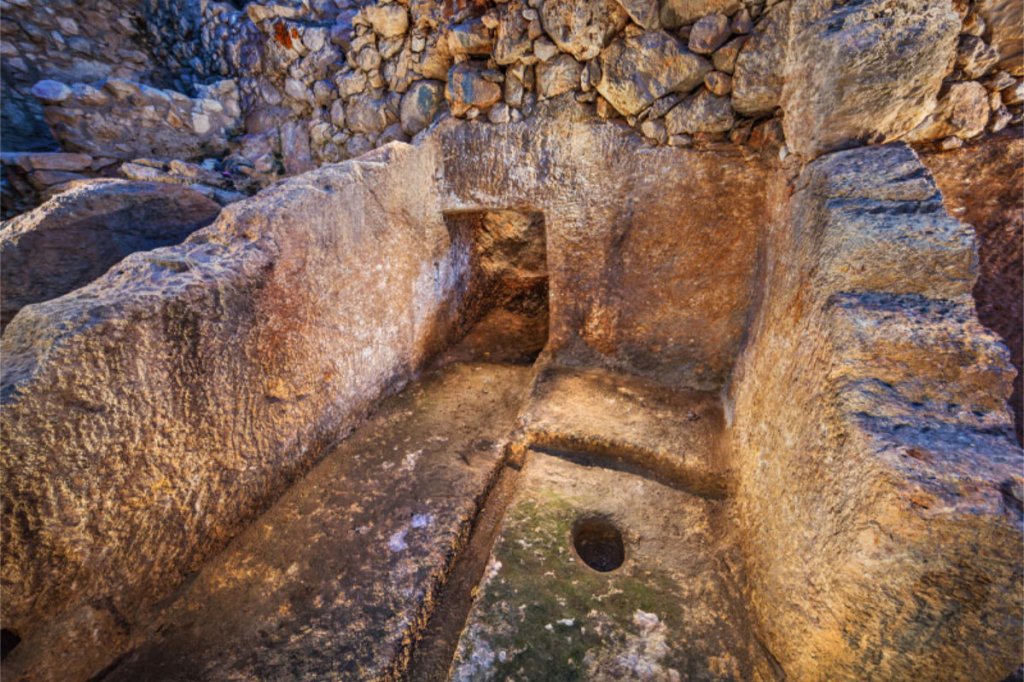
Archaeologists have discovered an ancient religious site carved into the rocks only a few hundred yards from Temple Mount in Jerusalem, the NY Post reports.
The eight room site is dated to the reign of King Hezekiah (741 BC – 687 BC). It included an altar on which animal sacrifices were made identified by the drainage channel designed to carry away the blood.
After becoming king on the death of his father, Ahaz, Hezekiah initiated major godly reforms, ending the idol worship that has been popularized during his father’s reign.
After he took the throne, along with destroying the pagan sites, Hezekiah even destroyed the bronze serpent that Moses made in the wilderness to stop a plague because the Jews were worshiping it:
He removed the high places and smashed the memorial stones to pieces, and cut down the Asherah. He also crushed to pieces the bronze serpent that Moses had made, for until those days the sons of Israel had been burning incense to it; and it was called Nehushtan. (2 Kings 18:4 NASV)
The site had been filled in with dirt during Hezekiah’s reign. This suggests it had been closed as part of his reforms. Since the stone altar had had not been destroyed, it may not have been a pagan site, but actually used, perhaps covertly, to worship Jehovah during the reign of King Ahaz.
This is because, Ahaz had not only promoted pagan idol worship, he also ended the Jewish worship by nailing the doors of the Jewish Temple shut (2 Chronicles 28:24). This forced those who wanted to continue worshiping Jehovah to develop other locations to do it.
The site was first discovered in 1909, but Israel Antiquity Authority only started excavating it in 2010.
“When we uncovered it, we found it standing in its place, with stones around it. The standing stone was covered with earth; it was preserved – no one destroyed it. When we found it, it was exactly as it was here 2,800 years ago,” said lead archaeologist Elis Shukron in a news release.
“The structure ceased to function during the 8th century BCE, possibly as part of King Hezekiah’s religious reform,” Shukron added, “According to the Bible, Hezekiah sought to centralize worship at the Temple in Jerusalem, abolishing the ritual sites scattered across the kingdom,”
Besides the altar, the 220 square meter structure also included a wine press for making wine and an oil press for making oil. There were also other artifacts dated to the eight century found at the site. This included pots with Hebrew inscriptions, grinding stones, weights, and scarabs.
Hezekiah ended up being one of Judah’s more godly Christians, who did “what was good, right, and true before the Lord his God.” (2 Chronicles 31:20).
Some suggest that Hezekiah was influenced by his godly mother, Abijah, who was the daughter of Zechariah. Some believe this is the same Zechariah who served as a godly counselor to King Uzziah (2 Chronicles 26:5-7) and also served as a priest (Isaiah 8:2). After becoming king, Hezekiah reopened and restored the temple (2 Chronicles 29:3), reinstated the priesthood (2 Chronicles 29:5) and restored the Passover celebration (2 Chronicles 30:1).

 OpentheWord.org
Leave a comment