
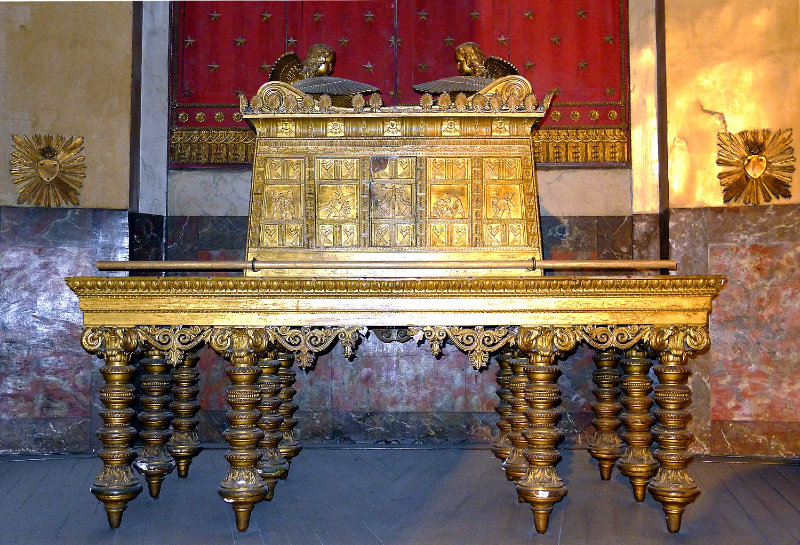
Credit: Mbzt, Wikipedia, CC BY-SA 3.0
In an interesting article for Charisma News, Michael Snyder discusses the mysterious disappearance of the Ark of the Covenant.
The Ark of the Covenant is arguably one of the world’s most famous missing artifacts. I mean, it has had movies made about it.
What we do know is that the Ark of the Covenant disappeared after Jerusalem fell to the Babylonians in 586 BC and has never reappeared. We know from the Biblical record that it was not on the list of objects that the Babylonian army took when it looted the temple (2 Kings 25:13-17).
So what happened to the Ark of the Covenant?
With the Ark being the most valuable object in the Jewish Temple, the most accepted theory is that Jewish priests hid it in the labyrinth of tunnels and caves located beneath the temple mount before Jerusalem fell to the Babylonians.
With the senior priests slaughtered during the Babylonian invasion (2 Kings 25:18-21), it seems that information on the Ark’s location was lost as well.
The Temple Institute is an organization in Israel dedicated to seeing the construction of a third Temple in Jerusalem. Snyder points to information on the Institute’s website that suggests, they know exactly where the Ark is located:
While some claim to have evidence that the ark is in Ethiopia, and of course, moviegoers were treated to a fanciful version of the story in “Raiders of the Lost Ark,” in reality, the expression “lost” ark is not an accurate description for the Jewish people’s point of view – because we have always known exactly where it is. So the Ark is “hidden,” and hidden quite well, but it is not lost.
Tradition records that even as King Solomon built the First Temple, he already knew, through Divine inspiration, that eventually it would be destroyed. Thus Solomon, the wisest of all men, oversaw the construction of a vast system of labyrinths, mazes, chambers and corridors underneath the Temple Mount complex. He commanded that a special place be built in the bowels of the earth, where the sacred vessels of the Temple could be hidden in case of approaching danger. Midrashic tradition teaches that King Josiah of Israel, who lived about forty years before the destruction of the First Temple, commanded the Levites to hide the Ark, together with the original menorah and several other items*, in this secret hiding place which Solomon had prepared.
This location is recorded in our sources, and today, there are those who know exactly where this chamber is. And we know that the ark is still there, undisturbed, and waiting for the day when it will be revealed. An attempt was made some few years ago to excavate towards the direction of this chamber. This resulted in widespread Moslem unrest and rioting. They stand a great deal to lose if the Ark is revealed – for it will prove to the whole world that there really was a Holy Temple, and thus, that the Jews really do have a claim to the Temple Mount.
While the Institute states that it knows where the Ark of the Covenant was hidden, a verse in Jeremiah suggests something different.
Jeremiah was alive when Babylon invaded, and he was uttering prophetic warnings to the Jews and their leaders that they would be hauled off into captivity because of their sin.
His prophecies actually included a word about the Ark of the Covenant:
“And it shall be in those days when you become numerous and are fruitful in the land,” declares the Lord, “they will no longer say, ‘The ark of the covenant of the Lord.’ And it will not come to mind, nor will they remember it, nor miss it, nor will it be made again.” (Jeremiah 3:16 NASV)
First, Jeremiah talks about how the Ark of the Covenant will disappear, and at some future time, the people of God will not even “miss it.”
In other words, the Ark of the Covenant on which the very presence of God rested in the Temple will no longer be important or desired by God’s people.
How is it possible that the most significant religious relic in Israel, on which the very presence of God rested, would no longer be considered essential?
Perhaps the reason for this is because of Christ’s death on the cross, the very presence of God can now reside inside both Jews and Gentiles who believe in Jesus.
“Or do you not know that your body is a temple of the Holy Spirit within you, whom you have from God, and that you are not your own? 20 For you have been bought for a price: therefore glorify God in your body,” Paul writes in 1 Corinthians 6:19-20.
We are the temple of God.
With the presence of God residing inside each of us, a gold-plated box made of Achaia wood with two Cherubim on top is no longer necessary to contain God’s presence on Earth.
So for God’s people, the Ark of the Covenant no longer has any spiritual significance.
But did you notice, the last phrase in Jeremiah’s prophecy about the Ark, when he said, “nor will it be made again.”
Why would the prophet say that the ark would not be made again?
It is an unusual statement because it implies that the Ark has already been destroyed. This would be the reason it would even need to be ‘made again.’
Since the Temple Institute has already built all the furniture and utensils necessary for a functioning temple, including the Altar on which the animals will be sacrificed, what would stop it from constructing a second Ark of the Covenant?
Based on that statement on their website, the Institute has not built the Ark of the Covenant, because it believes it still exists and plans at some future point to recover Israel’s most sacred religious object.
I am not so sure that they will.
As I have mentioned in the past, I am not convinced that God will even allow Israel to construct a third Jewish Temple.





Leave a Reply