
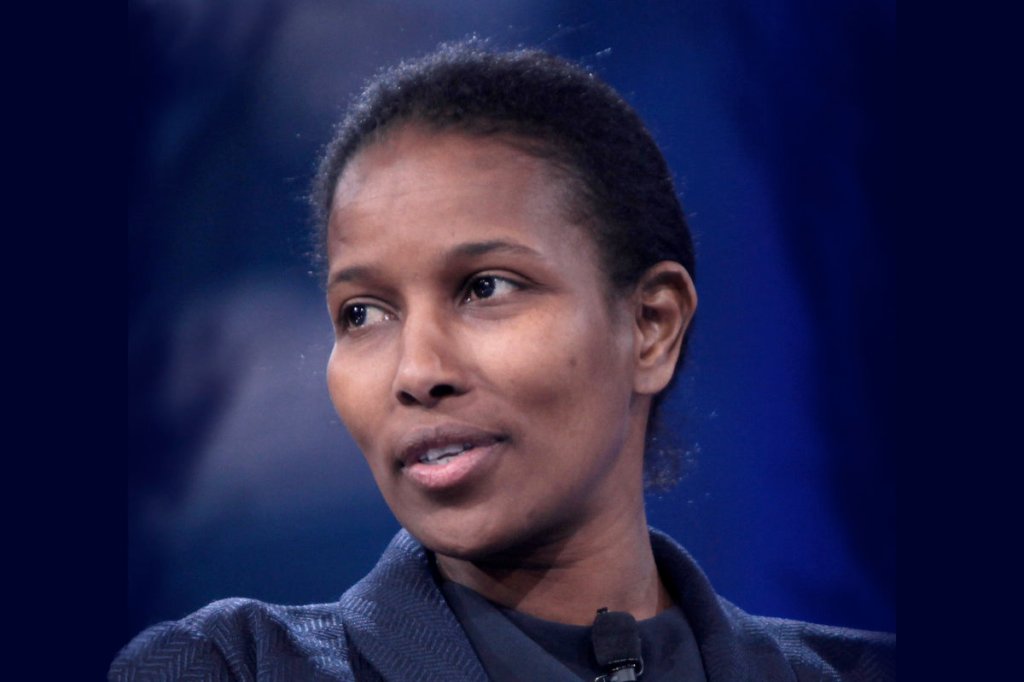

Credit: Gage Skidmore, Wikipedia, CC BY-SA 3.0
To say that Ayaan Hirsi Ali has been on a spiritual journey would be an understatement. The rather famous political activist recently announced in an article for Unherd.com, that she had converted to Christianity.
Prior to her conversion, she had previously been an ardent Muslim and then an atheist.
Over the course of her career, Ali has written several books including Heretic: Why Islam needs Reformation Now and Nomad: From Islam to America. She has also received over 16 awards and nominations including Nova Civitas’ Prize of Liberty and was included on Time magazine’s 2005 list of 100 most influential people in the world under its Leaders and Revolutionaries category. In 2006, Reader’s Digest voted her European of the Year.
The former Dutch politician was born in Mogadishu, Somalia in 1969.
She started off life as a Muslim, attending an all-girls Islamic school in Somalia where she embraced the more extreme facets of Islam being promoted by Saudi Arabian Muslims who were funding the school.
She moved to Holland in 1992 in order to escape a forced marriage where she received political asylum. After receiving a degree she got a job with a left-leaning think tank, Wiardi Beckman Stichting.
However, the Sept 11, 2001 attacks in the US led her to re-evaluate Islam and particularly the statement of Osama bin Laden who used the Qur’an to justify the attacks. This resulted in her taking a deep dive into the Muslim Holy book to understand what it really said.
In her article for Unherd.com, Ali stated that her decision to embrace atheism was impacted in part by an op-ed discussing Bertrand Russell’s 1927 speech, “Why I Am Not a Christian”, that she read in 2002 a year after the US attack.
As a result of this dramatic spiritual shift, Ali became a forceful critic of Islam, writing several articles, particularly on Islam’s treatment of women. She entered politics in 2003, winning a seat in the Dutch Parliament with the People’s Party for Freedom and Democracy.
Because of growing Islamic radicalism in Holland that led to the assassination of Theo van Gogh who produced a video on Islam’s treatment of women, Ali was forced into hiding. The extremist who murdered van Gogh also included Ali as another person he wanted to kill. Other pro-radical Islamic groups also began to target her.
This along with growing controversy within her own party over Ali’s anti-Islamic activism and questions about her asylum process resulted in Ali immigrating to the US in late 2006 where she worked with numerous organizations including the American Enterprise Institute.
In the US, Islamic organizations continued to target her work as she was part of a 2010 Al-Qaeda hit list, which also included Salman Rushdie.
So what led to her decision to embrace Christianity?
According to Faithwire, Ali gave multiple reasons.
The first centered on the need for the West to preserve its Judeo-Christian heritage in order to survive.
“Western civilization is under threat from three different but related forces: the resurgence of great-power authoritarianism and expansionism in the forms of the Chinese Communist Party and Vladimir Putin’s Russia; the rise of global Islamism, which threatens to mobilize a vast population against the West; and the viral spread of woke ideology, which is eating into the moral fibre of the next generation,” Ali wrote in her op-ed.
The second reason centered on her own spiritual need, that atheism couldn’t fulfill.
“I have also turned to Christianity because I ultimately found life without any spiritual solace unendurable — indeed very nearly self-destructive,” Ali wrote. “Atheism failed to answer a simple question: what is the meaning and purpose of life?”
READ: Famed Atheist Does About-Face, Embraces Christianity: ‘The Only Credible Answer’ AND Why I am now a Christian


 OpentheWord.org
Leave a comment