

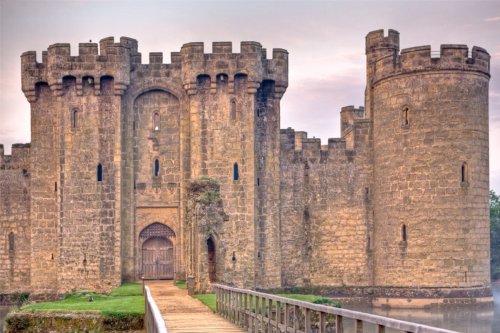
Credit: Antony McCallum/WyrdLight.com/Wikipedia/Creative Commons 3.0
FOLLOW OUR PODCAST ON (search opentheword):
PODCAST NOTES:
Hi, my name is Dean Smith, and in this podcast, I ask do you have a Bodiam stronghold in your mind?
Bodiam Castle, located in South East England in the county of Kent, is one of Britain’s more popular castles because of its massive size and very photogenic moat.
You have probably already seen pictures of it, and aren’t even aware of it.
But there is something deceptive about this imposing castle, that’s guarding Britain’s Southeastern coast.
It is not all that it seems. It is more smoke and mirrors than mortar and stone.
King Richard II gave Sir Edward Dalyngrigge permission to build the castle in 1385 as he had been a faithful servant fighting for the English king in the Hundred Years War.
It seems back then, like a car, you had to have a license or “crenellate” as it was called then to build a castle as kings wanted to control who could build a castle, because it could be used for you or against you.
When Sir Edward started construction he went all out. He built it quickly and because of its location in South East England, the castle was an ideal spot to protect the country’s southern coastline from invasion by the French.
And when he was finished, it was an imposing structure.
The castle with its massive, perfectly hewed walls and its mammoth drum towers on each corner of the castle was a picture of power in Southern England.
Sir Edward even went one step further and built Bodiam in a low basin of land surrounded by rolling hills.
Aside from the smashing scenery, it allowed him to create a lake-sized moat to surround the castle using a natural spring in the area.
There were only two narrow wooden bridges providing access to the castle’s two gates. The handful of invaders who could navigate the bridge at one time would be easily picked off from the archer slots in the drum towers or have burning oil poured down upon them from the battlements above.
But looks are deceiving.
Unknown to the French, Sir Edward was shaking in his boots over the terrifying thought that someone might actually lay a siege against Bodiam Castle because if they did, the castle was in serious trouble.
In fact, there is a debate going on about whether Bodiam Castle should be considered a castle or a fancy little manor house.
Why?
When a person actually gets close to Bodiam Castle, you quickly realize it is one big optical illusion.
Once visitors are inside, they are shocked by how small it is, because from the approach it looks like an enormous, imposing fortress.
So how did Sir Edward create this picture of deception?
First, when Sir Edward was creating the windows, they were purposefully made proportionally smaller the higher up they went giving the impression that the towers were massive looming structures.
In fact, the archer windows at the top of the towers are so narrow, it would have been almost impossible to shoot arrows through them.
The imposing drum columns guarding the four corners were also tapered to give them an exaggerated towering perspective.
At the top of the castle walls, the battlements are so small, they would have been almost useless in fending off an attack.
And the lake-sized moat that surround the castle was the key to this elaborate deception because it kept invaders far enough back that they would be unable to detect the deception.
But those examining the moat today suggest that due to the earthworks not being that substantial, the water could have probably been drained in a day.
But nevertheless, the cunning illusion worked because while dozens of Britain’s castles lie in ruins, Bodiam is still standing revealing the power of optical illusions, that delude people into thinking one thing, when the opposite is true.
When Moses led Israel out of Egypt into the promised land, he ran into problems with an optical illusion, that was rooted in a deeper emotion of insecurity of the Hebrews.
The Hebrews had just spent several years in Egyptian captivity. Treated as slaves, they were not only beaten physically but mentally as well by their Egyptian overlords.
And though God had powerfully delivered them from this captivity, that slave mentality, that they were no good, was still hanging over them.
And it showed up on the border of what would eventually be Israel after Moses sent in 12 men to spy on the Promised Land. The Bible says ten of the spies came back with an evil report.
But look at what they said.
33 There also we saw the Nephilim (the sons of Anak are part of the Nephilim); and we became like grasshoppers in our own sight, and so we were in their sight.” (Numbers 13:33 NASV)
Notice how they described the giants, by first describing themselves — we looked like grasshoppers in our own sight.
When I look at grasshoppers scurrying along the ground, I realize how easily I could squish them with my foot. The giants in the Promised Land weren’t that big and the Hebrews were not that small.
But 10 spies had turned these giants into monsters.
It was an optical illusion created by fear, magnified by their own personal feelings about themselves. They were still slaves living in Egypt, even though they were out of their captivity.
And a study a few years back at Penn State University in the United States revealed how bad this problem is. For a full month, the researchers asked a group of 29 chronic worriers to keep track of everything they worried about.
Then a few weeks later, they followed up with this group and asked them what happened to all those worries that they had written down.
The researchers found out that 91.4% of the things these people had been worrying about never came to pass and for several people in the study group, it was actually 100%
Another study came to a similar conclusion and reported that 85% of the people in its test group reported that the things they worried about never happened.
And of the 15% who reported that they did, 79% stated they were exaggerated and easier to deal with than expected. This meant that 97% of them were worrying about fake or exaggerated fears.
Fear magnifies our concerns, making them bigger than they actually are.
Fear exaggerates. It changes men into grasshoppers, large men into monsters, and manor houses into impenetrable fortresses.
Many times throughout the Bible, God tells His children to “fear not.” Because our real enemy is fear, not giants or an enemy army.
God knew that if He did not deal with this fear emotion, His people could not move forward because they had created invincible barriers in their minds.
When David wrote Psalm 34, he was at this point trying to stay one step ahead of reprobate King Saul who was trying to kill him while trying to find refuge in the neighboring nations.
In the midst of this, David writes:
I sought the Lord and He answered me,
And rescued me from all my fears. (Psalm 34:4 NASV)
The word megûrâh, translated fear, has its roots in a person traveling in a strange land where he doesn’t know the people, and he doesn’t know their culture.
He doesn’t know if they will be friends or foes and because of this the person is full of fear and apprehension.
David was scared.
Other versions state that after seeking the Lord, God delivered David from all his fears.
But the best translation of the Hebrew word, nâtsal, is rescued.
God rescued David from his fears. David did not need rescuing from a powerful vicious army, he needed to be rescued from his thinking.
God pulled down the fear stronghold that had captured David’s mind.
This was his real enemy.
And many of us have fear strongholds in our minds, and we need to realize they are Bodiam Castles that are made up of lies and deceptions, and God is ready to deliver us today.
READ: Bodiam Castle: My trip to one of the most ingenious castles in England AND 85 Percent of What We Worry About Never Happens AND Most things you worry about will never actually happen: Exposing Worry’s Deceit: Percentage of Untrue Worries in Generalized Anxiety Disorder Treatment: Science Direct

 OpentheWord.org
Leave a comment