
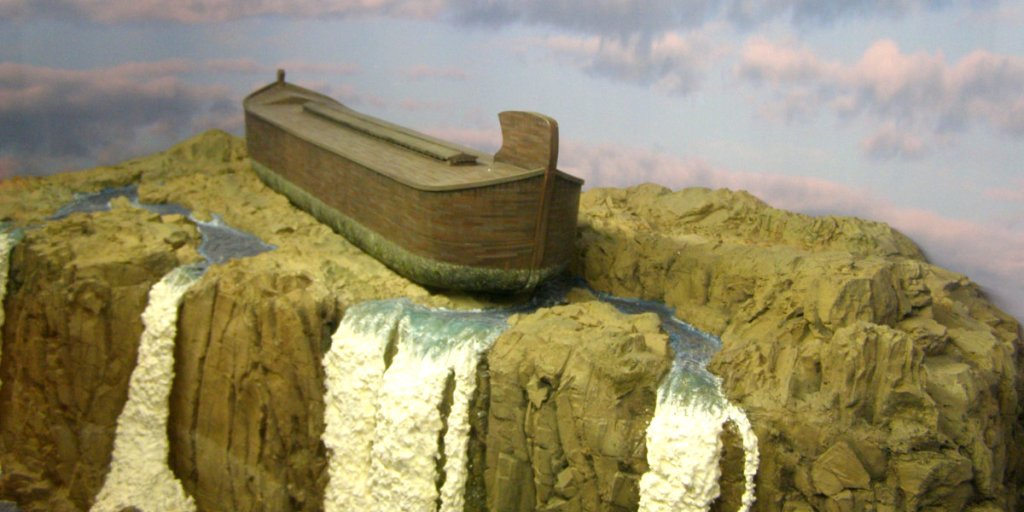
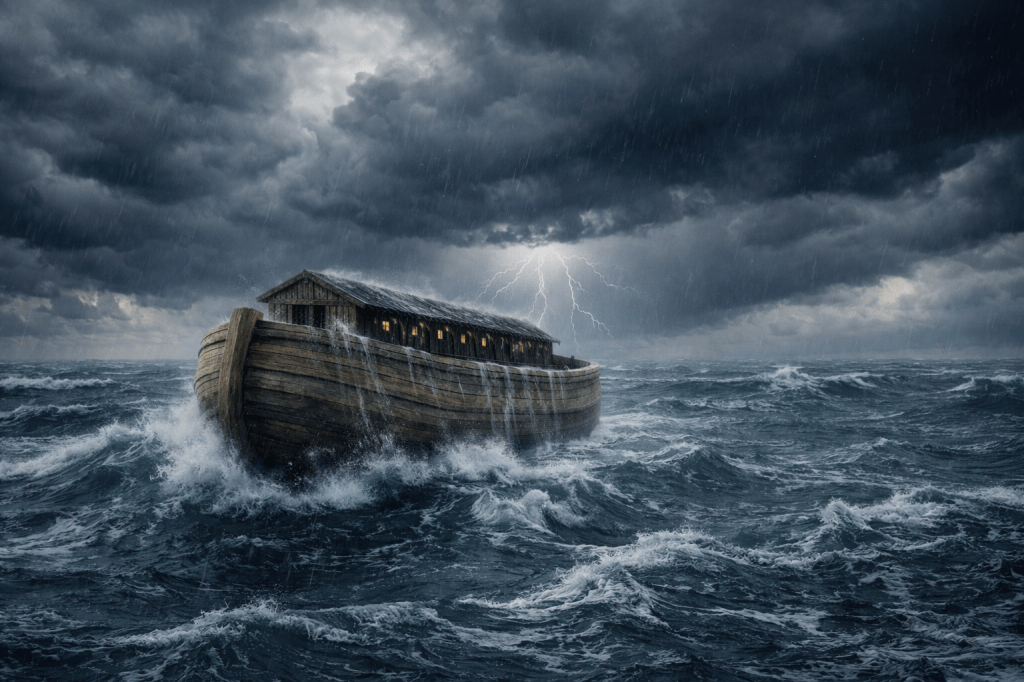
People who don’t like the Bible, or believe that it is not true, like to point out the story of Noah’s flood as proof that they are correct. How can any reasonable person believe that the whole world was covered with water and animals marched two by two into a large wooden boat? Where is the scientific evidence for that?
You might be surprised.
Noah’s flood, in the Bible, is dated at about the same time as other flood stories from almost every ancient culture. Stories about a huge and deadly flood are found in the Australian outback, the mountains of Ecuador in South America, in China, in the stories of Gilgamesh and Noah’s flood from the ancient Middle East, and in the Greek story of Atlantis.
Plato and other Greek writers told us about an ancient land of Atlantis that was flooded, and apparently the Atlanteans invaded other places, in desperation. Ancient flood stories are everywhere, from people who did not speak to each other. They made their own versions in isolation.
We now know that ocean levels rose about 130 meters / almost 430 ft. when ice-age glaciers melted and large land areas were flooded. Did you know that the sea between England and Denmark contained Doggerland, now the Dogger Banks and fishermen have pulled up ancient human tools from the sea bottom, and the British Isles were more like the British peninsula?
The Grand Banks of Newfoundland were once dry land, near where the Titanic went down, and Japan not was a string of islands but was part of the Asian mainland.
Imagine if the Bible never mentioned a flood story while every other source did. Critics would say it was a more modern creation, or fraud, and the authors did not know the ancient stories. The story of Noah’s ark and all those animals is evidence that the oldest parts of the Bible are really old.
And then we have the Okotoks.
During the ice ages, glaciers were found where we find them today, near the poles and on high mountains, but with more ice. The Alps, Norway and Scotland sent ice into most of Europe, but what we can’t explain easily is Canada.
The Laurentide Ice Sheet covered Canada and stopped near the U.S. border. In Finland, the ice stopped in the east, near the modern border with northern Russia. I think it is weird how ancient ice and modern borders are so close, but that is off the topic.
I live where an ice sheet covered Canada, and only the experts can see evidence if ice erosion. What we have is evidence of massive floods from when the ice melted. The ground under me is lake-bottom clay as thick as a tall building, and large dry valleys are everywhere, known as coulees.
And we have the Okotok.
There is a narrow string of rugged rocks about 600 miles / 1000 km long extending south into Montana, including the Okotok “the Big Rock”.
- READ MORE: Foothills Erratics Train
Okotoks is one of my favorite towns, in the foothills, with a view of the Rocky Mountains, and just outside of town is a large and rugged rock the size of a battleship. Strangely, this rocky mass in a farmer’s field came from near Mount Edith Cavell in Jasper National Park, far to the north.
So how did the Okotok, and other rocks in the Foothills Erratic Train walk out of a mountain valley to the open plains, about 60 miles / 100 km and then do a hard right turn and march to Okotoks and Montana? That is a ten-hour drive on modern highways, with no breaks.
And here is another mystery; why are those angular rocks not small, round and smooth, like all the other rocks in farmers fields? My wife has memories of picking rocks on her grandpa’s farm. Picking rocks on the farm is a common complaint around here, and those rocks were ground by moving ice.
Here is one possibility that I like; geologists believe a huge avalanche dropped large pieces of mountain rock on a valley-bottom glacier near Mount Edith Cavell, possibly from an earthquake.
In the warmer valley bottom a pool of melt water formed under the glacier and when it burst out, the flash flood flowed down the valley and turned right when it hit the Laurentide Ice Sheet on the plains. Angular rocks like the Okotoks were rafted on ice in a temporary river. They probably traveled quickly, which explains why they are not small, round and smooth now. This is mainstream science, and not some conspiracy theory.
We know that an ocean of fresh water erupted from ice-age Canada and ocean levels rose suddenly around the Bible’s time for Noah’s flood. We don’t know how high the water surged before it settled to the modern level, but the whole world was dramatically affected by the floods.
The Bible story talks about rain and also water from below “on that day all the springs of the great deep burst forth, and the floodgates of the heavens were opened.” (Genesis 7:11)
In the context of modern science, the story of Noah and his ark in a flood is not so strange. And Canada might be in the Bible; who knew?
And since we know destructive floods happened, I find these words comforting; at the end of Noah’s flood story in the Bible, God spoke these words:
Never again will I curse the ground because of humans, even though every inclination of the human heart is evil from childhood. And never again will I destroy all living creatures, as I have done. As long as the earth endures, seedtime and harvest, cold and heat, summer and winter, day and night will never cease. (Genesis 8:21 to 22)




 OpentheWord.org
Leave a reply to Sumiko de Barbeyrac Cancel reply