

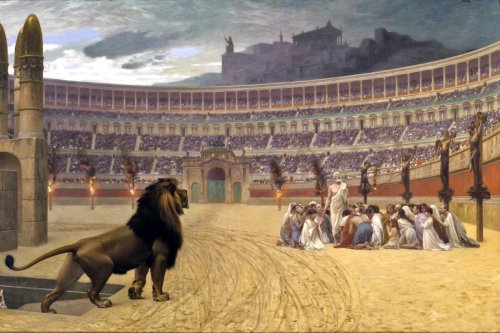
by Jean-Léon Gérôme, 1863, Wikipedia, Public Domain
The discovery of the remains of a Roman Gladiator dated to the second century confirms the historical accounts about the deaths of Christians in the Roman Colosseum.
The man believed to be around 30-35 years old was buried in a graveyard near York, England. It is suspected that he was a gladiator who fought to the death as a form of entertainment in the Roman Empire, the Daily Mail reports.
But what caught everyone’s attention was the fact that this man had bite wounds.
Malin Holst, a professor at the University of York, explained the finding’s significance:
“The bite marks were likely made by a lion, which confirms that the skeletons buried at the cemetery were gladiators, rather than soldiers or slaves, as initially thought.“
“They represent the first osteological confirmation of human interaction with large carnivores in a combat or entertainment setting in the Roman world.”
The man also had several head wounds that had healed indicating these were from earlier gladiatorial battles. Since the lion bite in the hip showed no evidence of healing, it probably led to the man’s death.
The gladiator graveyard holds the remains of dozens of similarly aged men. This suggests that there must have been a amphitheater in this area at one time, where these type of fights were featured.
But it also confirms the historical records of the horrific deaths Christians faced in Rome’s Colosseum because of their faith in Christ.
In his book, Annals, Roman historian and senator Tacitus (55 AD-118 AD) provided a brief description of the horrific persecution Christians faced.
These paragraphs were included in a section describing the reign of the deranged Roman Emperor Nero who ruled between 54 AD–68 AD.
According to Tacitus, after the Romans accused Nero of purposefully starting the fire that destroyed Rome in 64 AD, he accused the Christians of arson to deflect the blame.
“[Neither] human effort nor the emperor’s generosity nor the placating of the gods ended the scandalous belief that the fire had been ordered [by Nero],” Tacitus wrote. “Therefore, to put down the rumor, Nero substituted as culprits and punished in the most unusual ways those hated for their shameful acts… whom the crowd called ‘Chrestians.’”
Its believed this persecution led to the deaths of Paul and Peter..
Tacitus, then added that Christians were martyred in various ways including in Rome’s Colosseum.
“Besides being put to death they [the Christians] were made to serve as objects of amusement; they were clothed in the hides of beasts and torn to death by dogs; others were crucified, others set on fire to serve to illuminate the night when daylight failed. Nero had thrown open his grounds for the display, and was putting on a show in the circus, where he mingled with the people in the dress of charioteer or drove about in his chariot.“
As Tacitus pointed out, Nero tied Christians to posts and set them on fire to light his gardens.
It is generally believed that the Apostle Peter wrote his first epistle between 60 and 65 AD. This means it could have been written after the great fire in Rome and the start of Nero’s horrific persecution.
If this is the case, then Peter’s words about fiery trials may have been a direct reference to Christians being set on fire.
“Beloved, do not be surprised at the fiery trial when it comes upon you to test you, as though something strange were happening to you” (1 Peter 4:12 ESV)
But Tacitus also pointed out that the cruelty Nero poured out on the Christians had the opposite effect. Romans began to feel sorry for their brutal treatment.
“All this gave rise to a feeling of pity, even towards men whose guilt merited the most exemplary punishment,” Tacitus wrote. “For it was felt that they were being destroyed not for the public good but to gratify the cruelty of an individual.”




 OpentheWord.org
Leave a comment