
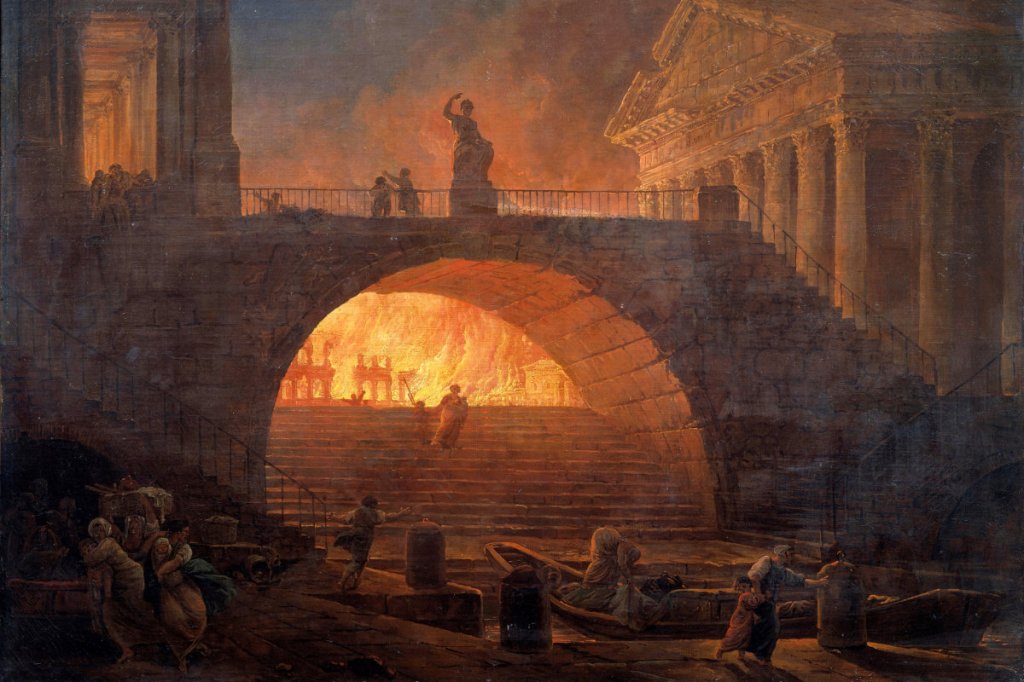
Painting by Hubert Robert, 1785, Wikipedia, Public Domain
A document written by ancient Roman historian Tacitus called The Annals, provides information on the crucifixion of Christ confirming the Biblical account, the Daily Mail reports.
Tacitus, who lived between 56 AD and 120 AD, was Roman politician who wrote several books providing historical information on the Roman Empire. Many look upon him as one of the best historians of his day. For his research, Tacitus relied on official government documents, Senate hearings and interviews with people who witnessed the events.
In The Annals which was written about 91 years after the death of Christ, Tacitus provides an overview of the Roman Empire from the start Emperor Augustus’ reign in 14 AD to the death of Nero in 68 AD.
In this book, Tacitus discusses the Great Fire of Rome which took place in 64 AD during Nero’s reign. When rumors started circulating that Nero had purposefully started the fire, Tacitus states the emperor deflected these accusations by blaming the Christians.
‘Christus, from whom the name had its origin, suffered the extreme penalty during the reign of Tiberius at the hands of one of our procurators, Pontius Pilatus,’ Tacitus writes in the second sentence of Book 15.
“‘Christus,’ the Latin version of ‘Christ,’ means ‘the Anointed One’ or ‘the Messiah,’ and comes from the Hebrew word Mashiach (Messiah),” explains Stacy Liberatore in her article for the Daily Mail.
Nero then initiated a horrific persecution of these early believers. Any who confessed to be Christians were arrested and Tacitus writes that many died horrific deaths. This included a bloody martyrdom in the Roman coliseums.
‘Covered with the skins of wild beasts, they were torn by dogs and perished, or were nailed to crosses, or were doomed to the flames and burnt, to serve as a nightly illumination, when daylight had expired,’, Tacitus writes.
Tacitus validates the Gospel accounts that spoke of Christ’s death and crucifixion under Pontius Pilate.
But his reference to Nero’s persecution of Christians is interesting because Nero’s reign intersects with the last few year’s of the Apostle Paul’s ministry.
The Apostle Paul and Nero
Nero was emperor of Rome from 54 AD to 64 AD. This means he was emperor during the last half of Paul’s third missionary journey that took place between 51 AD and 58 AD. Luke records the start of this third trip in Acts 18.
Paul was arrested when he went to Jerusalem around 57/58 AD. After his arrest, Paul appealed to Caesar, because the Jews opposed his release and the fact that Paul was a Roman citizen.
He was sent to Rome where he was put under house arrest from 59/60 AD to 62 AD. During this period, Paul wrote Ephesian, Philippians, Colossians and Philemon.
He was then released. Some suggest that Paul hinted of his imminent release when he told the church at Philippi, “And I am confident in the Lord that I myself will come soon,” (Philippians 2:24 NASV).
We have no record in the Book of Acts on what happened after the Romans released Paul, because Luke ends Acts with these two verses:
Now Paul stayed two full years in his own rented lodging and welcomed all who came to him,31 preaching the kingdom of God and teaching things about the Lord Jesus Christ with all openness, unhindered. (Acts 28:30–31 NASV)
It is uncertain why Acts ends so abruptly. We know that Luke was providing an orderly account to Theophilus (Acts 1:1) of Jesus’ ministry (Gospel of Luke) and the start of the early church (Book of Acts).
Luke obviously decided to send the letter at this point. The ending suggests he may have.intended to send a third letter to Theophilus at a later date. Either that never took place, or the letter was lost.
During Paul’s release (62 AD to 64 AD), he wrote Titus and 1 Timothy.
Though we have no record of what happened next, Paul was undoubtedly caught up in Nero’s persecution of Christians after the Great Fire in 64 AD.
It is believed that Paul wrote 2 Timothy during this second incarceration and referenced his arrest writing:
“Therefore do not be ashamed of the testimony of our Lord or of me His prisoner, but join with me in suffering for the gospel according to the power of God,” (2 Timothy 1:8 NASV)
We also see indications that Paul realized he wasn’t going to be released this time and that his death was imminent:
“I have fought the good fight, I have finished the course, I have kept the faith; 8 in the future there is reserved for me the crown of righteousness, which the Lord, the righteous Judge, will award to me on that day; and not only to me, but also to all who have loved His appearing.” (2 Timothy 4:7-8 NASV)
Tradition states that the Romans executed Paul by beheading in either 64 AD or 65 AD.

 OpentheWord.org
Leave a comment