
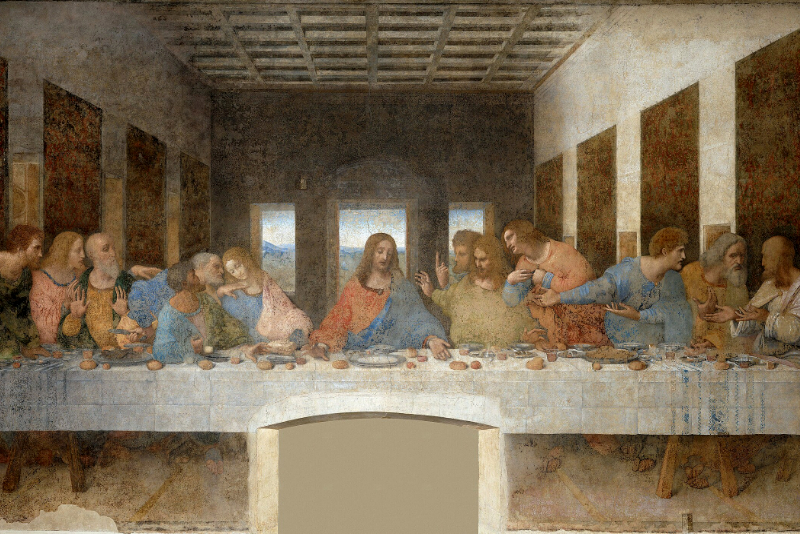
Credit: Wikipedia, Public Domain
By now, you have probably heard about the opening ceremonies for the Olympic Games in Paris. There was some controversy.
One of the biggest shocks was a scene created by some Trans activists. They apparently recreated the scene in a famous painting, and that scene was based on a story in the Bible.
In the story of the “Last Supper” where Jesus met with his closest followers and ate a meal with them. A few hours later, he was arrested, prosecuted, and executed on a cross.
For many people who identify as Christian, that re-creation was a shocking offense. Some facts are important here: there are about 2.4 billion people in the world who are identified as Christian.
There may be different levels of commitment and devotion, but that is a huge number. The whole population of the world is just over eight billion. Also, probably billions watch the opening ceremonies of the Olympics, a major world event.
It appears that a group of biological males, trans men, dressed in women’s clothes and makeup, and posed just like Jesus and his closet followers, in a famous painting:
I won’t include a link to a comment about the incident because there may be consequences. Don’t be surprised if external links are canceled. There is a move to remove links outside of official Olympic channels.
You could do a search with terms that refer to the incident, and you may find many open links.
So, speaking as a Christian, should I argue and protest? Should you?
There are some cautions here:
- This scene, at the Olympics, is ridiculous, and it makes no sense, in my opinion. It doesn’t seem to relate to the athletic games that will follow. My first impression is that we probably should not argue about every silly thing that is shown on the Internet.
- With so many people in the world identifying as Christians, this appears to be a sucker play. Someone wants attention, and they apparently would enjoy an argument. Annoying all the Christians in the world might get them some free publicity if the Christians shout back. Also, probably billions of people, around the world, are watching the Olympic Games, and many of them identify as Christian. That creates a huge instant audience who are focused on the act.
- The actors in the scene didn’t necessarily claim that they were making an insulting scene from a Bible story. Maybe they were, but maybe they can deny the accusations later.
- There might be an argument about inclusiveness. Some sexual practices are not approved by the Bible and most Christian groups, and people who follow those practices are probably offended. They can claim that they are being excluded.
If you are a believer, brace yourself for this argument.
There is an invisible argument, in this incident. So, let’s argue:
Who or what are you? “I am …”
What do you think or believe? “I believe …”
Activists who promote modern morality have one thing in common; they defend who or what they are. I seldom hear about activists who defend what they have chosen to believe. They defend who they are. That is the modern way.
Religions start, at least, with communities of believers; people who decide to be what they are. Identification started from choosing to believe, but over centuries, future generations inherited an identity, and choosing to believe was less important. Now, we can say “I am one of them.” like cheering for the football team in your area, and this position comes from our extended families and our old culture.
The source of our convictions can fade away, and we can identify with our heritage more than we personally decide to believe. This is a kind of spiritual decay that occurs among religious believers, and among Christians, it can bring communities to irrelevance. I know, that in parts of the United States, Wales, and Scotland, followers of a social trend changed and became devoted followers who chose to believe. We call those movements “revivals.”
The audio quality of the following video is very poor, the recording is more than a hundred years old, but this is a revival preacher trying to persuade cultural Christians to become sincere and personal believers:
We learn in the Bible about making a choice to follow Jesus. We are directed to make a decision and to change the direction of our lives, with God. The people who were given that direction were religious and already had an identity. They could tell you who or what they were.
Then Jesus told his disciples, “If anyone would come after me, let him deny himself and take up his cross and follow me.” (Matthew 16:24)
And to a rich man …
Jesus said to him, “If you would be perfect, go, sell what you possess and give to the poor, and you will have treasure in heaven; and come, follow me.” (Matthew 19:21)
I hope we can all learn this simple truth. We are being pulled into an apples-and-oranges argument. We are called to decide and believe, not just to be. That issue should be included in the conversations.



 OpentheWord.org
Leave a comment