

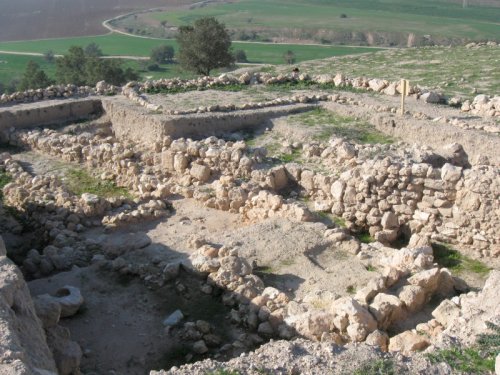
Credit: Ori~, Wikipedia, Creative Commons
Are you a believer? We should all ask ourselves what we really believe; what gives direction to our lives.
One of the tragedies of modern times is the pressure to belong to one tribe or another, where we are told what we must believe and who we must be. Usually, we don’t have a choice, or at least, choosing is not easy.
We should make choices, and we should accept responsibility for what we choose. We should look in a mirror, and see that person we decided to be.
So, for you, is God: yes / no?
Have you ever made an honest choice? Our families and friends can be on one side or the other, and often we can just follow the crowd, without making our own personal choice.
It is a tragedy when we don’t own ourselves.
In the Bible, we have instructions to be free and make our own personal decisions:
“Choose this day whom you will serve whether the gods your fathers served … But as for me and my house, we will serve the Lord.” (Joshua 24:15)
That is freedom and responsibility. Go with the crowd, or think for yourself.
We need to unlock ourselves, and here is something that can help:
“At that time Hazael king of Syria went up and fought against Gath and took it. But when Hazael set his face to go up against Jerusalem …” (2 Kings 12:17)
We have a minor record of a war between two ancient kingdoms, that no one remembers, except that it is mentioned in the Bible, in one place.
Did that ancient war really happen? Is that record reliable, or is it just something that someone made up, like a folk tale?
The reliability of the text makes the stories possible or impossible to believe.
The responsibility to make up my own mind might be taken from me, and you, if the stories in the Bible are some kind of fairy-tale fraud; like a Santa Claus story that keeps children obedient. You know the words, “He’s making a list and checking it twice, he’s gonna find out whose naughty and nice.”
Believing or not as a child was never a choice.
So, how old were you when you learned that Santa Claus was not real and children are manipulated by made-up stories?
Now back to the obscure reference to a forgotten time in history. A king, named Hazael, from Syria, who probably lived in the city of Damascus, sent his army to the city of Gath.
The remains of that city are in modern Israel, not far from the modern Gaza Strip, where a war is happening today. In the story of David and Goliath, Goliath was from Gath.
When Hazael sent his army to Gath, they conquered and destroyed the city. At least that is how the story is presented in the Bible.
Recently, Archaeologists used some new methods, developed by physicists, to examine bricks from the remains of the city of Gath.
The argument has been, that Gath just got old and gradually collapsed, and that the obscure story about Hazael was just a made-up folk tale.
We shouldn’t really believe those old stories as historical, because they were only meant to inspire us.
However, the scientists discovered that the bricks in Gath were burned, exactly when the Bible stated that the Hazael’s army attacked and burnt them. The proof is beyond dispute, and that obscure story in the Bible is true.
- READ: New research method verifies event mentioned in Bible | CTV News
I remember a conversation with a professor of religious studies, who spoke Hebrew. He told us that the names in the Bible always fit their time in history, and the pattern was uncanny. An ancient name always fits the time in history for the story that contained it.
In our modern times, we have old names. For example, if someone is named “Fonterloy” they probably lived two hundred years ago. I hope no child has that name today.
The professor was liberal-minded about the Bible, but he said the name pattern was always consistent, and it indicated the historical accuracy of the old stories in the Bible.
I find it interesting that the Bible’s story of the creation of life follows the same pattern as modern science: Conditions on the Earth changed, and life started in the oceans, including plants. Plants and animals emerged on land, and humans came last. The pattern is consistent with science.
How did ancient goat herders in the desert know that? Did they dig up fossils, and examine the patterns?
Even poems, in the Bible, contain references to Earth sciences, and God:
“He established the earth on its foundations; it will never be moved. The watery deep covered it like a garment; the waters reached above the mountains. Your shout made the waters retreat; at the sound of your thunderous voice they hurried off as the mountains rose up, and the valleys went down to the place you appointed for them. You set up a boundary for them that they could not cross, so that they would not cover the earth again. He turns springs into streams; they flow between the mountains. They provide water for all the animals in the field; the wild donkeys quench their thirst. The birds of the sky live beside them …” (Psalm 104: 5 to 12)
So, believing, Yes / No, is a free choice and a personal responsibility. We can choose the direction of our lives, with God, and we can never say someone else made the decision for us.
The burnt bricks in Gath tell an interesting story.

 OpentheWord.org
Leave a comment