


Credit: BRBurton, Wikipedia, CC0 Public Domain
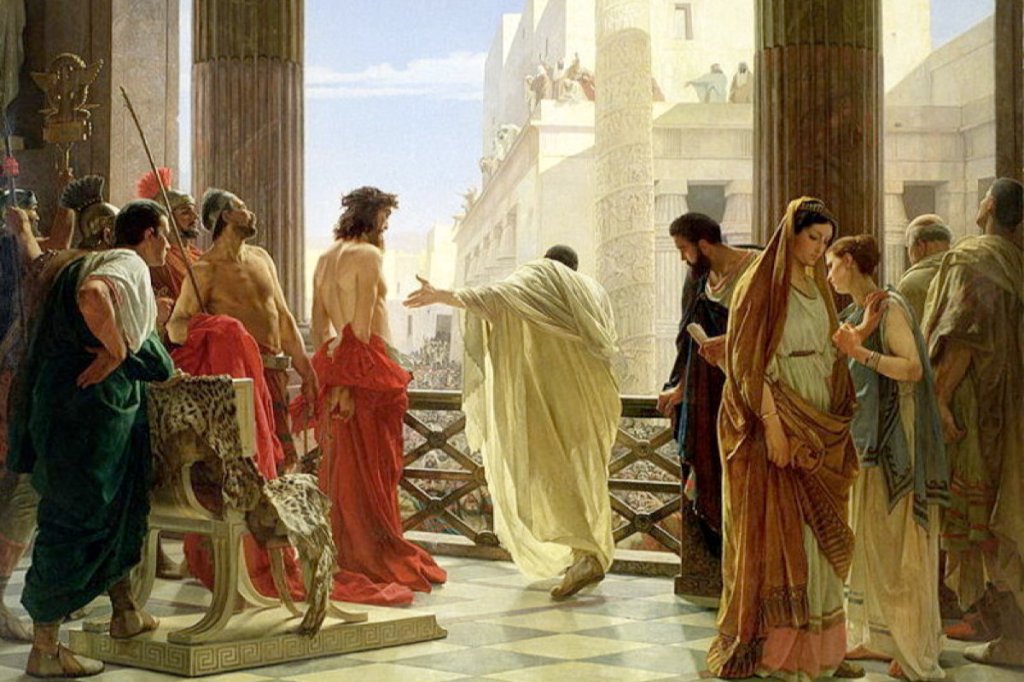
Pontius Pilate is one of the most notorious figures in the New Testament, as the Roman governor of Judea he was the one who ultimately ordered the crucifixion of Christ.
He did it as political expediency to appease the Jewish priests and elders, because Pilate repeatedly stated he did not believe Jesus was guilty of the charges that he had been accused of by the Jewish leaders (Luke 23:14, Luke 23:22).
Pilate’s wife even had a disturbing dream warning her husband to have nothing to do with Jesus who she described as a righteous man (Matthew 27:19).
Though Pilate played a major role in the crucifixion of Christ, it wasn’t until 1961 that archaeologists discovered evidence confirming his existence.
Called the Pilate Stone it was discovered by Italian archaeologist, Maria Teresa Fortuna Canivet during the excavation taking place in the ancient port city of Caesarea Maritima.
The limestone block which was 82 cm x 65 cm had Pontius Pilate’s name carved into it and called him the prefect of Judea. The term prefect was used to define the administrative leader of a particular area.
It is a significant discovery in that it was probably ordered by Pilate himself and also confirmed his role as the governor of Judea.
According to the archaeologists, the stone was probably used as a plaque installed at a temple dedicated to the Roman emperor Tiberius who reigned between 14 AD and 37 AD.
The plaque read:
To the Divine Augusti [this] Tiberieum…Pontius Pilate…prefect of Judea…has dedicated [this]
The Divine August referred to the deification of Tiberius’ stepfather Augustus, the first Roman Emperor, and his mother.
But the stone’s connection to the Biblical story of Jesus doesn’t stop there.
The temple or Tiberieum was constructed sometime during Tiberius’ reign, and eventually fell into disuse or disrepair.
In the fourth century, the stone on which the dedication was carved ended up as part of a staircase inside a building constructed behind a major theater building known as the Herodian Theatre.
This massive theater had been constructed during the reign of King Herod the Great who ruled from 37 BC to 4 BC. The building behind was probably constructed at a later date as part of the theater complex.
There are four Herods mentioned in the Bible all from the same bloodline. This is the first Herod, who as the King of Jews is associated with Christ’s birth (Matthew 2).
So it seems the Pilate stone is oddly connected to both Christ’s death and His birth.
READ: Archaeologists Find First Evidence of Existence of Pontius Pilate AND Pilate Stone, Wikipedia


 OpentheWord.org
Leave a comment