
Perhaps one of the most controversial articles I have written is “King David’s deep dark secret.” I have had more comments on that article than any others I have written and I have easily had more people disagreeing with me.
In the article I contend that King David was illegitimate. When he said in the Psalms that he was conceived in sin — he meant it quite literally. His mother conceived him in an act of sin.
Behold, I was brought forth in iniquity,
And in sin my mother conceived me. (Psalm 51:5 NASV)
This explains what happened when God told Samuel to go to Bethlehem to anoint one of the sons of Jesse as the next king of Israel, replacing Saul (1 Samuel 16:1-13).
The Bible tells us the elders were trembling when the prophet showed up (v 4). Samuel terrified the elders, so when God’s prophet asked for all the sons, the elders would make sure they were there.
But they excluded David. Some suggest this happened because he was the youngest, but considering the fear they had of Samuel, that doesn’t make sense. However, if David was not a true son (illegitimate), the elders could rationalize not including David.
Nevertheless, when Samuel realized that none of the sons before him was the one God chose, the prophet asked if there were any others. The elders quickly brought David in from the fields and Samuel anointed him as king.
But a comment on the article by Dr. J. Watson got me thinking, he wrote in part:
“For one thing, you are giving Jewish commentaries far too much credibility. Plus, if this totally groundless theory were true, then David would have been a bastard and would not have been allowed to enter into the congregation of the Lord (Deut. 23:2), which he did do, of course, many times with great delight (Ps.42:4)… — Dr. J. D. Watson, pastor/author”
Dr. Watson respectfully makes a very good point.
The Tabernacle of Moses was where the congregation gathered and where the priests performed the sacrifices on behalf of Israel. Illegitimate children were forbidden from participating in these gatherings (Deuteronomy 23:2).
So despite being chosen by God to be King of Israel, because of his illegitimacy, David could not participate in worship at the Tabernacle of Moses.
When David became King, the Tabernacle of Moses was at set up at Shiloh but after the Philistines destroyed Shiloh and temporarily captured the ark of the Covenant (1 Samuel 4:1, 1 Samuel 6:1-2, 1 Samuel 7:1), the Tabernacle of Moses was moved to Gibeon and Ark of the Covenant ended up at Kiriath Jearim after the Philistines decided to return it because of all the problems the Ark was causing them (2 Chronicles 1:1-4).
The Ark of the Covenant was the most important piece of furniture in the Tabernacle because the presence of God rested on the Ark as it sat inside the Holy of Holies, a place only the High Priest could enter.
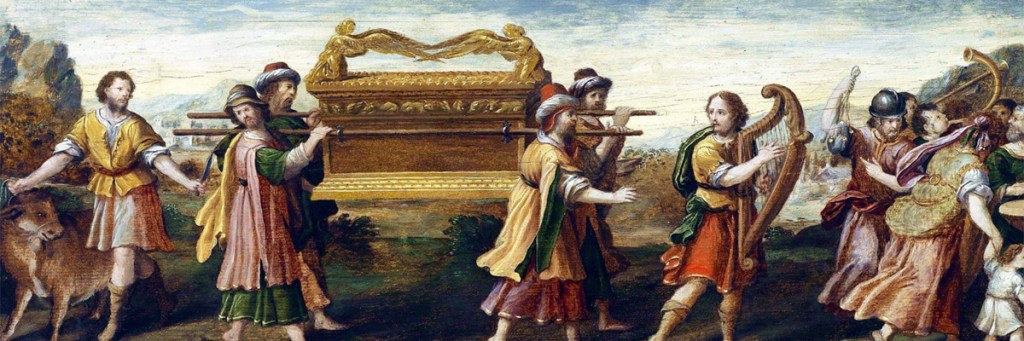
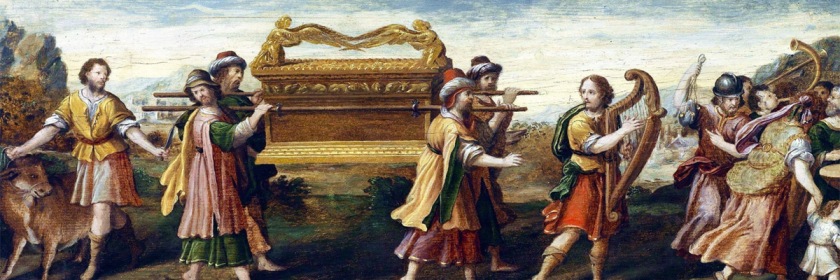
After David became king, he decided to move the Ark of the Covenant to a tent set up in Jerusalem — called the Tabernacle of David (see also 1 Chronicles 16) instead of returning it to the Tabernacle of Moses.
16 Then it happened as the ark of the Lord came into the city of David that Michal the daughter of Saul looked out of the window and saw King David leaping and dancing before the Lord; and she despised him in her heart.17 So they brought in the ark of the Lord and set it in its place inside the tent which David had pitched for it; and David offered burnt offerings and peace offerings before the Lord. 18 When David had finished offering the burnt offering and the peace offering, he blessed the people in the name of the Lord of hosts. 19 Further, he distributed to all the people, to all the multitude of Israel, both to men and women, a cake of bread and one of dates and one of raisins to each one. Then all the people departed each to his house. (2 Samuel 6:16-19 NASV)
Though the Ark of the Covenant was now in Jerusalem, the priests continued making sacrifices at the Tabernacle of Moses (1 Chronicles 16:37-40).
So why did David make this controversial decision to move the Ark to a tent in Jerusalem?
David made this unusual move because he realized when Samuel anointed him king this meant despite his bastard status God accepted David just as he was. God had shown mercy. God approved of him.
David deeply desired to be in God’s presence, but he couldn’t do it at the Tabernacle of Moses because of his illegitimacy. But he could do it, if he moved the Ark of the Covenant to a different location and different home. And despite one glitch (2 Samuel 6:6-7), the move had God’s approval.
At the Tabernacle of David, King David now had full, free access to God’s Presence. Further, there was no veil separating people from Ark of the Covenant, as there was in Moses’s tabernacle.
Everyone could come before God’s Presence at this simple tent.
Many of the Psalms were written for worship in the Tabernacle of David. The move sparked a different type of worship than what typically occurred at Moses’s tabernacle. At David’s tabernacle, the people:
- Made sacrifices of praise (instead of animal sacrifices) to God (Psalm 27:6).
- Clapped their hands (Psalm 47:1).
- Lifted their hands in worship (Psalm 134).
- Shouted (Psalm 47:1, 5).
- Danced (2 Samuel 6:16; Psalm 149:3).
- Sought the Lord (1 Chronicles 16:10-11), and
- Played their instruments (1 Chronicles 23:5; Psalm 47:5; Psalm 149:3).
They had glory times in God’s presence.
Aside from these expressions of worship, the psalmists also wrote several time of gentiles coming into the Kingdom of God (Psalm 18:49; Psalm 117:1; Psalm 47:8-9). They would have the same access to God’s presence as the Jews.
The Tabernacle of David existed for a brief time between the Tabernacle of Moses and the Temple that David’s son Solomon constructed. After the temple was completed, the priests transported the Ark of the Covenant from David’s tent into the Temple’s Holy of Holies and the Glory of God fell (2 Chronicles 5:14).
But after the temple’s construction, some strange prophecies started surfacing. The prophet Amos talked about the restoration of David’s Tabernacle — not the Tabernacle of Moses or even the Temple — but rather David’s small tent.
“In that day I will raise up the fallen booth [Tabernacle] of David,
And wall up its breaches;
I will also raise up its ruins
And rebuild it as in the days of old;
12 That they may possess the remnant of Edom
And all the nations who are called by My name,”
Declares the Lord who does this. (Amos 9:11-12 NASV)
But notice the reference to the Gentiles. They would become a big part of the restoring of David’s tabernacle. In fact, it seems the restoration would be primarily for this purpose — to bring in the gentiles.
Everyone, Jew or gentile, would have equal access to God’s Presence.
This passage is mentioned again by leaders of the early church when controversy erupted after the gentiles became Christians and were filled with the Holy Spirit. The church called a meeting to decide what to do with these outsiders.
Some of the Judaizers thought the church needed to circumcised the gentiles. Essentially they needed to become Jews before becoming Christians.
But others disagreed.
At the conference, James quoted the Amos passage (Acts 15:13-20), and said it was being fulfilled before their eyes. Further he added gentiles did not need to be circumcised, they would come in as equal partners in faith with the Jews.
The Tabernacle of David was a symbol or foreshadow of the church. In the Book of Hebrews, we are told to come boldly into the Throne Room of God (Hebrews 4:16). Because of the redeeming work of Jesus, we have full access to God’s presence, just like they did in the Tabernacle of David.
The New Testament writers described Jesus as head of the Church (Colossians 1:18). The prophet Isaiah described this in a slightly different way. He said the Messiah would rule from the “tent of David” (Isaiah 16:5).
The Tabernacle of Moses had its purpose. It showed the perfection needed to come before the Presence of God. No sin. No illegitimacy.
But the Tabernacle of David showed the mercy of God. He was going to make a way so all would have equal access to God’s Presence because of Jesus’ cleansing blood (1 John 1:7).
Illegitimate sons would become “children of God” (2 Corinthians 6:18).
26 For you are all sons of God through faith in Christ Jesus. (Galatians 3:26 NASV)
FINAL NOTE: As King David was transporting the Ark of the Covenant from Kiriath-jearim to Jerusalem, an incident took place that stopped the procession (2 Samuel 6:6-15). The Ark of the Covenant slipped and Uzzah reached out steady it.
As soon as his hand touched the Ark of the Covenant, he was immediately struck dead by the Presence of God.
Stunned, the procession stopped. No doubt at this moment David thought he had made a huge mistake moving the Ark out of the Tabernacle of Moses. He may have even thought it wasn’t God’s will.
They quickly arranged to store the Ark at the farm of Obed-edom. He was a Gittite — a gentile. Probably fearing for their lives, David and his entourage headed back to Jerusalem.
The Ark sat at the farm for three months. But something bizarre began to happen God blessed this gentile farmer. It was so noticeable that the news even reached King David at his palace. It was a prelude to God’s prophetic promise that gentiles would pour into the Kingdom of God through the Tabernacle of David.
It revealed one important thing. God was not angered by the Ark being moved out of the Tabernacle of Moses. If He was, Obed-edom would have been cursed, not blessed. Emboldened by what was happening, King David realized his plan to set up the Ark in Jerusalem was God’s will, but that it needed to be done properly.
A plan was quickly developed to transport the Ark to the Tabernacle of David.
More in the Tabernacle of David series:




 OpentheWord.org
Leave a reply to James T. Foster Cancel reply