

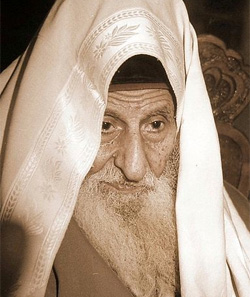
When Rabbi Yitzhak Kaduri died in January 2006 over 200,000 people lined the streets of Jerusalem to watch his funeral procession. He was one of the most famous rabbis in Israel at the time. Born around 1900 his age was estimated to be between 106 and 108 at his passing.
Shortly before his death, Kaduri did something very mysterious. He wrote a message on a piece of paper, sealed it, and told his followers they must wait until a year after his death before opening it. The note, he said, would reveal the name of the Jewish Messiah. And on top of that, the old Rabbi told his supporters the message was written in code.
Incredibly, when the letter was opened in February 2007, Kaduri declared Jesus Christ the Messiah of the Jews.
Kaduri the Kabbalist
Kaduri was a Kabbalist — a mystic Jew. The Kabbalah are considered by many to be holders of the secrets of the Jewish faith. Much of their beliefs are derived from two books — the Zohar and Sefer Yezirah — said to be so mystical, they are dangerous to the untrained.
They believe every word and even every letter and number in their religious writings contain secrets that can only be uncovered by trained Kabbalists. The ability to unlock these secrets is passed down verbally from rabbi to rabbi. Kaduri gained his imminent position having trained under many senior Kabbalists early in his life.
Certain elements of Kabbalah practice magical rights such as amulets used to promote healing and success. They also believe lost souls (dybbuks) can inhabit living people. Kaduri was involved in both these activities. He not only used amulets but reportedly delivered 20 people tormented by lost souls.
Others rites include forcing oaths upon demons and evil spirits — a dangerous practice according to Kabbalah doctrine — and one Kaduri never involved himself with. Some believe because of these latter practices, Kabbalah mysticism strays into the occult.
Kabbalists also focus on end time events particularly the coming of the Jewish messiah. Kaduri spent much of his time studying and searching for information on the coming Messiah. He was renown for his apocalyptic warnings.
Kaduri’s rise to prominence

Kaduri rose to prominence during the 1973 Yom Kippur War when families approached him to use his mystic powers to determine if loved ones were still alive.
Kaduri also wielded tremendous political influence. During the 1996 Israeli election, Shas (Sephardi Religious party) distributed 10,000 Kaduri amulets hoping to influence the election results. Shas shocked everyone and won 10 seats in the Knesset. Many attributed its success to Kaduri’s amulets as did the political establishment which a short time later passed a law forbidding the distribution of amulets for electioneering purposes.
Even pop singer Madonna dabbled in this mystic element of Judaism and tried to have a meeting with Kaduri in 2004 when she was in Israel visiting important Kabbalah sites. Kaduri reportedly turned her down stating “It is forbidden to teach a non-Jew Kabbalah.” Nevertheless, on her CD entitled “Confessions on a dance floor” released in 2005, the pop star featured a song called “Isaac” about a 16th century Kabbalist mystic Yitzhak Luria.
The Secret Message
In February 2007, a full year after Kaduri’s passing, the message Kaduri had written was opened. For some reason the main-line media in Israel was slow to pick up the story and it took a few months for the message to percolate out to the rest of the world.
Following his mystic and secretive Kabbalah tradition, Kaduri used a code to reveal the secret. He wrote a sentence in Hebrew “Yarim Ha’Am Veyokhiakh Shedvaro Vetorato Omdim” which translated means “He will lift the people and prove that his word and law are valid.”
He hinted that the first letters of each Hebrew word spelled the name of the Messiah. Israel Today — which broke the story — said, “The initials spell the Hebrew name of Jesus — Yehoshua. Yehoshua and Yeshua are effectively the same name, derived from the same Hebrew word ‘salvation’ as documented in Zechariah 6: 11 and Ezra 3:2.”
Based on the huge uproar in orthodox Jewish circles that erupted on Kaduri’s pronouncement, there is little doubt they understood this to be a reference to Jesus Christ. Some at the Nahalat Yitzhak Yeshiva — an ultra Orthodox seminary in Jerusalem — who looked to Kaduri as their rabbi came to the same conclusion, but others tried to get around the problem by stating the code was open to interpretation.
In an interview with Israel Today, Kaduri’s 80-year- old son Rabbi David Kaduri claimed the note was a forgery, so the publication asked Rabbi David for examples of his father’s writing to compare the styles.
When Israel Today studied Kaduri’s hand written notes, they noticed something very strange. The Kabbalah rabbi had painted crosses throughout his writings. The cross is not used by ultra conservative Jews because of its strong Christian connection. The use of the “plus” sign is also restricted to avoid even a semblance of a cross.
When questioned about this overtly Christian symbol, Rabbi David said they were the “sign of an angel.” When Israel Today pressed him on what this meant, the son said his dad had a unique relationship with God and “had met the Messiah in his dreams.”
Despite opposition, followers close to Kaduri stated the note was directly handed to them by the Rabbi and is definitely not a forgery but do admit they are confused about its meaning. The rabbi’s final message was published in full on Kaduri’s official website — effectively declaring Jesus as the Messiah.
Old men will dream dreams
Certainly there is a Biblical precedence for dream revelations. Prior to Jesus’ coming, Joel prophesied God will pour out His Spirit upon the earth. Read carefully what he has to say:
“It will come about after this That I will pour out My Spirit on all mankind; And your sons and your daughters will prophesy, Your old men will dream dreams, Your young men will see visions.” (Joel 2:28)
Notice Joel’s words. He said the Holy Spirit would be poured out on “all mankind.” This means these manifestations will not be limited to just “Christians” as many have traditionally interpreted this to mean.
Certainly, these events took place prior to Jesus first coming on the earth: dreams (Mt 1:20, Mt 2:12, 13), visions (Lk 1: 11, 22, 26-30); and prophesy (Lk 1: 67, 68).
However, elements of Joel’s prophecy clearly refer to the second coming of Christ — the Great and terrible day of the Lord (Joel 2:31) — when the Lord returns to judge satan and sin. This means dreams and visions will be prominent prior to Jesus’ second coming as well.
It was also a time, when the Israelites would be gathered back to the Promised Land (Joel 3:1; 3:20) — which happened in 1948. It will also be marked by the Jews turning to God (Joel 3:16, 17).
In Romans chapter 11, the Apostle Paul talks of a future day, when the Israelites will turn to Christ. He said Israelites rejection of Jesus paved the way for the gospel being preached to the Gentiles (v 11). However, he adds once the fullness of the gentiles has come into the Kingdom of God the Jews would turn to Christ (Rom 11:25).
Sources:
Rabbi Reveals Name of the Messiah (Israel Today: http://www.israeltoday.co.il/) / Rabbi Yitzhak Kaduri by Lawrence Joffe (Guardian, http://www.guardian.co.uk/: January 31, 2006) / Rabbis criticize New Madonna song (CBS News: October 9, 2006) / http://www.judaism.about.com/ / Messiah myster follows death of mystical rabbi (http://www.worldnetdaily.com/: May 18, 2007) / Rabbi’s Note Reveals Name of Messiah … “Yehoshua” (Jesus) (Breaking Christian News: May 29, 2007)




 OpentheWord.org
Leave a comment