
FOLLOW OUR PODCAST ON (search opentheword):
PODCAST NOTES:
Hi, my name is Dean Smith, and in this podcast, I want to talk about arguably the greatest cover-up of the meaning of a Bible verse in the history of the Bible.
And this misinterpretation has an odd connection to an important prophetic event, the Tabernacle of David.
But not only have Christians been involved in this insidious conspiracy, so have Jewish rabbis, but in a much different way.
King David wrote Psalm 51 in the aftermath of his adulterous relationship with Bathsheba that resulted in David initially trying to cover up this affair after Bathsheba became pregnant, and failing that ordered a mafia-style hit to take out her husband.
In verse 5, David lamented:
“Behold I was brought forth in inquity, and in sin my mother conceived me.”
Now, Christians have traditionally used this verse to explain that because of Adam and Eve’s fall into sin, we are all born with a sinful nature, which is true.
But is that what David really meant, when he wrote, “in sin my mother conceived me?“
I think It means exactly what it says. David’s mother conceived Israel’s most beloved king in an act of sin.
This meant that either David’s mother or his father, Jesse, committed adultery. Since Jesse could have married a single woman, it would have involved either a married woman or perhaps even a prostitute, who Jesse would have been hesitant to marry due to the public shame.
And David’s mother being a prostitute is not completely out of the question. In Judges 11:1-2, we read how a married man, Gilead, had relations with a prostitute who became pregnant.
But then the most bizarre thing happens.
Gilead brings his illegitimate son, Jephthah, home to be raised as a member of his family.
But this decision did not go over well, and the sons of Gilead’s wife eventually drove Jephthah from their home so that they would not have to share their father’s inheritance with the son of a prostitute.
Though some are shocked that David was conceived as a result of an illicit affair, it actually explains one of the Bible’s odder stories.
In 1 Samuel 16:1-13, we read how God called the prophet Samuel to anoint one of Jesse’s sons as the next king of Israel after rejecting King Saul because of his disobedience.
Jesse and his family were from Bethlehem, and when Samuel showed up, he asked the elders of the town to round up the sons of Jesse.
But as Jesse’s sons were lined up, Samuel realized that none of them was the one who God had chosen as the next King of Israel.
Puzzled, Samuel asked if these were all the sons and was told that the youngest son, David, was minding the sheep.
This subtly suggests Jesse was the one who had the affair. The same idea is presented in 1 Chronicles 2, when we are told Jesse fathered David, along with six other brothers and two daughters.
The elders quickly rounded up David, who was anointed as Israel’s next king.
Now, most Christian commentators explain David’s absence by suggesting he was excluded because he was the youngest.
But a single word changes our traditional understanding of this account. It is the Hebrew word “charade,” which literally means to ‘shudder in terror.’
When Samuel showed up in Bethlehem, we are told in verse 4, that the elders were ‘charading’. The NASV used the word trembling. They were shuddering in terror. They were absolutely terrified of the prophet.
Because of this fear, when the prophet Samuel asked for all the sons of Jesse, the elders would have made sure they were all there.
Obviously, there must have been a loophole, something in the fine print, that safely disqualified David from being included in that list.
And certainly being illegitimate would qualify.
And similar to Jephthah, I wonder if it was David’s stepbrothers who demanded that David not be included.
Though Christian commentators have covered-up what King David was really saying in Psalm 51, so have Jewish rabbis, but for a completely different reason.
When the rabbis read verse 5, they understood that it meant exactly what it said. David’s mother conceived him in an act of sin.
But this led to an even bigger theological quagmire, which we see hinted at in the Gospels when Jesus and the disciples encountered a man who had been born blind in John 9:2.
The disciples asked if this man was born blind because of the sin of his parents or the man’s sin.
You see, the rabbis taught that the children would be judged for the sins of their parents.
So, how could Israel’s greatest King be the result of an illicit affair, particularly if the woman was a prostitute?
And what kind of example would David set for Jewish youth, if God blessed children conceived in an act of sin.
The threat that God would judge their illegitimate children would be absolutely worthless.
But they had a problem because David clearly said he was conceived in sin. This meant, that the rabbis had to come up with an explanation that was still a sin, but not a really, really bad one.
They had to spin this story.
Now, we need to understand that the rabbis’ explanation is found nowhere in the Bible.
It comes from the Talmud or Mishnah, which is essentially a Jewish commentary of the Bible, that also included a huge list of dos and don’ts that the Jews were required to obey, in addition to the Law.
Though the Talmud is not scripture, it’s often treated as such. For example, many Jewish men today wear skull caps. There is no mention of a man needing to wear a cap in the Bible, it’s from the Talmud.
And to give their cover-up more credibility, the rabbis even provided the name of David’s mother, Nitzevet, which again is not mentioned in the Bible.
According to the rabbis, Jesse and Nitzevet were married, but Jesse had divorced his wife and under the law, it was forbidden for a man to remarry a woman he had previously divorced (Deuteronomy 24:1-4).
After the divorce, Nitzevet did a strange thing. Desiring another child she secretly switched places with her maidservant who was still living with Jesse and one night crawled into bed with Jesse resulting in David’s conception.
According to the Talmud, after she became pregnant, Nitzevet was so embarrassed that she refused to tell the family that Jesse was David’s father, and the sons accused their mother of harlotry.
And this is not even the Talmud’s only embellishment of the story.
It also says that Jesse was an illustrious leader in the Jewish community and even led the Sanhedrin. In fact, the Talmud describes Jesse as “one of only four righteous individuals who died solely due to the instigation of the serpent.” In other words, he didn’t die because he was a sinner.
None of this is mentioned in the Bible.
And as a further display of his righteousness, Jesse told his sons to allow David to be raised as part of the family.
Clearly, the rabbis were pumping Jesse’s tires, so people would understand why David was such a great and glorious king.
Though Jesse’s and Nitzevet’s actions were technically a sin, it was not on the same level as having an affair with a prostitute or married woman.
God condemns the Talmud
Now, as I mentioned earlier, the rabbis used the Talmud to create hundreds of new rules and regulations to control how the Jews lived their lives, and because of this both God and Jesus condemned the Talmud.
Isaiah prophesied:
“These people come near to me with their mouth and honor me with their lips, but their hearts are far from me. Their worship of me is based on merely human rules they have been taught. (Isaiah 29:13).
Those human rules come from the Talmud, and Jesus even quoted this passage in Mark 7, when the Pharisees asked why the disciples did not perform the ceremonial washing before eating, intended to wash off any gentile contamination, after purchasing food in the market.
This rule is not mentioned in the Bible and comes from the Talmud. And in verse 13, Jesus said the Pharisees were nullifying the word of God with their traditions.
Why did God choose David?
So, this leads to the big question, why would God choose an illegitimate man to be the next King of Israel?
Well, first God was letting everyone know that He will use anyone, no matter their circumstances.
When the disciples asked if the man was born blind because of his parent’s sin, they were subtly suggesting he was illegitimate. But Jesus answered that it was not due to his or his parent’s sin, but that the works of God might be displayed, and promptly healed the man.
But there may have been another reason why God chose David, the illegitimate son of Jesse, as the next King of Israel, and that involved the creation of the Tabernacle of David.
The gold-plated ark of the Covenant was the most important piece of furniture in the Jewish religious life because the very presence of God rested on the ark.
The Ark was initially set up in the Tabernacle of Moses and then eventually moved to the Temple constructed by King Solomon.
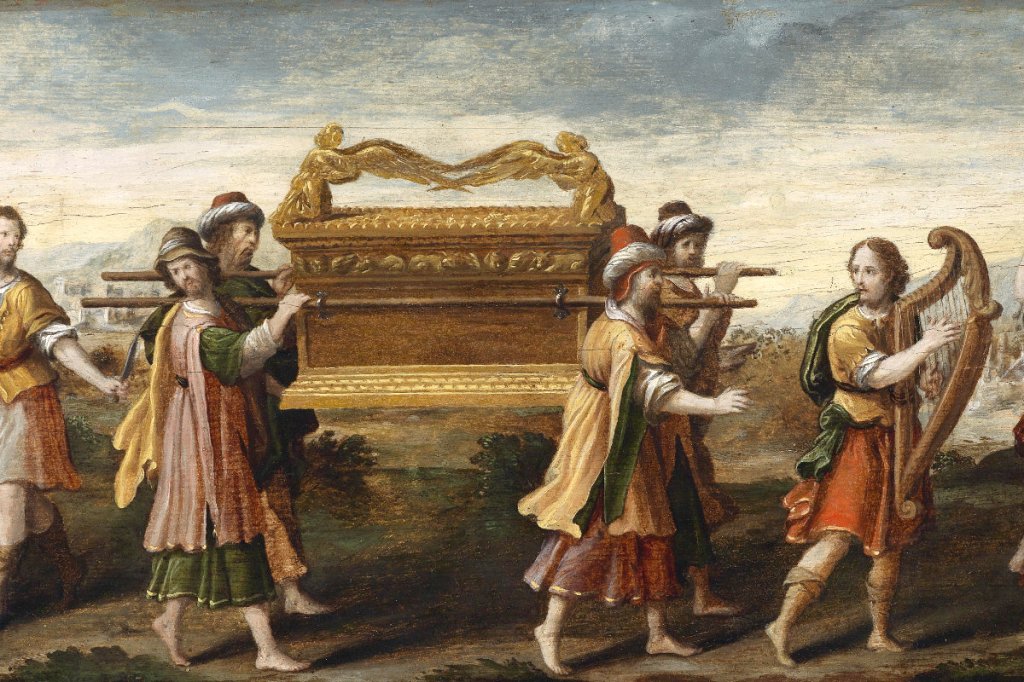
But for a few years between the Tabernacle of Moses and the Temple, the ark was in a tent set up by King David in Jerusalem, known as the Tabernacle of David.
And oddly, David’s illegitimacy may have played a role in the setting up of this tabernacle.
Despite being king, if he was illegitimate, David was not allowed to participate in the worship at the Tabernacle of Moses according to Deuteronomy 23:2.
So, King David decided to move the ark to a tent in Jerusalem, where he could worship God unhindered.
At this point, the ark of the Covenant was essentially in storage.
During the reign of King Saul, the Philistines had captured the ark after the Israelis took it with them into battle. But the Philistines returned the ark after experiencing the judgment of God, and it ended up at the House of Abinadab where it stayed for several years.
Despite not having the ark, the sacrifices continued on at the Tabernacle of Moses.
So why wasn’t it returned to the Tabernacle of Moses? In 1 Chronicles 13:3, we are told that interest in the Ark of the Covenant had fallen during the days of King Saul. This was probably due to the fact, they had chosen to use it as a good luck charm in a battle, and basically, it didn’t work.
But King David was very interested and decided to move the ark to a tent he had set up in Jerusalem.
But as the ark was being transported on a cart pulled by oxen, a man was struck dead when he touched the ark to steady it. This death horrified David, leading him to believe that his plan to move the ark to Jerusalem was a huge mistake.
In 2 Samuel 6:10-11, David ordered his men to leave the ark at a nearby farm, owned by a man named Obed-edom the Gittite.
But here is the strange thing, Obed-edom was a gentile, and even stranger three months later, David heard that God was pouring out his blessing on this gentile farmer because of the presence of the ark on his farm.
This showed David that God was not upset about moving the ark, but rather by how it was done. David ordered the ark to be successfully transported to Jerusalem on the shoulders of the Levites, as required by the Law.
And in 1 Chronicles 16:37-38, we read that despite being a gentile, Obed-edom ministered regularly at the Tabernacle of David.
Much of what we read in the Psalms, the sacrifices of praise, shouting, the lifting of hands, the dancing, clapping, and the musical instruments revolved around the worship at the Tabernacle of David.
But this lasted for only a few years. The Ark of the Covenant and animal sacrifices were moved to the temple after its construction, resulting in the closure of both the Tabernacle of Moses and David’s tabernacle.
The restoration of the Tabernacle of David
Though the Tabernacle of David was gone, a strange thing happened.
Amos prophesied that God wanted to restore the Tabernacle of David:
“On that day I will raise up
The tabernacle of David, which has fallen down,
And repair its damages;
I will raise up its ruins,
And rebuild it as in the days of old;
12 That they may possess the remnant of Edom,
And all the Gentiles who are called by My name,”
Says the Lord who does this thing. (Amos 9:11-12 NKJV)
And God specifically wanted to restore David’s tabernacle, so He could welcome the Gentiles into the Kingdom of God.
While the Tabernacle of Moses and the Temple represented the law and the sacrifices, the Tabernacle of David represented the grace of God where everyone including the illegitimate and the gentiles could come before the presence of God.
Did this restoration ever take place?
In fact, it did.
After the Holy Spirit fell upon the gentiles in Acts 10, the early church held a major meeting in Jerusalem to discuss what to do with these uncircumcised people.
At that meeting recorded in Acts 15, James quoted from Amos 9 about God’s promise to restore the Tabernacle of David in order to welcome the Gentiles into the House of God.
The church was the fulfillment of this promise to restore the Tabernacle of David, created by the illegitimate son of Jesse.
It’s a picture of God’s grace.
.
 OpentheWord.org
Leave a comment