
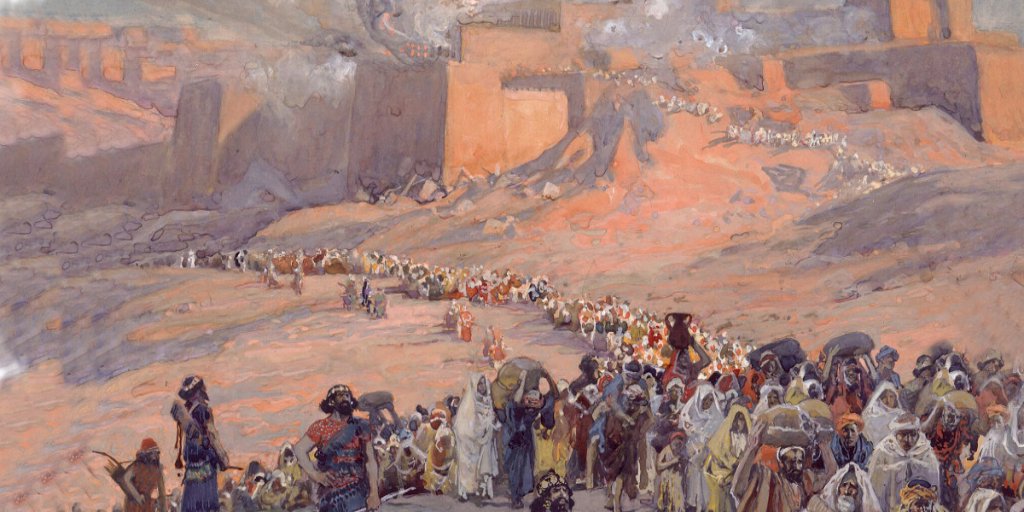
It’s called the Nebuchadnezzar Chronicle, but some have nicknamed it the Jerusalem Chronicle.
It is part of 45 clay tablets on display at London’s British Museum recording the history of the Babylonian kings.
The Nebuchadnezzar Chronicle is dated between 605 BC and 594 BC. It is referred to as the Jerusalem Chronicle, because one of its headline stories involved the sacking of Jerusalem by King Nebuchadnezzar:
In the seventh year (of Nebuchadnezzar) in the month Chislev (Nov/Dec) the king of Babylon assembled his army, and after he had invaded the land of Hatti (Turkey/Syria) he laid siege to the city of Judah. On the second day of the month of Adar he conquered the city and took the king prisoner. He installed in his place a king of his own choice, and after he had received rich tribute, he sent forth to Babylon. — British Museum
Though lacking personal details like names, the tablet confirmed the Biblical record of Babylon’s sacking of Jerusalem referred to as the ‘city of Judah.’
It even provided the actual date when Jerusalem’s walls were breached (‘conquered the city’). It took place, in the ’Seventh year’ and the ‘second day of the month of Adar’ or March 16, 597 BC.
This sacking of Jerusalem by Nebuchadnezzar is recorded in 2 Kings 24:10.
The chronicle confirms three Biblical events associated with this assault.
First we are told that the Judah’s king was taken ‘prisoner’. This refers to the capture of King Jehoiachin, Judah’s 18 year old king, who only ruled for three months. He, along with his family, were hauled off to Babylon (2 Kings 24:15).
It appears that the kings captured by Babylon functioned as little more than trophies of war. A later Babylonian king released Jehoiachin from prison. He was given an allowance, and allowed to eat at the King’s table, along with all the other captured Kings (2 Kings 25:27-28).
According to Bible Archaeology, four tablets were found in Babylon that listed the captured kings receiving rations from the Babylonian King. Jehoiachin and his family were included in the list. The tablets are now on display at the Pergamum Museum in Germany, home to Pergamon’s throne of Satan (Revelation 2:12-13).
Secondly, we are told that Nebuchadnezzar appointed a new king over Judah to replace Jehoiachin. This happened to be Jehoiachin’s uncle, Mattaniah, who Nebuchadnezzar renamed Zedekiah (2 Kings 24:17).
Thirdly, the chronicle stated that Babylon ‘received rich tribute.’ And according to the Biblical record that was certainly true. The writer of 2 Kings stated, “Nebuchadnezzar removed the treasures from the temple of the Lord and from the royal palace, and cut up the gold articles that Solomon king of Israel had made for the temple of the Lord” (2 Kings 24:13).
This is not the sacking of Jerusalem that resulted in the destruction of the Temple. That would took place 10 years later in 587/86 BC, when Zedekiah rebelled against Babylon (2 Kings 24:20, 2 Kings 25:1-10).
But it is part of one of the Bible’s great mysteries: the disappearance of the Ark of the Covenant. Several passages list the sacred items taken from the Temple by the Babylonians, yet one item is missing from every list—the Ark of the Covenant.
Since it was the temple’s most important piece of furniture, its omission was not an oversight. It tells us that when Jerusalem fell, including the first assault in 597 BC, the Ark was not longer in the Jewish temple.
The only question is who removed it and where was it hidden:




Leave a comment