
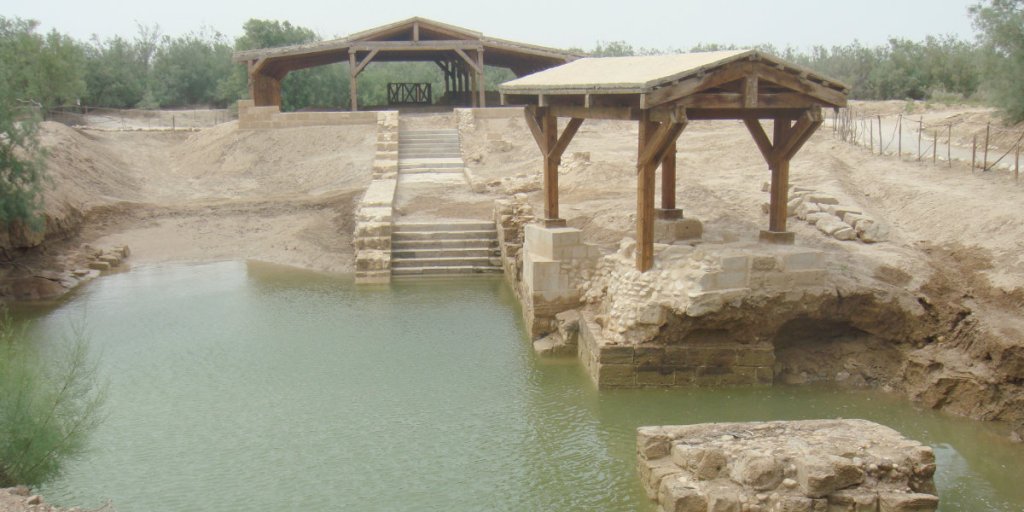
The importance of Jesus’ baptism is underscored by the fact that all four Gospels record the event, in which John the Baptist baptized Jesus in the Jordan River.
But there have been disagreements on where Christ’s baptism actually took place.
In John 1:28, the apostle John identifies the location as ‘Bethany beyond the Jordan.’ Later writers referred to it as Bethabara.
The difficulty is that John also mentions another town named Bethany—a village near Jerusalem where Mary, Martha, and Lazarus lived (John 11:1).
By adding the phrase ‘beyond the Jordan,’ John appears to distinguish the place associated with Jesus’ baptism from the other Bethany.
In a study published earlier this year in the Egyptian Journal of Archaeological and Restoration Studies, archaeologist Waheeb argued that the evidence supports Al-Maghtas as the site of Jesus’ baptism, the Daily Mail reports. Waheeb is a professor at Jordan’s Hashemite University.
Al-Maghtas, a UNESCO World Heritage Site, is widely considered to be the site of Jesus’ baptism. It is located on the eastern side of the Jordan River, just north of the Dead Sea.
In his study, Waheeb cited three pieces of evidence in support of this conclusion.
First, he noted that archaeological work conducted in the area between 1996 and 2002 uncovered a strong Christian presence at the site. This included evidence of churches, prayer halls, and—importantly—several baptismal pools.
The baptismal pools suggest that people gathered there to be baptized, possibly including visitors from beyond the local population.
Second, there is evidence that Jews were living at the site in the first century, indicating that a small village existed there.
“These remains indicate that the area was inhabited during the time of John the Baptist and Jesus,” Waheeb noted in his study.
Finally, in addition to the archaeological evidence, Waheeb pointed to historical evidence supporting the identification of Al-Maghtas as the site.
In his report, he cited both the Pilgrim of Bordeaux, who visited the region in AD 333, and Theodosius, who visited in AD 530. Both described the baptism site as being on the Jordan River, five miles from where it flows into the Dead Sea.
“From the site [Al-Maghtas] where the Lord was baptized, to the site where the river Jordan pours into the Dead Sea, there are five miles,” Theodosius noted in his study.
Other pilgrims described Jesus’ baptism site as being across the Jordan River from Jericho.
According to Waheeb, the Madaba Map—a mosaic map on the floor of a Byzantine church in Madaba, Jordan—also supports the identification of Al-Maghtas as the site.
Created between AD 542 and 570, the map of the Holy Land shows Bethabara, identified as the place where Jesus was baptized, with Jericho nearby.
This location corresponds to the present-day baptismal site at Al-Maghtas.
Jesus’ baptism is significant because it presents the three persons of the Trinity—the Father, the Son, and the Holy Spirit—appearing at the same time.
After He was baptized, Jesus came up immediately from the water; and behold, the heavens were opened, and he saw the Spirit of God descending as a dove and settling on Him, 17 and behold, a voice from the heavens said, “This is My beloved Son, with whom I am well pleased.” —Matthew 3:16–17, NASB
Jesus, who had set aside His divine privileges and appeared in human form, is present in the Jordan. The Holy Spirit descends upon Him like a dove, while the Father speaks from heaven: ‘This is My beloved Son.’




Leave a Reply