

Do you believe in something—anything? Most of us do. I am writing from a Christian perspective.
Do you ever attend meetings with other people who share your beliefs? Do you wear a team T-shirt or hat, or display a bumper sticker on your car?
Imagine if the system or religion you believe in was illegal. Imagine that if you ever got caught, you could be killed, or possibly sent to a hard-labor camp and worked to death.
Do I seem ridiculous when I say these things? Does it sound as though I am describing a strange video game or a bad science-fiction movie?
Did you know that there are places in the world where all the things that I just described are true? Millions of people in our modern world practice their faith in secret. When the secret comes out, they usually die, quickly or slowly.
I remember a story from more than ten years ago about Christians from the African country of Eritrea, which used to be a part of Ethiopia. The government of Eritrea is strict about religious communities, and only permits a few Christian groups.
Saudi Arabia is an important center of the Muslim religion, and other religions are mostly banned. The government has religious police who enforce the official policies.
The Eritrean workers faced difficulties in both countries. They worked in Saudi Arabia, while their homes were in Eritrea, and some of them were Christians without belonging to an approved denomination. As they worked for their Muslim employers, they would meet quietly for quiet worship services in private apartments.
This might seem harmless, but one worship group was discovered by the Saudi religious police and arrested. They were deported back to their home country. The news story stopped there, but the end of the story was probably sad and painful. If those Christians weren’t executed, they may have been sent to prison and certainly lost their jobs.
Imagine—all of those things happened because they believed in something.
I don’t want to get lost in criticism of governments that persecute. I’m sure you don’t agree with them, but the other side of the story is this: How do those believers live? In most countries, religions have churches and mosques and temples, and people belong to communities and practice some kind of worship or celebration quite openly.
It’s a group exercise, but in some places, belief is secret and private, and the punishment for getting caught could be prison or execution. We should know that this is reality for millions of people in the modern world. Christians were warned about this in the Bible: “Indeed, all who desire to live a godly life in Christ Jesus will be persecuted.” (2 Timothy 3: 12).
For some of us, persecution takes the form of social criticism or limited career opportunities. When I was a young university student, I remember a professor who was quite friendly until he found out I was a Christian. Suddenly, he sneered at me, and told me that people like me were “literalists.” I didn’t know what that meant, but I could see trouble coming and after I completed and passed that course, I was careful to never take another course from him. Eventually I graduated with a degree, and my life moved on to other things.
It was easy for me to dodge that bullet, but imagine life, for millions, where that “literalist” conversation could have resulted in an arrest and severe punishment.
We don’t have to imagine severe persecution. It is common in our world, and Christians are often the most persecuted. North Korea, for example, is a strict Communist country, and punishment for breaking the law can be terrible. We know that “All who desire to live a godly life in Christ Jesus will be persecuted” but sometimes this persecution is more than a sneer from a neighbor.
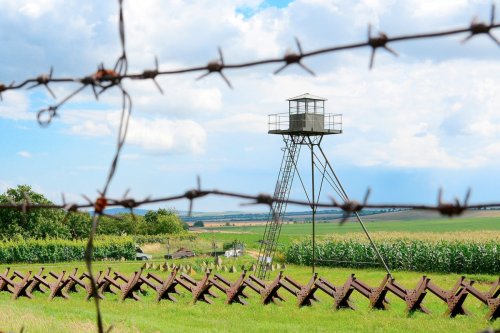
When I was young, I traveled through Europe with a friend using a railway pass. It was mostly fun, but one day we took a walk to see the “Iron Curtain”, which was the boundary between Western Europe, and Communist countries on the eastern side.
That was a very bad idea.
Somehow, we walked past the border ground markers, and we were arrested by soldiers with guns. I was handcuffed and we were held and questioned for several hours.
Eventually we were handed over to police on the western side, and they drove us to their local jail. I remember that their official squad car was a Volkswagen Beetle. After some time, we were released by the western police, and I never did anything like that again.
We were two foolish tourists who didn’t notice a small marker stone. I have friends with similar stories, like the hippie tourist who took photos of the eastern side of the Berlin wall. That resulted in arrest, jail time, and deportation.
Imagine being both a believer and a citizen in one of those strict countries.
We don’t have to imagine.
In North Korea, most religion is forbidden. The capital city of Pyongyang was once known as the Jerusalem of East Asia, because so many Christians lived there, but things have changed. Somehow, the number of Christians is increasing. There may be as many as half a million Christians in that country now, but the real number is difficult to determine.
I think every believer today could use a message from the dark side. Could we continue as believers, if our cultural supports were taken away and we could practice our faith only in secret? Many millions already know that experience, and their numbers are growing. Someday they might be the majority of believers. Paul, an author of the Bible who knew how to be persecuted told us how to live on the dark side of belief:
Three times I pleaded with the Lord to take it away from me. But he said to me, “My grace is sufficient for you, for my power is made perfect in weakness.” Therefore I will boast all the more gladly about my weaknesses, so that Christ’s power may rest on me. That is why, for Christ’s sake, I delight in weaknesses, in insults, in hardships, in persecutions, in difficulties. For when I am weak, then I am strong. (2 Corinthians 2: 8-10)




Leave a Reply