
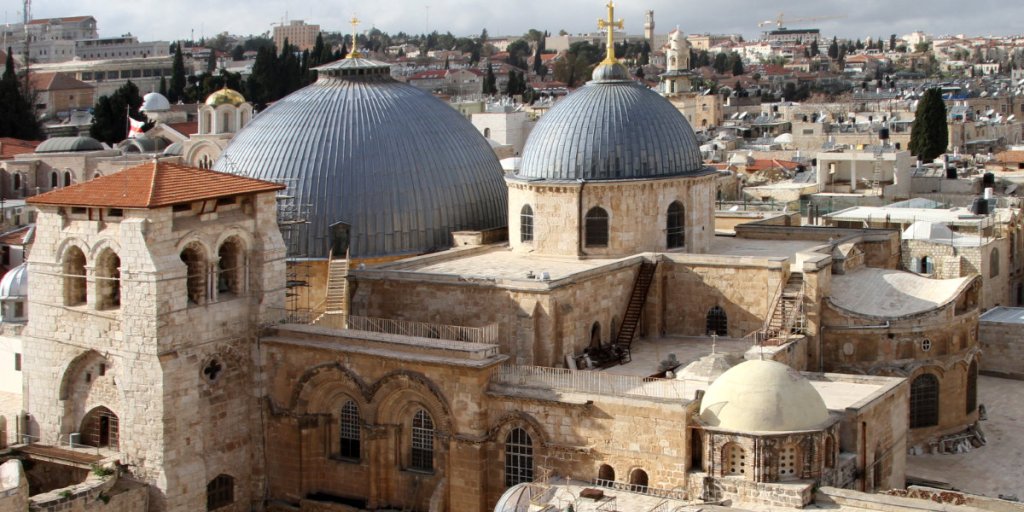
ESPAÑOL: Las pruebas se acumulan: la tumba de Jesús está en la Iglesia del Santo Sepulcro
Archaeologists from Italy’s “La Sapienza” University of Rome have found evidence confirming that Jerusalem’s Church of the Holy Sepulchre is the location of Jesus’ burial tomb, the New York Post reports.
A church was first built in the fourth century over the site believed to be the spot where Jesus was crucified, buried and then resurrected from the dead.
It is considered to be Christianity’s most holy site. According to the Times of Israel, the church is currently being co-managed by three groups, the Orthodox Patriarchate, the Custody of the Holy Land, and the Armenian Patriarchate. The relationship between the three groups has been described as tumultuous.
In 2022, archaeologists were brought in as part of restoration work at the church, which included major repairs to the main floor.
By 2025, archaeologists studying what lay beneath the church’s ground floor had found the remains of an ancient garden with several tombs cut out of the limestone rock. They also discovered a stone quarry and cultivated land.
This fits John’s description of Christ’s tomb, which is described as being located in a garden:
Now in the place where He was crucified there was a garden, and in the garden was a new tomb in which no one had yet been laid. (John 19:41 NASB)
The archaeologists added that the quarry would have been found just outside the city in Jesus’ day which confirms the Biblical record. John writes that “the place where Jesus was crucified was near the city” (John 19:20), and the writer of Hebrews adds that Jesus was crucified just outside Jerusalem’s gates (Hebrews 13:12).
The excavation also found that part of the quarry had been backfilled with dirt for cultivation purposes. Researchers found pollen and other organic evidence of vines and olive trees dating back to the first century.
It’s possible these were the remains of plants growing in the garden at the time of Christ’s burial.
The discovery of tombs cut out of the limestone rock showed that it was part of a larger burial ground. It fits the description provided by Luke, who wrote that Joseph of Arimathea laid Christ’s body “in a tomb cut into the rock (Luke 23:53 NASB).”
While this does not definitively confirm that this is Christ’s burial site, the Church of the Holy Sepulchre has been recognized historically as Christ’s tomb for centuries.
In 326 AD, Roman Emperor Constantine ordered the destruction of a Roman temple that Emperor Hadrian had built over the tomb in 135 AD, and had a church constructed in its place.





Leave a comment