
Another early mention of Jesus from a non-Christian sources was made by a second century Greek philosopher named Celsus. He believed in the ancient Greek and Roman gods and supported Roman emperor worship.
Though, he actively opposed Christianity, his statements not only supported the existence of Christ, but also revealed what Christians believed about Jesus.
No copies of Celsus’ major work, The True Word, have been found to date. But it was extensively quoted by Christian apologist Origen, in his book Contra Celsum, where he countered Celsus’ arguments. Most historians state that these quotes are legitimate.
Since Contra Celsum was written about 75 years after Celsus’ death, it reveals that the philosopher’s arguments were still having an impact decades later.
Celsus got many of his arguments opposing Christianity from the gnostics, whom the philosopher actually cited. He also acknowledged a Jewish source in his opposition of Christ’s virgin birth.
The gnostics were a Christian cult that believed all matter was evil and only the spirit was good. Because of this, the gnostics did not believe Christ appeared on earth as human. They held that Jesus came in a spirit form and subsequently questioned the miraculous birth of Christ.
This falls in line with Celsus’ attack on Christianity as he focused his attention on the virgin birth, suggesting instead that Jesus was illegitimate, writing:
“born in a certain Jewish village, of a poor woman of the country, who gained her subsistence by spinning, and who was turned out of doors by her husband, a carpenter by trade, because she was convicted of adultery; that after being driven away by her husband, and wandering about for a time, she disgracefully gave birth to Jesus, an illegitimate child, who having hired himself out as a servant in Egypt on account of his poverty, and having there acquired some miraculous powers, on which the Egyptians greatly pride themselves, returned to his own country, highly elated on account of them, and by means of these proclaimed himself a God.”
But in his opposition, Celsus acknowledged both the birth of Christ and the fact that Joseph was a carpenter. He also confirmed that Jesus performed miracles, but said they were done “by sorcery (γοητεία)” which He learned in Egypt.
Celsus even admitted that Jesus proclaimed to be God, a fundamental belief of the Christian faith.
But Celsus’ main accusation that Jesus was illegitimate was not new.
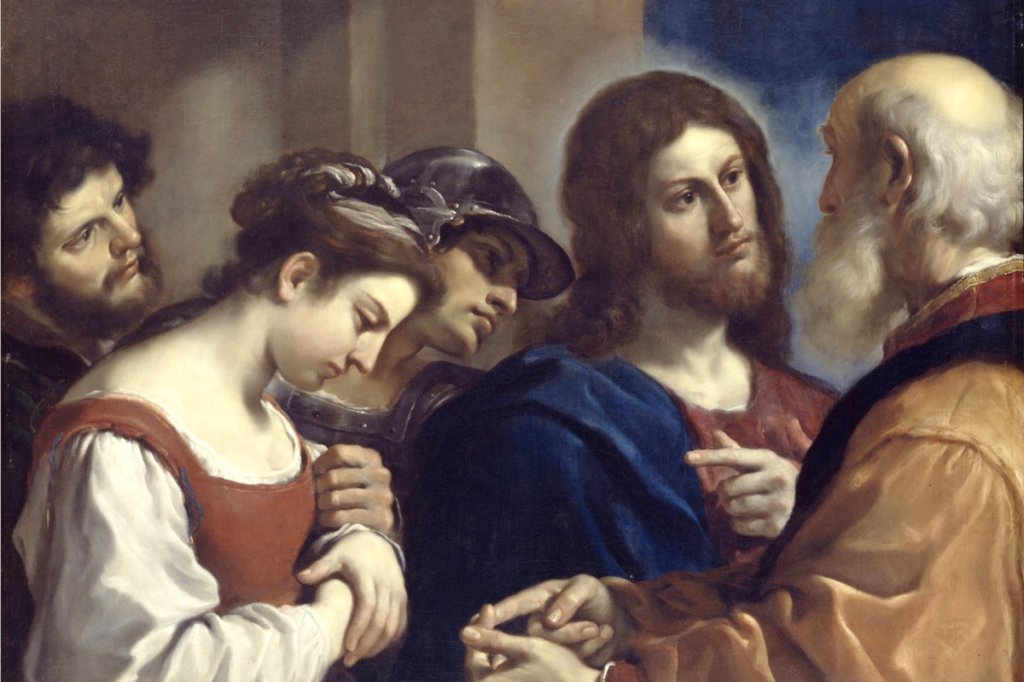
This same argument was front and center in Christ’s heated confrontation with the Pharisees and scribes after Jesus saved the woman caught in adultery in John 8.
When Jesus questioned their lineage as descendants of Abraham, because of their failure to recognize Jesus as the Messiah, the pharisees countered it with, “We are not born of fornication” v 41.
This was an odd defence and seems more like a personal attack. This is revealed a few minutes later when they blurted out, “Do we not say rightly that you are a Samaritan [half Jew and half gentile] and have a demon?” (v. 48).
Both Joseph and Mary were full-blooded Jews. To accuse, Jesus of being a Samaritan meant they believed Mary had illicit sex with a gentile before her marriage to Joseph.
Celsus went one step further and stated that Christ’s father was a Roman soldier.
This is not surprising. The Jews were desperate to neutralize Christ’s growing popularity. There was no better way of doing this than by slandering Mary and accusing Jesus of being the illegitimate son of a hated Roman Centurion.






Leave a Reply