

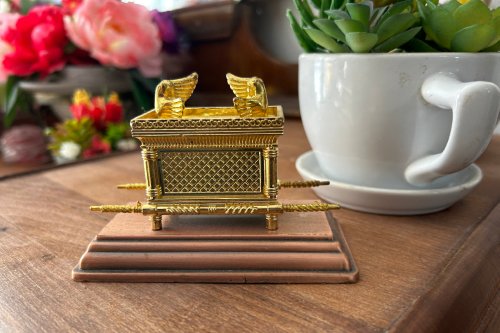
The significance of a recent archaeological find at the ancient town of Shiloh was seen in the Daily Mail’s headline: Ark of the Covenant mystery blown wide open as ‘Biblical relic’ is discovered.
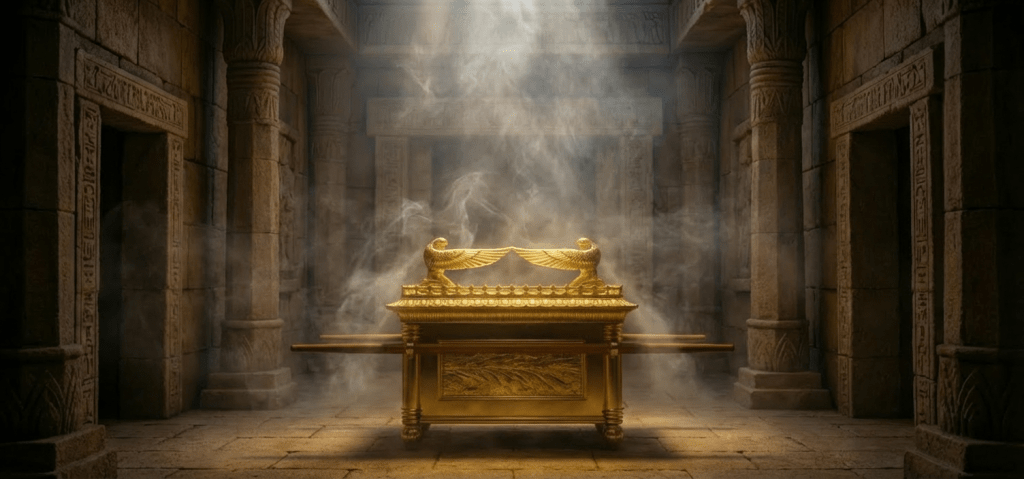
It was a massive discovery as they uncovered the building that once housed Israel’s most important piece of furniture, the Ark of the Covenant. This is where God’s Presence rested in the Tabernacle of Moses, Tabernacle of David and later Solomon’s Temple.
While the Israel wandered through the wilderness, the Ark was housed in a tent referred to as the Tabernacle of Moses. It was very mobile, allowing it to be easily transported.
Once they reached the Promised Land, the Tabernacle of Moses was set up at Shiloh, where it remained for several centuries. Today, Shiloh is found in the West Bank.
Because of its central location, Shiloh served as both the political and religious capital of ancient Israel before David conquered Jerusalem.
We see its importance through several major decisions that were made at Shiloh. It was here that Joshua apportioned the land to each of the 12 tribes (Joshua 18:1-2). The Tribe of Levi asked for and received their designated cities at Shiloh (Joshua 21:1-2).
When the tribes of Gad and Reuben built an altar along the Jordan river, a force was sent from Shiloh to stop it (Judges 22:12).
With the Ark of the Covenant at this location for over 350 years, they eventually replaced the tent (Joshua 18:1) with a permanent structure.
Initially, it was probably constructed of wood which may have even been built over top of the tent dwelling. This was later upgraded to a stone structure.
We see references to the permanent structure in several passages. It had both door posts (1 Samuel 1:9) and doors (1 Samuel 3:15).
At Shiloh it was no longer referred to as a Tabernacle or tent (Hebrew word ‘mishkân’), which is what it was originally called (see Exodus 25:9).
It was referred to as the “‘hêykâl’ of the Lord”, which literally means Temple of the Lord. The word is used to describe a more permanent structure.
Which is how the ESV translates the word:
After they had eaten and drunk in Shiloh, Hannah rose. Now Eli the priest was sitting on the seat beside the doorpost of the temple (hêykâl) of the Lord. (1 Samuel 1:9 ESV)
Unlike the temple eventually built by King Solomon, the dimensions of the Shiloh temple was patterned off the Tabernacle provided in Exodus 26.
Archaeologists working at Shiloh announced they have discovered the remains of a stone structure that matches the dimensions of the Tabernacle of Moses in Exodus 26.
According to Dr Scott Stripling, who is heading the excavation, it even mimicked the Holy of Holies found in the Tabernacle where the Ark of the Covenant sat.
“We’ve uncovered a monumental building from the Iron I period that matches the biblical dimensions of the Tabernacle. The structure is oriented east-west and divided in a 2:1 ratio, just as described in scripture,” Stripling said.
In the Tabernacle of Moses, a large curtain was used to separate off the Holy of Holies, where the Ark of the Covenant sat. However, in the Shiloh building, this area was created using a large stone wall.1
In addition, archaeologists discovered the bones of thousands of sheep, cattle of goats on the correct side of the building. This fits the Biblical pattern which stated that the priestly offerings were to be made on one particular side of the Tabernacle in Leviticus 7.
“This isn’t a coincidence,” Dr Stripling said in an interview with CBN. “The evidence of sacrificial rituals here is overwhelming, and it matches the biblical account to a degree that’s hard to ignore.”
This Shiloh temple is where Eli the High Priest ministered and where Samuel the prophet grew up.
Shiloh fell out of use after a battle with the Philistines. After losing the first skirmish, Israel decided to bring the Ark of the Covenant to the front lines, as a good luck charm.
But, instead, Israel experienced a massive defeat (1 Samuel 4) and the Philistines captured the Ark of the Covenant.
When Eli heard that the Ark had been taken, he fell off his chair and broke his neck (1 Samuel 4:18). Since he was described as a very large man, some wonder if the shock caused him to have a heart attack.
Though it is not specifically mentioned in the Bible, it’s believed that the Philistines also destroyed the temple at Shiloh. This is alluded to in Jeremiah 7:12.
After the Philistines set up the Ark in one of their pagan temples, God brought plagues upon the nation. This forced them to return the Ark to Israel (1 Samuel 5).
With the High Priest dead, and Shiloh’s temple destroyed, the Ark of the Covenant was set up at a new location, Kirath Jearim (1 Samuel 6:1, 21). Other passages indicated they used a tent to house it.
- In the Temple built by Solomon and later rebuilt by Ezra and Nehemiah, it seems they used a large curtain to separate the Holy of Holies from the rest of the Temple (Matthew 27:51). ↩︎


 OpentheWord.org
Leave a comment