
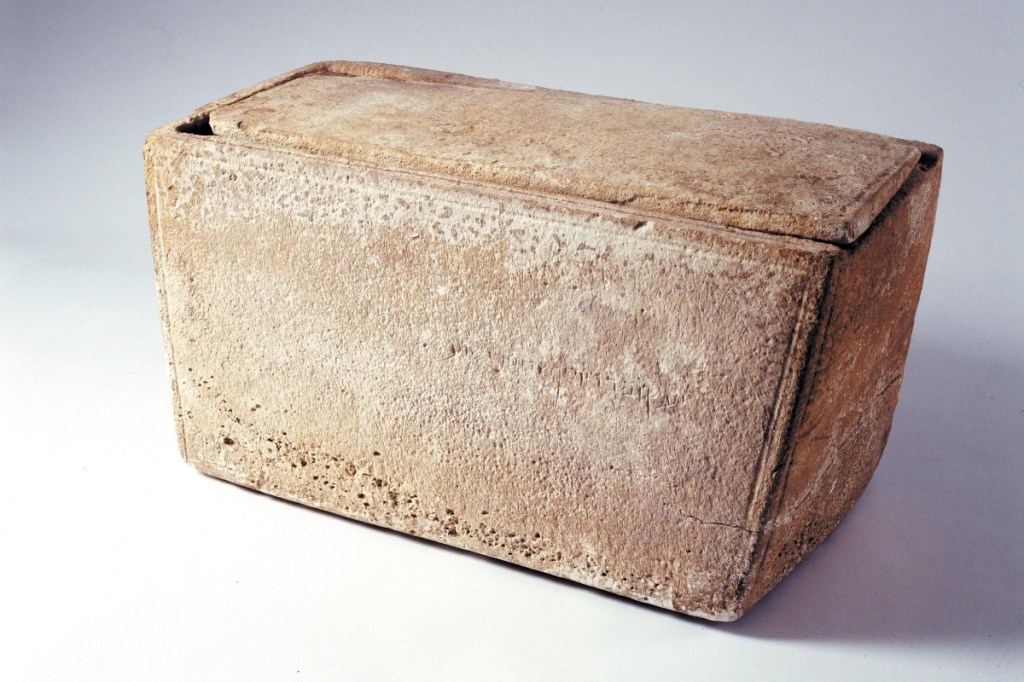

We know from New Testament, that James, the half-brother of Jesus, headed the Church in Jerusalem as he made the final ruling on how the early church would handle the believing gentiles (Acts 15;13). He was also author of the epistle of James.
Just over 22 years ago, an ossuary (a small stone box used in ancient times to hold the bones of the deceased) was revealed with the wording “James, son of Joseph, brother of Jesus,” inscribed on its side.
It was a shocking revelation as many believed that it was actually the ossuary that once contained the bones of Jesus’s brother James.
The box is now back in the lime light, because it is part of an exhibit at the Pullman Yards in Atlanta entitled, “Discovering the World of Jesus: Ancient Treasures from the Holy Land”.
According to the Christian Post, this is the first time that this private collection of 350 ancient artifacts has been outside of Israel. It also includes an ossuary believed to be of the priest Zacharias, the father of John the Baptist.
This was not the first time that the James’ ossuary was out of Israel as it had been featured at Toronto’s Royal Ontario Museum (ROM) in 2002 and 2003.
As the son of Joseph and Mary, James would have been Jesus’ half brother due to the virgin birth. But the ossuary also revealed that despite claims by Catholics that Mary was a perpetual virgin, she and Joseph had other children (see Matthew 13:55).
Though James and Jesus were popular names at the time, the reference to James being both the ‘son of Joseph’ and the ‘brother of Jesus’ left little doubt for many that this box once contained the bones of Jesus’s brother.
When the existence of this ossuary was revealed in 2002, it was promptly enveloped in controversy as it was clear evidence of both existence of Jesus and two other key Biblical characters.
While the names Jesus, James and Joseph were popular at the time, the chances of another James having a father named Joseph and brother named Jesus was extremely low.
According to a statistical analysis done by Tel Aviv University professor, Camil Fuchs, at that time in Jerusalem there would have been only 1.71 people named James who had a father named Joseph and brother named Jesus.
As well, it was extremely rare to find an ossuary with three names on it as this was the only the second time one has been found.
The inclusion of the brother’s name indicates that this individual must have been significant. Being the brother of Jesus Christ would certainly meet that qualification.
So as a result, the critics were forced to attack the legitimacy of the ossuary. Not surprisingly, the most ardent attacks came from those who don’t even believe that Jesus actually ever existed.
It’s an opinion that is relegated to the back water of modern research, as even the most ardent critics of Christianity today would grudgingly admit that Jesus was a real person.
But the evidence for the legitimacy of the ossuary was strong, writes Richard Ostling in an an article for CBN.
First we know that James died around 62 AD and the box itself was dated to 63 AD which fit withing the time frame of removing the bones once the flesh had decayed.
Secondly, ossuaries were only popular in Israel between 20 BC to 70 AD, again fitting within the time of frame of James’s death..
Thirdly, the writing on the ossuary box fits the style of the first century .
Fourthly, an examination of the writing by Israeli government scientists could find no evidence that the writing was recent and created with modern tools or chemicals. They concluded that the box and the script were ancient.
Though there have been several attempts to prove the ossuary was a forgery, Edward John Keall, the Senior Curator at the Royal Ontario Museum (ROM), stated that “the ROM has always been open to questioning the ossuary’s authenticity, but so far no definitive proof of forgery has yet been presented, in spite of the current claims being made.“

 OpentheWord.org
Leave a comment