
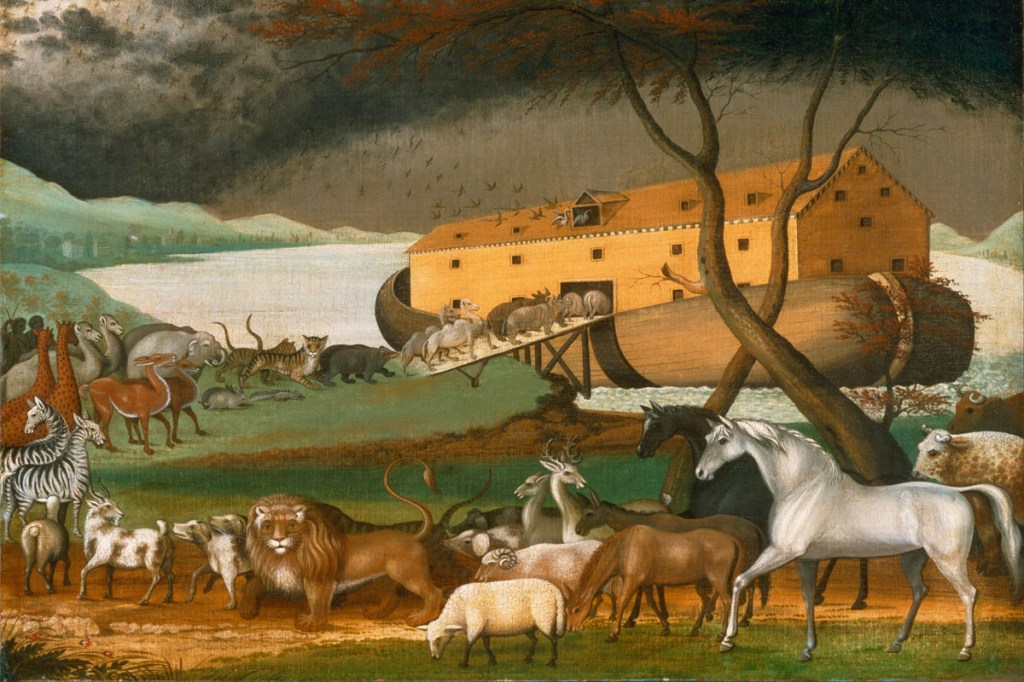
by Edward Hicks (1780-1849)/Wikipedia/Public Domain
Researchers at London’s British Museum recently translated the words on an ancient Babylonian tablet that was uncovered in the late 1800s, and were shocked by what they found.
The tablet which has writing and drawing on both sides was written in ancient wedged shaped cuneiform language. They discovered that the tablet included a map that provided specific directions so people of that day could see the remains of Noah’s ark, the Daily Mail reports.
On the back of the tablet, people were told that if they traveled ‘seven leagues… [to],” they would “see something that is thick as a parsiktu-vessel.’
Similar to the Bible, the Babylonians had an account of a great flood. Parsiktu is the term used to describe the massive vessel that saved a small group of humans and the animals in Babylon’s version of the great 150 day flood that destroyed the ancient world.
The Babylonian map gives specific instructions so others could see the remains of the boat located on “Urartu,” which is the equivalent of Mount Ararat in the Biblical account where Noah’s ark came to rest after the water began to recede. Note the Bible does not say Mount Arafat, but rather that it came to rest in the mountains of Arafat (Genesis 8:4).
“The first place you come to is called ‘Urartu’, it’s drawn on the map. Now, the interesting thing about that is that in the Bible Noah, in his Ark, landed on a mountain where the name is ‘Ararat’ and ‘Ararat’ is the Hebrew equivalent of the Assyrian ‘Urartu’. said cuneiform expert and British Museum curator Dr. David Finkel in an interview with CBN.
“That’s quite a meaty thing, quite an interesting thing to think about because it shows that the story was the same, and of course that one led to the other but also, that from the Babylonian point of view, this was a matter of fact thing,” Finkel added.
The Babylonian story of a great flood shouldn’t surprise us, because the Bible states that the world was divided into different languages in Genesis 11, in response to the construction of the Tower of Babel.
This means everything before this point was common history to all nations, and this would include the world wide flood, which is exactly what we find.
According to Answers in Genesis, there are over 270 flood stories found in nearly every nation and cultural group on Earth.
There are about 20 stories of a great flood among North American Indian Tribes alone including the Cree, Inuit, Ojibwa, and Mi’kmaq. The Orowignarak in Alaska tells the story of “a great inundation, together with an earthquake, swept the land so rapidly that only a few people escaped in their skin canoes to the tops of the highest mountains.”
Accounts of the great flood can be found in India. The Shatapatha Brahmana dated to 700 to 300 BC, tells how people were warned about an impending flood and how Manu built a giant boat and saved the animals.
Similar stories of a great flood are found among the Maya and Aztecs in South America. There are several stories of a massive flood in China and the Great Flood of Gun-Y dating to around 2300 BC correspond to the dating Noah’s flood which some have calculated took place around 2348 BC.
There are stories of a great world-wide flood among the aborigines in Australia and among the Ket people in Siberia.
In other word, from the ends of the world there are stories of a massive world wide flood, just as the Bible suggested there would be.

 OpentheWord.org
Leave a comment