
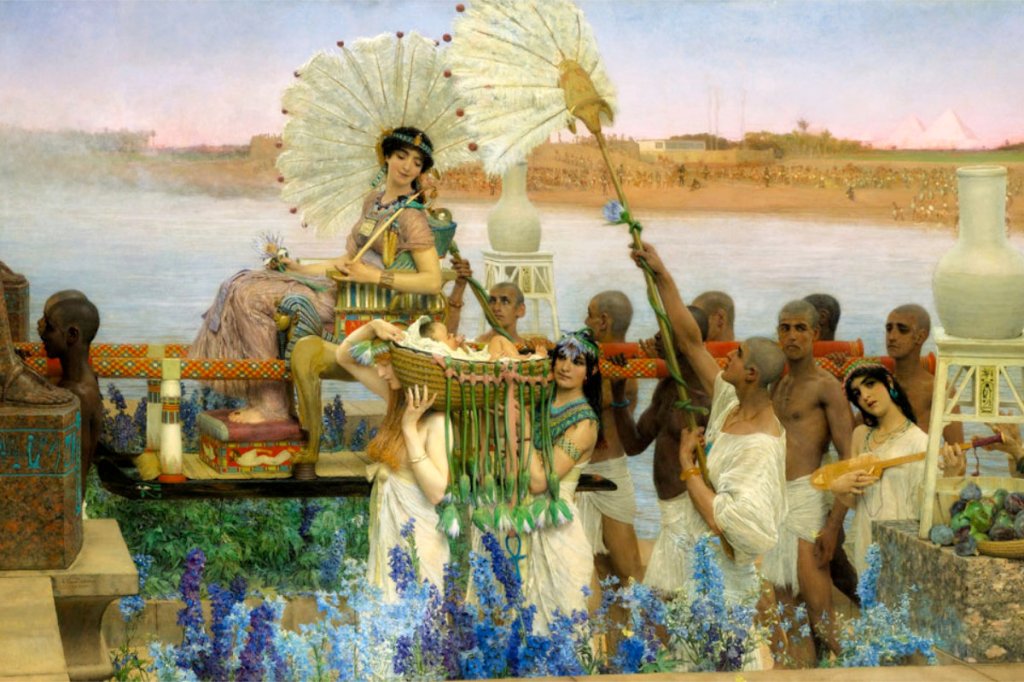

By Edward Poynter (1836-1919)/Wikipedia/Public Domain
Cicero Morares, a graphics expert from Brazil, has released an image of the Egyptian Pharaoh Amenhotep I, based on a reconstruction of his face from his mummified remains, the Daily Mail reports.

Morares is an expert involved in the forensic reconstruction of faces from skeletal remains. He used a variety of methods based on CT Scans taken of Amenhotep’s mummy in 2021.
Amenhotep I is best known for having created the Valley of the Kings where many Egyptian pharaoh’s were buried. He lived about 3,500 years ago and was the son of Pharaoh Ahmose.
These are two of the three Pharaohs mentioned in the Exodus account and Israel’s deliverance out of Egypt.
It was Ahmose who initially tried to kill off the Hebrew boys, which led to Moses miraculously being raised in Pharaoh Ahmose’s court.
At around 40 years of age, Moses fled Egypt after killing an Egyptian guard during the reign of Ahmose’s son, Amenhotep I.
Moses later returned when he was around 80 years old (Exodus 7:7) and led the Hebrews out of Egypt after a series of plagues involving a third Pharaoh either Thutmose II or Thutmose III.
Pharaoh Ahmose drives out the Hyksos
Around the 1800 BC, the Hyksos successfully invaded Egypt occupying the Northern part of the Nile Delta, forcing the Egyptian government into the Southern half.
The Hyksos were Semitic, cousins of the Hebrews.
It is believed that Joseph arrived in Egypt when the Hyksos were in power when God raised him up to second in command. This was helped by Joseph having a similar language and culture to the Hyksos.
Joseph then invited his family to come live in Egypt and again because of the cultural similarities were allowed to come and thrive in Northern Egypt.
I go into this Hyksos connection in more detail in the podcast below. However, in this podcast, I mistakenly suggest that Amenhotep I was the pharaoh of the Exodus, which I know today is clearly wrong:
Around 1550 BC, the Egyptians living in the south under Pharaoh Ahmose finally drove the Hyksos out of northern Egypt and that event is actually mentioned in the Bible.
“Now a new king (Ahmose) arose over Egypt, who did not know Joseph,” (Exodus 1:8 NASV)
Pharaoh Ahmose would not have known the Hebrews because they had been invited to live in Northern Egypt by the Hyksos.
Ahmose’s decision to enslave the Hebrews was over his fears that they would join the Hyksos if they ever decided to retake Northern Egypt (Exodus 1:10).
We know that Moses was raised in the family of Pharaoh Ahmose as the adopted child of one of his daughters. This meant that Moses would have personally known Amenhotep I and may have even played with him growing up.
When Moses fled Egypt after killing an Egyptian guard (Exodus 2:11-25), Moses stayed in Midian about 40 years before returning and delivering the Hebrews out of Egypt.
In the podcast below, I explain why I believe Thutmose II is probably the Pharaoh that faced Moses and the plagues of Egypt:
Amenhotep I was considered to be half god
The Daily Mail article adds that the mummy indicates that Amenhotep I, was 5’5″ tall, had what was described as ‘very curly hair’, and was between 35 to 40 years old when he died.
There was another unusual feature of Amenhotep I that plays into the Exodus story.
The Pharaohs of ancient Egypt were considered to be half gods and the Egyptians worshiped Amenhotep I “as a god after he died, primarily because he ushered Egypt into a new age of peace and prosperity during his reign,” writes Dailymail columnist, Ellyn LaPointe.
This leads to this interesting question that has always puzzled me. When Moses returned to lead the Hebrews out of Egypt at 80 years of age, why didn’t Pharaoh Thutmose II or Thutmose III, just execute Moses?
This would have stopped the exodus in its tracks. We know that Amenhotep I tried to execute Moses after he killed the guard (Exodus 2:15).
Now many would say that God obviously protected Moses. Which is true, but we don’t have a single recorded instance of the Pharaoh even attempting to kill Moses after he returned.
Why didn’t the Pharaoh even try?
I believe God used this ancient belief that the pharaoh’s were gods to Moses’ advantage as I suspect that the last pharaoh believed that Moses was half god as well (Exodus 7:1).
I explain why the Pharaoh believed this in the podcast below:


 OpentheWord.org
Leave a comment