
Credit: Wikipedia, Public Domain
It took nearly 140 years, but someone finally got around to translating a small cuneiform table located at the British Museum in London, England and made a remarkable discovery.
The tablet was discovered in 1870s in the excavation of a sun-worship temple located a mile outside Baghdad, Iraq.
Austrian Assyriologist Dr. Michael Jursa from the University of Vienna took a look at the tablet on July 5, 2007, and because it was in such good shape it took only a few minutes to translate it.
He quickly discovered that it actually referenced a man mentioned in the Bible, King Nebuchadnezzar’s right hand man, chief eunuch, Nebo-Sarsekim, Bible Archaeology reports.
He was part of a meeting of three top officials of King Nebuchadnezar’s Babylonian government who met at one of Jerusalem’s gates shortly after the walls of Jerusalem had been breached in 587 BC.
“Then all the officials of the king of Babylon came and took seats in the Middle Gate: Nergal-Sharezer of Samgar, Nebo-Sarsekim a chief officer, Nergal-Sharezer a high official and all the other officials of the king of Babylon.”
(Jeremiah 39:3 NIV)
Though the NIV describes Nebo-Sarsekim as a ‘chief officer’, as Albert Barnes explains in his commentary, Nebo-Sarsekim was literally a “Rab-saris, i. e., chief of the eunuchs,” as the Hebrew term was used to describe both a high ranking official and Eunuch as they were often one and the same.
According to some commentators, the decision to meet at one of the city’s main gates may have been symbolic as this is where Jewish elders typically met to make rulings. The location revealed that the city had new bosses.
What is unusual about the cuneiform tablet is that not only does it provide the name of this Babylonian official, it also describes him as an Eunuch and adds that he was making a gold-donation to the temple of Marduk.
[Regarding] 1.5 minas (~850 grams / 27 troy oz) of gold, the property of Nabu-sharrussu-ukin, the chief eunuch, which he sent via Arad-Banitu the eunuch to [the temple] Esangila: Arad-Banitu has delivered [it] to Esangila. In the presence of Bel-usat, son of Alpaya, the royal bodyguard, [and of] Nadin, son of Marduk-zer-ibni. Month XI, day 18, year 10 [of] Nebuchadnezzar, king of Babylon.[1]
Cuneiform translation
What is equally intriguing is that the table actually provided the date when the donation was made, 595 BC. And since it was made just eight years before the fall of Babylon, it leaves little doubt in anyone’s mind that this was the Biblical character mentioned in Jeremiah.
The difference in spelling of Nebo-Sarsekim ‘s name is a result of the Jew’s translating his Babylonian name into Hebrew as they typically tried to make it sound the same.
‘It is very exciting and very surprising. Finding something like this tablet, where we see a person named in the Bible making an everyday payment to the temple in Babylon and quoting the exact date is quite extraordinary,” Jursa said.
“In 601 BC King Nebuchadnezzar marched to the Egyptian frontier where the Babylonian and Egyptian armies clashed with both sides suffering heavy losses. Over the next few years the struggle between the Babylonians and Egyptians continued and in the course of these campaigns Jerusalem was captured (597 BC),” Jursa added.
“To find a cuneiform reference to someone connected with these remarkable times is rare but evidence from non-Biblical sources for the existence of any individual named in the Bible – other than kings – is incredibly rare.“
As many noted the confirmation of the existence of an obscure official mentioned in the Biblical account, highlights the overall accuracy of the Scriptures.
“This is a fantastic discovery, a world-class find. If Nebo-Sarsekim existed, which other lesser figures in the Old Testament existed? A throwaway detail in the Old Testament turns out to be accurate and true. I think that it means that the whole of the narrative [of Jeremiah] takes on a new kind of power,” said Irving Finkel, from the British Museum’s Department of the Middle East.
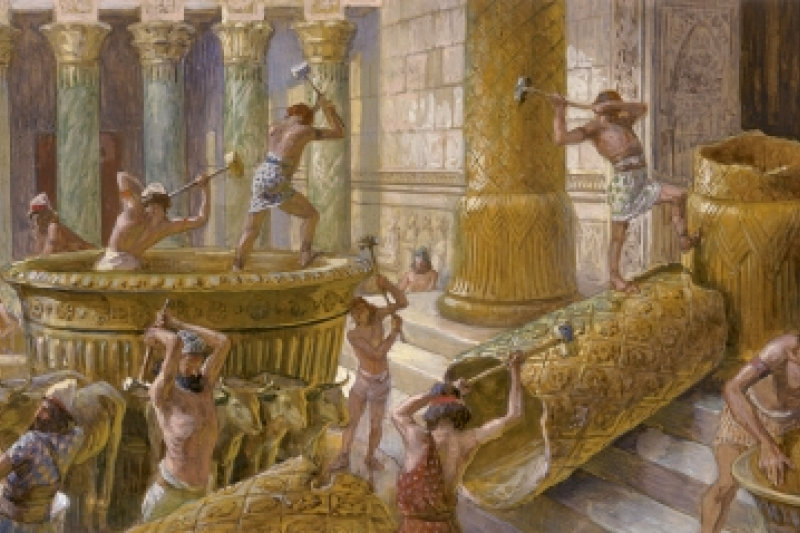
After the looting of Jerusalem and the Jewish Temple, the Ark of the Covenant completely disappears from the Biblical record. Though many of the items in the temple are listed as being taken back to Babylon, the Ark of the Covenant is strangely missing from this list Jeremiah 52:17-23.
There are many theories as to what happened to the Ark. Some believe that before Jerusalem’s fall, the Jewish priests hid the ark in the catacombs and caves located below the temple. When these priests were either killed or hauled off into captivity, the record of the ark’s location disappeared with them (Jeremiah 52:24-27).
But, Jews living closer to that time accused Jeremiah of stealing the ark because he not only had motive, but opportunity as well.

 OpentheWord.org
Leave a comment