

Credit: Wikipedia, CC BY-SA 3.0
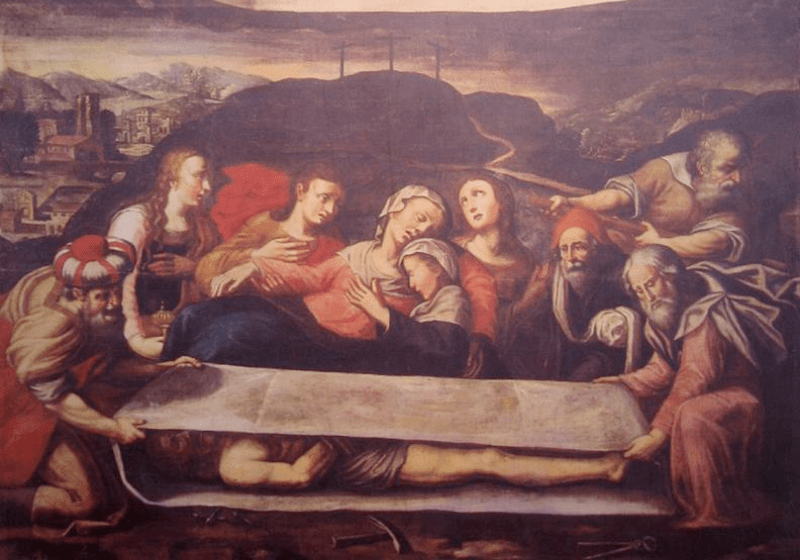
Though the Roman Catholic church has never publicly stated its position on the Shroud of Turin, that first popped up in the 1350s, it has been widely promoted as the burial cloth that Jesus was wrapped in after His death mentioned in Matthew:
“And Joseph took the body and wrapped it in a clean linen cloth, and laid it in his own new tomb, which he had cut out in the rock; and he rolled a large stone against the entrance of the tomb and went away.”
Matthew 27:59-60
The cloth has a faint image of a man burned into the cloth that believers say took place at the moment of Christ’s resurrection.
This image also shows evidence that the person was crucified with markings in the hand and feet as well on the back that revealed the scourging that Jesus received at the hands of the Romans. There are even marks on the head which revealed where the Romans mockingly stuck a crown made of thorns on Christ’s head. They have even found human blood embedded in the cloth.
The Holy Shroud, which has been at San Giovanni Battista Roman Catholic Church in Turin, Italy since 1578, has been analyzed over the years with conflicting results.
The cloth was made from flax that originated in the Middle East and while Carbon 18 analysis of the cloth from the 1980s revealed it was made in the 1300s, a more recent study concluded that the cloth was made in the first century coinciding with Christ death and resurrection, the Daily Mail reports.
Researchers at Italy’s National Research Council’s Institute of Crystallography used a wide-angle X-ray which analyzes the aging process of the barley used in the manufacture of the cloth. They then compared it to cloth that was known to have originated in the Middle East in the first century.
The study concluded, ‘The data profiles were fully compatible with analogous measurements obtained on a linen sample whose dating, according to historical records, is 55-74 AD, found at Masada, Israel.‘
They also compared the breakdown with similar cloth manufactured in the 13th century and found no match.
The researchers added that the dating from the 1980s was inaccurate most likely due to the contamination of the cloth over the centuries.
While we will never know for sure if this is Christ’s burial cloth, an analysis of the blood by the Institute of Crystallography in Bari, Italy, the Istituto Officina dei Materiali in Trieste, Italy and the Department of Industrial Engineering at the University of Padua in 2017 came to some startling conclusions.
The results, which were published in PlosOne, found that the blood contained high levels of ferritin and creatinine. This is not normal for human blood and only show up in higher quantities when inviduals have experienced severe truama, which would include torture.
“Hence, the presence of these biological nanoparticles found during our experiments point to a violent death for the man wrapped in the Turin Shroud,” said Glulio Fanti from the University of Padua.

 OpentheWord.org
Leave a comment