
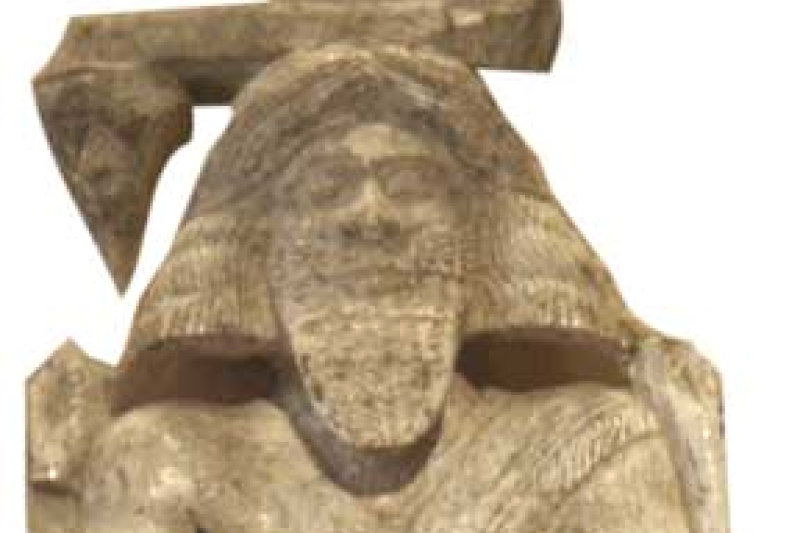

Credit: Biblical Archaeology, Wikipedia, Public Domain
A unique tool using the Earth’s magnetic field has confirmed an ancient battle recorded in 2 Kings 12:17, when King Hazael of Aram sacked the Philistine city of Gath, CBN reports.
Much of the city was destroyed and burnt during Hazael’s successful siege.
Though archaeologists found evidence of burnt bricks in the wall, there were questions on whether it was evidence of a battle, or simply the burning that comes with manufacturing bricks via a kiln.
If the latter was the case, it was argued that at some point the city was abandoned and simply collapsed on its own over time.
However, researchers from Israel’s Bar-Ilan University, Ariel University, and the Hebrew University of Jerusalem were able to confirm that the burning and destruction of the city was the result of a battle, confirming the Biblical record.
They were able to determine this because the mud used to manufacture bricks contains ferromagnetic particles that align with the earth’s magnetic field when heated.
If the bricks burning came via a kiln, the magnetic field would all be aligned in the same direction. However, when the workers inserted the bricks into the wall, this random placing would result in the magnetic fields pointing in all different directions.
If the bricks were already cemented into the wall when the heat was applied as a result of burning associated with a siege, then the magnetic fields would all be going in the same direction.
The archaeomagnetic examination of the bricks found that the magnetic fields were locked in the same direction, confirming that they were in place when the firing took place. This was evidence that the city had been destroyed as a result of a siege, with the Bible providing a record of who was responsible for Gath’s destruction.
The researchers were also able to determine, that the bricks at the top end of the wall experienced significantly higher levels of heat than those at the lower end. Again, this falls in line with burning from a siege fire, as bricks fired in a kiln would have more consistent levels of heating.
According to Wikipedia, archaeologists also found the remains of ancient siege systems at the site including trenches and berms (earth embankments), which King Hazael would have used when he attacked the city. This along with pottery and other findings dates the destruction of Gath to the time of King Hazael who ruled between 842 and 796 BC.




 OpentheWord.org
Leave a comment