
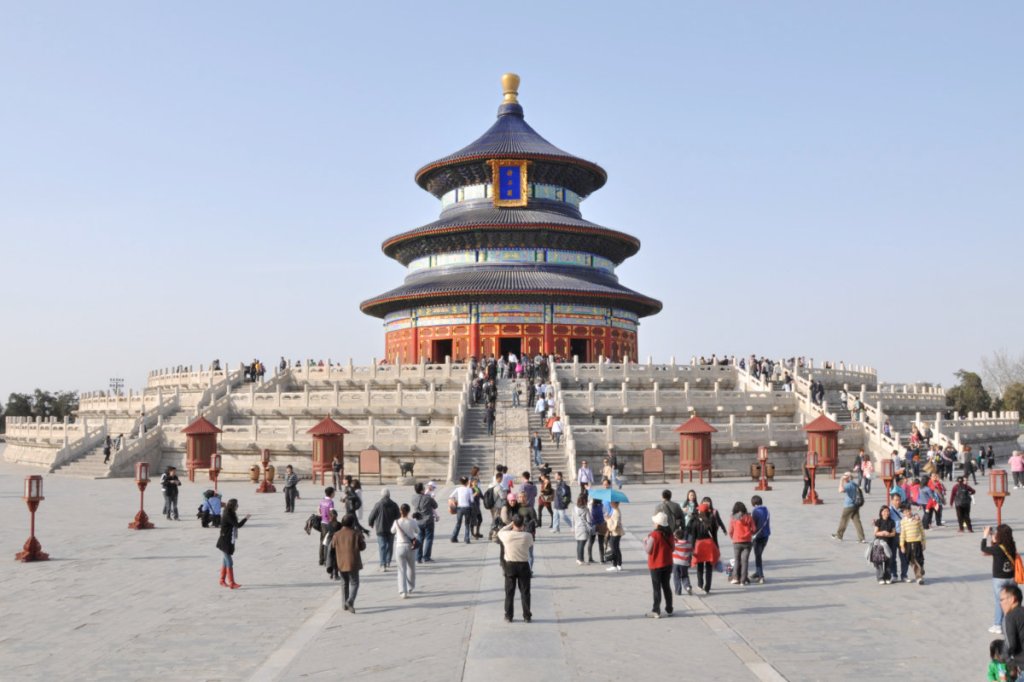
Credit: Charlie Fong/Wikipedia/Public Domain
- ESPAÑOL: Jehová en la antigua China?
Though there is a massive underground church in Communist China, we often look at its religious roots as being based on Confucianism, a philosophical approach to harmonizing life, family, religion, culture, and politics that developed around 550 BC.
However, in an article for Christianity Today, Jixun Hu, who pastors East Bergen Christian Church in New Jersey, writes that China’s earliest religious roots have many parallels to Judaism. This includes the discovery of ancient bronze vessels which depicted the sacrifices of oxen and sheep thousands of years ago, similar to what we find in the Old Testament.
But in particular, Hu cited an incident that took place during a great drought in 1585, when Emperor Wanli of the Ming dynasty went to the Temple of Heaven to pray for rain.
Prior to going to the temple to pray to the ‘God of the Highest Heaven’, Emperor Wanli and his officials fasted for three days (see Esther 4:16). Once they were at the temple, Wanli prostrated himself before the ‘God of the Highest Heaven’ and confessed his failures, prayed, and offered animal sacrifices and incense to the God of the Highest Heaven.
The failures that Wanli expressed were noted in a speech he delivered to his officials while at the Temple of Heaven. In it, he stated that the country was being judged for the government corruption that was taking advantage of the common people, and believed they, including himself, were responsible for this.
However, during his speech, the emperor also used a particular phrase, the ‘God of the Highest Heaven’, “(皇天上帝, huang tian shang di)” to refer to God, a term that many modern Chinese Bible translations use today to refer to God.
And what caught Hu’s attention was a song of praise that Emperor Wanli and his group sang to ‘God of the Highest Heaven’ while at the temple.
Hu noticed that it was very similar to what we find in the first few verses of Genesis chapter one:
| Emperor Hu’s ancient Chinese praise song: | Genesis 1:1-5, NIV | |
| Of old in the beginning, there was the great chaos, without form and dark. The five elements [planets] had not begun to revolve, nor the sun and the moon to shine. In the midst thereof there existed neither forms nor sound. Thou, O spiritual Sovereign, camest forth in Thy presidency, and first didst divide the grosser parts from the purer. Thou madest heaven; Thou madest earth; Thou madest man. All things with their reproducing power got their being. | 1 In the beginning God created the heavens and the earth. 2 Now the earth was formless and empty, darkness was over the surface of the deep, and the Spirit of God was hovering over the waters. And God said, “Let there be light,” and there was light. 4 God saw that the light was good, and he separated the light from the darkness. 5 God called the light “day,” and the darkness he called “night.” And there was evening, and there was morning—the first day. |
None of this should really surprise us.
The Bible tells us that the Tower of Babel became a defining moment in human history. This is where the world was divided into different languages and cultures (Genesis 11:7).
Though each nation developed its own unique history after this point, everything before Genesis 11 would still be common history to all cultures including creation and the flood.
This is why we find mention of a worldwide flood in nearly every culture around the world from Australian aborigines, to African cultures and indigenous tribes in South and North America.
READ: Ancient Chinese Sacrificial Rituals Resemble Those of the Israelites. Does This Matter?

 OpentheWord.org
Leave a comment