

Passover (Easter to some) is almost upon us again, and it’s time to reflect on God’s great gift for all of Adam’s lost children, Jew and Gentile alike. Old Testament prophecies and New Testament accounts of Christ’s death and atonement on the cross show very clearly who is to blame.
“For all have sinned and fall short of the glory of God, being justified freely by His grace through the redemption that is in Christ Jesus.” (Romans 3:23-24) All of us – rich, poor, Jew, Gentile, even Rembrandt, and me – we are all the cause of why “For God so loved the world that He gave His only Son” (John 3:16).
We are all guilty of putting Him on the cross so that we can all share in God’s redemption through it and be at peace with God. But how does Rembrandt fit into this.
Rembrandt (1606 – 1669) was one of the greatest classical Dutch painters. He had personal flaws like any of us, but he embraced the Reformation and his Christian values show in his work and life.
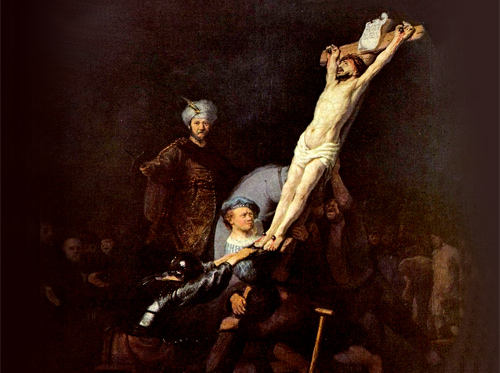
One of his paintings stands out to me as a favorite. It is called The Raising of the Cross, and was painted in 1633 for Prince Frederick Henry of Orange. What makes this painting so special to me at Passover is his personal statement done in oils.
In the painting, several people are seen helping, or standing in acceptance, during the raising of Christ on the cross. A religious/political leader, a soldier, a common person, and then, one person who does not fit – a self-portrait of Rembrandt himself in his 16th century clothes and painter’s cap.
Rembrandt is clearly identifying himself with putting Jesus on the cross, and demonstrates his personal need of a Saviour. 1500 years after Jesus’ death and resurrection, it was Rembrandt’s face in the painting – 500 years later, it could just as easily be yours or mine.



 OpentheWord.org
Leave a comment