

ESPAÑOL: El gran y oscuro secreto del Rey David
There was a big, dark secret in David’s life that few people are aware of. It’s not that David tried to keep it secret, but many of us simply fail to connect the dots.
When we study David’s life, there are a number of Biblical passages that at first read seem quite puzzling. One such passage is 1 Samuel 16:1-13.
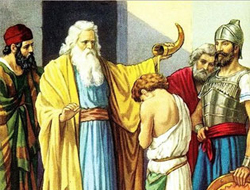
God had just rejected Saul as king of Israel and commissioned the prophet Samuel to anoint one of the sons of Jesse of Bethlehem as the next king (v 1). Samuel approached the elders of Bethlehem and arranged the meeting. Once Jesse and his sons had gathered, Samuel quickly realized none of the boys standing before him was the one God had chosen.
Puzzled, Samuel asked if there were any other sons and was told the youngest, David, was attending the flock. Samuel ordered David brought before him and anointed the young shepherd boy as the next king of Israel.
I was always curious as to why David was not initially included. Traditionally, most believe David was omitted because he was the youngest, but I don’t believe this theory holds up under closer scrutiny of the Biblical account.
When Samuel first approached Bethlehem’s elders, the Bible tells us they were “trembling” (v 4). They were terrified of the prophet. When he said jump, the only pertinent question was how high.
So when Samuel requested a special meeting with Jesse and his sons, all were expected to show up. There must have been some convincing reason not to extend an invitation to David.
Why was David excluded?
I believe David actually provides the answer to this question in Psalm 51 penned in the chaotic aftermath of his adulterous affair with Bathsheba.
In verse 5, King David wrote: “Behold I was brought forth in iniquity and in sin my mother conceived me.”
So what was David trying to tell us in this verse?
Traditionally, most believe David was explaining his affair was due to the sin nature that plagues all mankind because of Adam and Eve’s original sin. However, this does not explain why David committed adultery (though all humans have the same sin nature, not all commit adultery).
Setting aside all fancy theological interpretations, we need to interpret verse 5 simply as it reads — “in sin my mother conceived me” means exactly what it says — David’s mother conceived him in an act of sin. She committed adultery and David was the byproduct of this infidelity.
This explains why David was not initially included in the meeting with Samuel as technically it could be argued David was not a true son of Jesse. However, God did include David as part of Jesse’s family much in the same way Jesus was considered a son of Joseph though conceived by the Holy Spirit.
Who was David’s mother?
This is where it gets interesting. No where in scripture is David’s mother mentioned by name. This is a bit unusual, as mothers of several ancient prophets and patriarchs are not only mentioned, but many times written about, as they often played a significant role in the upbringing of their children — such as Moses’ mother Jochebed (Exodus 6:20) and Samuel’s mother Hannah (1 Samuel 1:1-20).
However, David’s mother was different — as a wife who committed adultery, she brought shame upon Jesse and his family and it’s not surprising her name was excised from the Biblical account.
There are several possibilities on what happened here — Jesse’s wife had an affair with another man or Jesse had an affair with another woman (married or unmarried).
Perhaps David’s mother was a prostitute. It was not uncommon for children born from such an illicit relationship to live with the father.
In the book of Judges, we have a story about Jephthah who was conceived when his father Gilead had sexual relations with a prostitute.
11 Jephthah the Gileadite was a mighty warrior. His father was Gilead; his mother was a prostitute. 2 Gilead’s wife also bore him sons, and when they were grown up, they drove Jephthah away. “You are not going to get any inheritance in our family,” they said, “because you are the son of another woman.” (Judges 11:1-2 NIV)
Though conceived through this illicit encounter, Jephthah nevertheless grew up in Gilead’s house who took responsibility for raising the child.
But Jephthah’s arrival created a tremendous tension with the sons born of the true mother. They eventually drove Jephthah out of the family to prevent him from receiving any of his father’s inheritance (v 2).
If David’s mother was also a prostitute it would explain why she wasn’t mentioned and I suspect it was the brothers who pushed not to have David included when Samuel called for a meeting with the sons of Jesse.
David’s miserable early life
David refers to his mother one more time in Psalm 69 which — next to Psalm 22 — is the most quoted Psalm in the New Testament. It is generally believed Psalm 69 covers David’s early life prior to his anointing by Samuel.
In verse 8, David writes: “I have become estranged from my brothers, And an alien to my mother’s sons.”
It is interesting how David seems to talk about two groups of children. He was estranged from his brothers (Jesse’s family) and an alien to his mother’s children. It implies both sets of children rejected David supporting the idea that his mother was either a prostitute (with other children) or possibly another married woman whose husband rejected David, forcing Jessee to look after his illegitimate son.
According to Strong’s dictionary, the Hebrew word for estranged “zur” means to “turn one aside from lodging” and can also refer to a person who has come from “adultery – to come from another man” or another woman. In fact, the word is rooted in the Hebrew word “mamzer” which means bastard or illegitimate.
Zur intimates David was not included in regular family activities such as meals. In fact this may be what verse 21 suggests when David says they gave me “gall for food” and “vinegar to drink.” It appears the brothers made David’s life miserable.
One thing oddly missing in Psalm 69 is any mention of David’s relationship with Jesse. Not once did David point to Jesse as the source of his misery. Neither do we see any hint of conflict when Jesse asked David to take food to his brothers who were fighting the Philistines, but as soon as David showed up at the army camp, you immediately see the animosity between David and his brothers (1 Samuel 17: 28-29).
The conflict between David and his half-brothers indicates it may have been the brothers who demanded David not be included in the meeting with Samuel.
Psalm 69 also addresses the misery David endured growing up. Because of his mother’s sin, David’s childhood was full of loneliness and rejection. He speaks of hours spent crying because of the rejection (v 3). He explains his frustration of being punished for a sin he did not commit (v 4) – his mother’s sin. Worse, he became the object of mockery as the drunkards sang about his plight (v 26).
David’s life also became a byword or proverb — literally a living warning — of what happens to those whose mother commits adultery.
“When I made sackcloth my clothing, I became a byword to them. Those who sit in the gate talk about me…” (v 11b, 12a)
What was particularly hurtful was those who “sit at the gate” used him as an example (v 12) of what happens when people sin. The term “sit at the gate” refers to the elders of the city who sat at the gates and made judgment on cases (see Proverbs 31:23; Deuteronomy 21:19; 22:15). These would be the same elders of Bethlehem who did not think it necessary to include David when Samuel wanted to meet with Jesse and his sons.
David then adds he carried the personal shame of his mother’s sin.
You know my reproach and my shame and my dishonor; All my adversaries are before You. Reproach has broken my heart and I am so sick And I looked for sympathy, but there was none, And for comforters, but I found none. (v 19, 20)
No one cared that David was the innocent byproduct of his mother’s sin. It was Jewish belief children could be punished for the sins of the parents. We see a hint of this in the gospels, when the disciples — after stumbling upon on a blind man — asked Jesus if he was being punished for the sins of his parents or his own sins (John 9:2,3).
Though despised and rejected by his family and humiliated by those in his home town, God saw David’s heart and how he responded to the rejection and the ugliness that filled his childhood and chose this boy as the next king of Israel.
Through this we gain a keen insight in the redemptive nature of God, who will use anyone despite their background and heritage as long as they have a heart for God. — EZ
More in the Tabernacle of David series:



 OpentheWord.org
Leave a reply to P. V. Cherian Cancel reply