
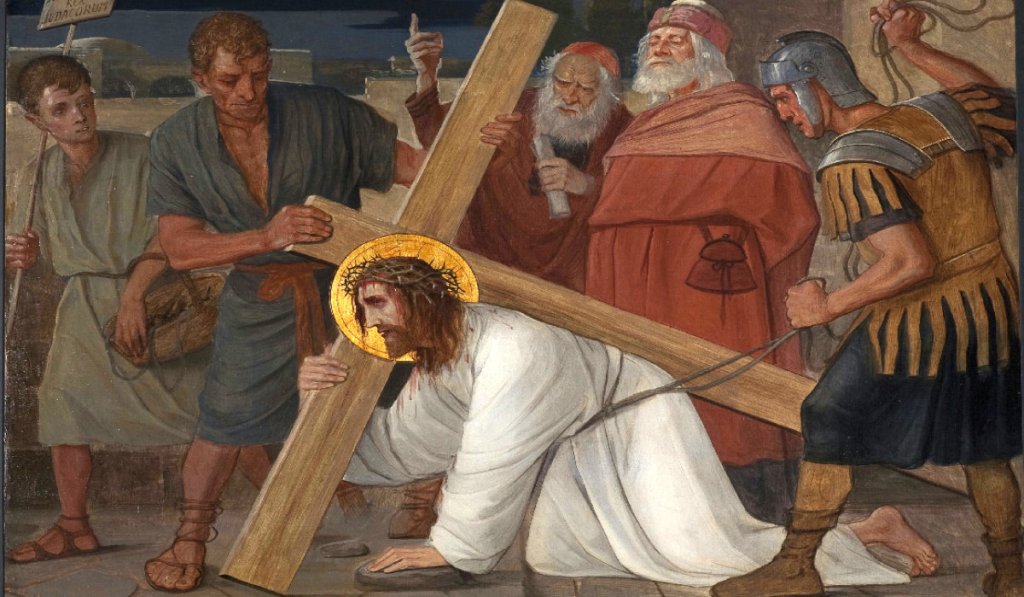
As Jesus was being led away to His crucifixion, the Romans forced Him to carry the cross on which He would be crucified (John 19:17). This was typical Roman behavior.
But somewhere along the journey to Golgotha, Jesus, who had been brutalised by the guards, was no longer able to continue.
At that point, the Romans grabbed an innocent bystander, a man named Simon of Cyrene, and forced him to carry Christ’s cross for the remainder of the journey. Simon was from the ancient city of Cyrene, which was located in what is now Libya. He was probably in Jerusalem for Passover..
Three of the Gospel writers—Matthew, Luke, and Mark—describe the incident. Since all three knew Simon’s name and where he was from, this suggests that they had more than a passing acquaintance with him.
Mark then adds even more tantalizing details:
“And they compelled a passer-by, coming from the country, Simon of Cyrene (the father of Alexander and Rufus), to carry His cross.” (Mark 15:21)
Mark includes the names of Simon’s sons, Alexander and Rufus. By adding them, Mark appears to assume that his readers would have known who they were.
This suggests that they were known within the Christian community.
Although this cannot be confirmed, some have wondered whether this was the same Rufus whom Paul greeted in Romans 16:13.
Simon’s encounter with Jesus may have led him and his family to become Christians.
But this unique combination of names provided by Mark has led some scholars to suggest that the ossuary of one of Simon’s sons may have been found, the Daily Mail reports.
Ossuaries were small stone containers in which the bones of the deceased were placed after the flesh had decayed. They sometimes contained the bones of several people. It was also common practice to engrave the name or names of the individuals whose bones were inside.
In 1941, an ossuary was discovered in a tomb in Jerusalem. Etched on its exterior were the words ‘Alexander, son of Simon.’
In fact, the names Simon and Alexander appear two more times on the ossuary. It appears in one instance that the etcher made an error in his first attempt, carving Alexander’s name beside Simon’s without stating that Alexander was Simon’s son.
The etcher then carved in the correct rendering immediately below it.
The lid of the ossuary bore the Hebrew name for the city of Cyrene, QRNYT. However, this reading is disputed because the name contains a one-letter error. Even so, this would not have been the first mistake the carver made on the ossuary.
Items found inside the tomb indicate that it dates to sometime before 70 AD.
Although Simon and Alexander were both common names at the time, this combination of names, together with the reference to Cyrene and the date, has convinced New Testament scholar Dr. Jeremiah Johnson that these may be the same two men mentioned in the Bible.
“So we have a Simon, a son named Alexander, and a Cyrenian family, buried in Jerusalem in the right period, before 70 AD. Is it the same family? I think it is very plausible, if not likely,” Johnson told the Daily Mail.
“What is not in doubt is what Mark is doing. He names Simon’s sons because his first readers knew them,” Johnson continued.
Johnson then discussed the additional significance of the two names.
“He is pointing to living witnesses who could confirm the story,” Johnson said. “Ancient legends don’t work that way. Eyewitness history does. And this ossuary shows that Mark’s details fit real people in real Jerusalem.”
Another expert on Jewish names, Tal Ilan, previously stated that it was ‘very likely’ that the name on the ossuary belonged to the same individual mentioned in the Gospel of Mark.




Leave a Reply