
FOLLOW OUR PODCAST ON (search opentheword):
- Spotify
- Apple Podcasts
- iHeartRadio
- Listen Notes
- TuneIn
- Podchaser
- YouTube Music Podcasts (audio)
- Amazon podcasts
PODCAST NOTES:
Hi, my name is Dean Smith.
Many have questioned the account of the ten plagues that God unleashed during the Hebrews’ exodus from Egypt because they are not mentioned in Egyptian records.
But that is simply not the case. In fact, the plagues may have been mentioned, but we have to look about three hundred years earlier to find them.
First there is the Ipuwer Papyrus which describes several events that resemble the plagues. However, it was simply a letter written by a concerned Egyptian citizen to government officials.
We also have an official Egyptian record of at least one of the plagues: the “Ahmose Tempest Stela” also known as the “Storm Stela.” It seems to describe the ninth plague.
A stela is an upright slab of rock used to commemorate significant events in a nation’s history.
Many Christians have traditionally believed that Rameses was the pharaoh of the Exodus. Although several blockbuster movies support this perspective, these two artifacts have many questioning whether Rameses was the pharaoh of the Exodus.
They suggest that Israel’s exodus from Egypt may have taken place at least three centuries earlier.
Many now believe the Exodus story actually started with the arrival of Pharaoh Ahmose. Around 1550 BC, Ahmose drove out the Hyksos, who had invaded the northern Nile delta about two hundred years earlier and forced the Egyptian government to move south.
Some believe Ahmose was the new Egyptian king mentioned in Exodus 1:8 — the king who did not know Joseph and eventually enslaved the Hebrews who had arrived during the Hyksos reign.
Like the Hebrews, the Hyksos were Semitic, so the two groups shared a similar culture and language. This could explain why Joseph so easily rose to power and why his family was allowed to settle in the land.
Fragments of the Ahmose Stela were discovered between 1947 and 1951. In his article ‘Proof for the Biblical Exodus,’ Simcha Jacobovici writes that two professors from the University of Chicago’s Oriental Institute—Robert Ritner and Nadine Moeller—translated the hieroglyphic inscriptions on the slab in 2014.
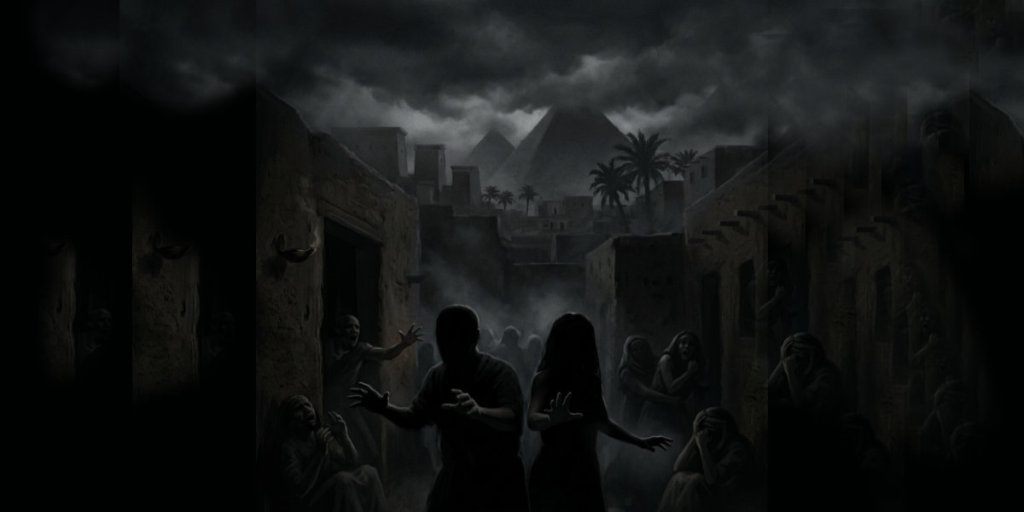
According to the two professors, the stela describes a massive darkness that occurred in Egypt. It was so unusual that it warranted its own memorial.
The stela records that the darkness was so intense that the Egyptians could not see people standing beside them. It also said the darkness was so heavy that the Egyptians were unable to light torches. The inscription literally states, “No torches could be lit in the two lands”, apparently referring to Upper and Lower Egypt.
Now compare this description with the ninth plague described in the Book of Exodus:
21 Then the Lord said to Moses, “Stretch out your hand toward the sky, that there may be darkness over the land of Egypt, even a darkness which may be felt.” 22So Moses stretched out his hand toward the sky, and there was thick darkness in all the land of Egypt for three days. 23They did not see one another, nor did anyone rise from his place for three days, but all the sons of Israel had light in their dwellings. (Exodus 10:21-23 NASB)
Notice how the darkness is described as being so thick that it could be felt. It was also so dark that people could not see each other.
While the stela states that the Egyptians were unable to light their torches, the Bible says that the Hebrews had light in their dwellings. The wording seems to suggest that the Egyptians did not. What would be unusual about the Hebrews having light in their dwellings if the Egyptians also had light?
There is, however, one notable difference. The stela says that the darkness lasted seven days, while the Bible says that the thick darkness lasted three days. The emphasis on the ‘thick darkness’ may suggest that it began to lift after the third day.
The stela adds that a massive storm struck Egypt in conjunction with the darkness. It was so severe that it flooded temples dedicated to the Egyptian gods and apparently washed some of them away. Death was everywhere, and bodies were seen floating down the Nile. The stela also says that every household was affected by death.
It is difficult to say, but this may refer to the seventh plague, which involved a devastating storm of hail and rain that killed many.
23 Moses stretched out his staff toward the sky, and the Lord sent thunder and hail, and fire ran down to the earth. And the Lord rained hail on the land of Egypt. (Exodus 9:23 NASB)
Perhaps the most significant statement on the stela concerns whom it blamed for the catastrophe. According to Ritner and Moeller, the inscription attributes the catastrophe to a singular ‘god’ who was more powerful than any of the Egyptian gods.
And this was exactly the intent of the plagues. When Pharaoh first refused to allow the Hebrews to leave, Moses warned him:
“May it be according to your word, that you may know that there is no one like the Lord our God. (Exodus 8:10 NASV)
In their report, the two professors believe the stela portrayed actual events that took place in Egypt. It other words they did not view it as a metaphor.
They attributed the darkness to a massive volcanic eruption on the Mediterranean island of Thera. Although they presented evidence that Ahmose’s reign and the volcanic eruption occurred at roughly the same time, many researchers believe the two events were separated by hundreds of years.
Once again, we see how archaeology confirms the Bible. Thanks for joining me on this podcast and I will catch you again.





Leave a Reply