
FOLLOW OUR PODCAST ON (search opentheword):
Podcast Notes:
ESPAÑOL: La extraña conexión entre la historia de Navidad y la mujer sorprendida en adulterio
Hi my name is Dean Smith and with Christmas around the corner, I thought I should do a podcast with a bit of Christmas twist.
So, I want to discuss the strange connection between the Christmas story and the woman caught in adultery.
We know from the Christmas story, that Joseph was engaged to Mary. When Joseph returned to Nazareth for the wedding, he was shocked to find Mary pregnant – having conceived by the Holy Spirit.
Though Joseph initially intended to send Mary away, he changed his mind after an angel spoke to Joseph via a dream telling him of Mary’s divine conception and encouraging Joseph to go through with the marriage in Mathew 1:18-25.
But with Mary showing signs of pregnancy so soon after the wedding, the village wags would have been very suspicious.
The gossip would have been all that more juicy considering Joseph had not been around.
But several things muddied the waters. First, Joseph continued on with the wedding. Normally, in similar situations the outraged husband would have nothing to do with his bride to be.
Secondly, Mary visited her cousin Elizabeth (mother of John the Baptist) for three months (Luke 1:39-56). Finally there was the census requiring Joseph to return to his home town — Bethlehem – where Jesus was eventually born.
But don’t kid yourself, people would have been suspicious and we even see this being hinted at in Mark 6:3:
“Isn’t this the carpenter? Isn’t this Mary’s son and the brother of James, Joseph, Judas and Simon? Aren’t his sisters here with us?” And they took offense at him.” (NASV)
What is so strange here is that the people of Nazareth referred to Jesus as the son of Mary, not the son of Joseph. Even though Joseph was probably dead at this point, a child was traditionally referred to as the son of the father.
In Jewish culture referring to someone as the son of the mother was an intentional slur. We see that at play in the story of Jephthah in Judges 11:1-2. His father, Gilead was married and had several children through his wife.
However, Gilead had a dalliance with prostitute which produced Jephthah.
After the father died, the others sons drove Jephthah from the family home. While doing so, they purposefully referred to Jephthah as his mother’s son, to emphasize the fact she was a prostitute and his illegitimacy.
So it seems the rumors of Mary’s infidelity were still circulating and could potentially harm Jesus’ credibility in the Jewish community.
This is because we read in Exodus 20:4-5 that the iniquity of the parents would be passed down on the children for three to four generations. In Jewish culture, it was believed the sins of parents transferred to the children. If Mary was a fornicator, Jesus was guilty by association.
With Christ’s growing popularity, the Jewish leaders were desperate for ways to discredit Christ. Any slander they could dig up about Mary would certainly do the trick.
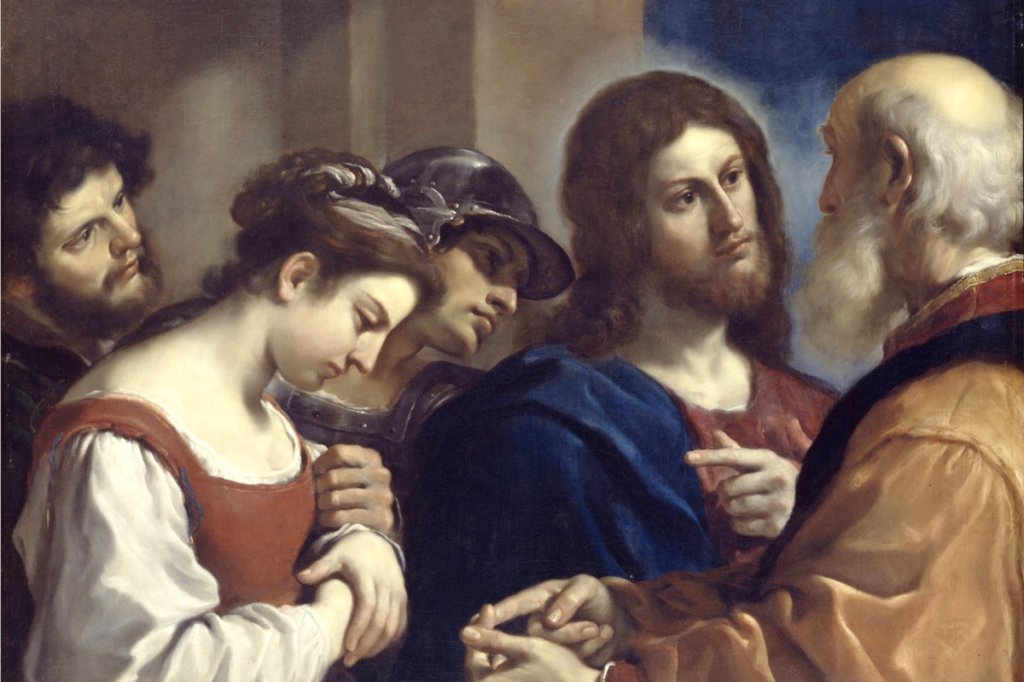
I believe this was behind their decision to drag the adulterous woman before Jesus while He was at the Temple in John 8.
John adds that the purpose of this confrontation was so the Pharisees “might have grounds for accusing Him” (v 6). But we are not clear at this point what these accusations involved.
When the pharisees asked Jesus if the woman should be stoned according to the law of Moses (v 5), the Lord diffused the situation by stating, “He who is without sin among you, let him be the first to throw a stone at her” (v 7).
We are told that the woman’s accusers skulked on their own volition.
I believe they intended to use this adulterous woman as a way to launch their accusations against Mary and against Christ.
If Jesus had tried to defend the woman or say she was forgiven, this would be an opening for the pharisees to accuse Jesus of letting her off because His own mother was guilty of the same sin.
But Jesus never gave them the opportunity as they slithered away on there own accord.
But the accusers regrouped and for next forty-six verses from verses 13 to 59, they engaged in an intense confrontation with Jesus which exposed their real agenda.
The First accusation: Where is Your father.
The first accusation occurs in verses 16-19, when Jesus said that He testifies of His Father — God.
The Pharisees responded,
We read:
“So they were saying to him, ‘Where is your father?’” (v 19).
Notice how John writes that multiple Jews were repeatedly asking Christ, “Where is your father?” There were many of them making this accusation.
We have to picture the situation as it was occurring. It was a confrontation. On one side were Jesus and His disciples and on the other a group of angry Pharisees and scribes aggressively trying to discredit Christ.
While Jesus was speaking, several were interrupting and shouting out, “Where is your father?” “Where is your father.”
This was not a peaceful discussion.
But did you notice the way they phrased it. They weren’t asking “Who Jesus’ Father was”, they were asking “Where He was.”
Doe this imply that the pharisees believed they knew already who Christ’s father was?
Jesus responded by saying that they had no idea who Christ’s Father was.
The Second Accusation: We are not born of fornication
Then a few minutes later, when Jesus questioned the pharisee’ lineage as descendants of Abraham, because of their failure to recognize Christ as the Messiah, the Pharisees countered with, “We are not born of fornication” (v. 41).
That was an odd defense. They were all true blooded Jews. At this point, they were not defending their lineage but now directly questioning Christ’s lineage.
The Third Accusation: Jesus’ Father was a Gentile
The conversation was getting heated. The pharisees finally tired of dancing around the issue and they finally just blurted out exactly what they were thinking.
We read:
“Do we not say rightly that you are a Samaritan and have a demon?,” (v 48 NASV).
This would not be the last time they accused Jesus of being demon possessed (see Mathew 12:22-32).
But what is new here is the accusation that Jesus was a Samaritan.
The Samaritans were people of mixed lineage – half Jew and half Gentile that emerged during the Assyrian captivity when the Assyrian king displaced many of the Jews living in Samaria and replaced them with Gentiles. These foreigners intermarried with the remaining Jews resulting in the formation of the Samaritans, who were utterly despised by the Jews.
Since both Mary and Joseph were full-blooded Jews, it doesn’t take much to read between the lines. The Pharisees were not only accusing Mary of fornication, but were actually accusing her of having an illicit affair with a gentile.
And the words, “do we not say rightly” tells us they were not joking, they were dead serious about this accusation.
During this intense confrontation, the disciples had a front row seat.
They would not have missed the insinuations they were making about Mary. If Mary was a fornicator, Jesus was equally guilty of his mother’s sin.
As Jesus and the disciples walked out the temple after this intense confrontation, they came upon a blind man begging for money.
Without thinking, the disciples blurted out:
“Rabbi, who sinned, this man or his parents, that he would be born blind?” (John 9:2 NASV)
Jesus answered neither and said it was so God’s work could be manifest in the man and then Jesus healed the blind man (v 1-41).
These accusations and slurs about Mary showed up early in Christ’s ministry, but they quickly faded away as Christ moved with power.
The pharisees and scribes were quickly overwhelmed by the flood of healings and deliverances being performed by Jesus, as God the Father confirmed His only begotten Son.




Leave a Reply