
Luke starts off Acts 12 starts off with ominous news that Herod Agrippa I (10 BC–44AD) had just executed James the brother of the Apostle John and as well arrested Peter.
The early church still in its infancy was under siege.
Appointed by the Roman Emperor Claudius, Herod Agrippa’s primary responsibility was to keep the peace. From Agrippa’s perspective this meant appeasing the Jews.
Luke high highlights this in the first three verses of chapter 12. After executing James the brother of the Apostle John, Herod ordered the arrest of Peter because, “he saw that it pleased the Jews,” (Acts 12:3).
This desire to keep the Jews happy was Agrippa’s primary motivation for arresting Peter.
But in response to this persecution, we see an increase in angelic activity. This included a rather vivid description of an angel breaking Peter out of prison. This actually resulted in Herod executing the guards in charge guarding Peter.
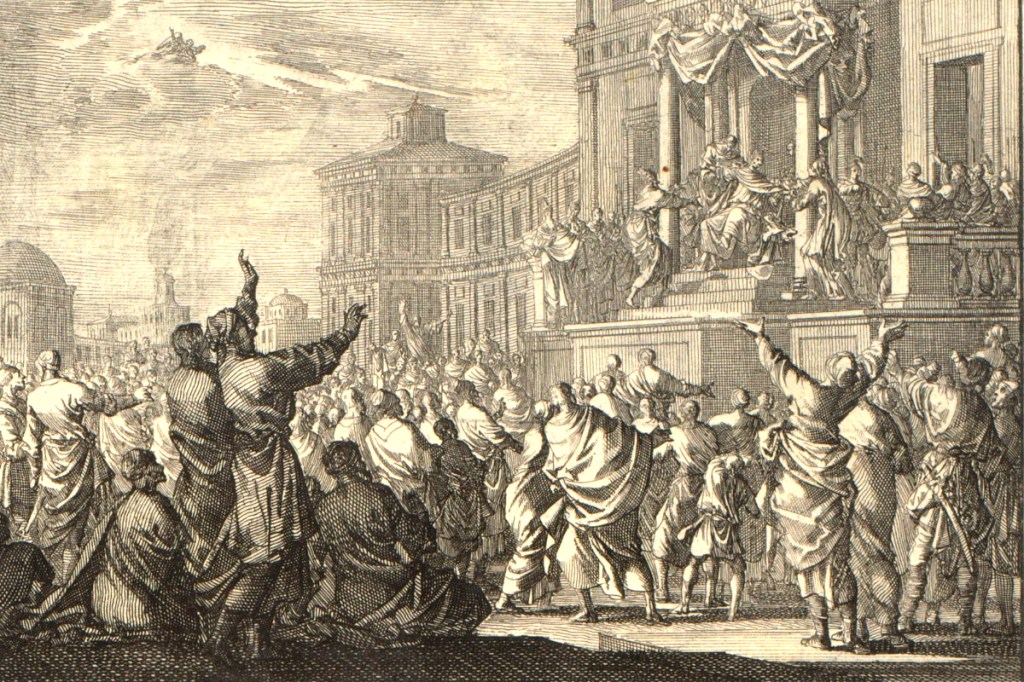
But perhaps the most dramatic account involved probably the same angel striking down Herod Agrippa while he was speaking at a public event in Caesarea .
Luke writes:
21 On an appointed day, after putting on his royal apparel, Herod took his seat on the rostrum and began delivering an address to them. 22 The people repeatedly cried out, “The voice of a god and not of a man!” 23 And immediately an angel of the Lord struck him because he did not give God the glory, and he was eaten by worms and died. (Acts 12:21-23)
The rostrum mentioned in this verse was platform from which dignitaries gave their speeches. This tells us that Herod was publicly addressing the people at Caesarea when it happened.
Herod was removed allowing the word of God to keep on “increasing and multiplying” (Acts 12:24).
This wasn’t the first time God struck down an individual. We see several instances of this including Nabal (1 Samuel 25:38) and King Jeroboam (2 Chronicles 13:20).
Josephus’ description of Herod’s death
Josephus was an ancient Jewish historian who lived between 37 AD and 100 AD. He also provided a description of Herod’s death in his book Antiquities.
He confirms Luke’s account that it took place at a public event and that Herod’s clothing seems to have sparked what followed.
The New English Translation summarizes Josephus words:
On the second day of a festival, Herod Agrippa appeared in the theater with a robe made of silver. When it sparkled in the sun, the people cried out flatteries and declared him to be a god. The king, carried away by the flattery, saw an owl (an omen of death) sitting on a nearby rope, and immediately was struck with severe stomach pains. He was carried off to his house and died five days later.
Some state that Luke’s account differs from Josephus in one important point. They suggest that Luke implied Herod was struck dead during the event, while Josephus says he died five days later.
However, all Luke said is that the fatal blow was struck as Herod was addressing the crowd. Herod’s irreversible death did not have to take place instantly.
While Josephus does not specifically cite angelic activity, he implies the divine with a reference to the owl.
It is still uncertain what caused Herod Agrippa’s death. But the mention of worms hints of a chronic problem of worm infestation linked with eating under-cooked pigs.
Others have theorized that if Herod had a major infection. If this was the case, ancient doctors often used larvae to eat away the infected and dead flesh.
However, Luke and Josephus differ in one key regard.
While Luke portrays Herod Agrippa’s death as a judgment from God, Josephus puts Herod in a more positive light.
In his book Antiquities, Josephus not only gave him the title of Agrippa the Great, he also described Agrippa this way:
“Agrippa’s character was gentle and his benevolence was equal for all. He was full of humanity for people of foreign races and also showed them his liberality, but he was also helpful for his compatriots and showed them even more sympathy”.
But historical records reveal that when Herod Agrippa died people throughout the region celebrated his death.
The Three Herod’s of the New Testament
As we read the Gospels and the book of Acts, three Herod’s are specifically mentioned. Herod was essentially the family name, much like Smith or Brown today.
Herod the Great was the one in power at the birth of Christ. He was the one who ordered the death of baby boys around Bethlehem (Matthew 2:16-18).
Herod Antipas, the son of Herod the Great, is the one who ordered the death of John the Baptist (Mark 6:14-29). He also played a role in Christ’s crucifixion when he mocked the Lord (Luke 23:6-12).
Herod Agrippa, mentioned in the Book of Acts, was the grandson of Herod the Great and the nephew of Herod Antipas.


 OpentheWord.org
Leave a comment