
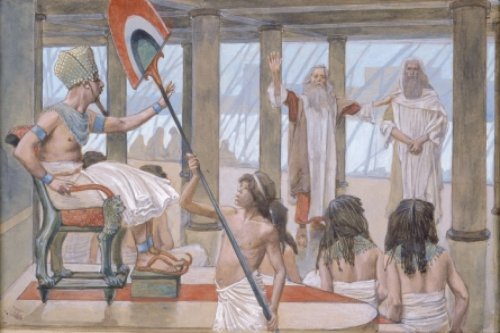
By James Tissot circa 1896-1902/Wikipedia/Public Domain
A researcher recently stated that an Egyptian inscription carved into stone at Serabit el-Khadim located on Egypt’s Sinai Peninsula refers to Moses, the Daily Mail reports.
It was part of over two dozen inscriptions found at the site of an ancient Egyptian mine in the 1990s.
After studying the inscription, Michael Bar-Ron concluded that it reads in ancient Hebrew ‘zot m’Moshe,’ which translated means ‘This is from Moses.’
It appears that it was etched into the stone before the Hebrews actual exodus out of Egypt, but while Moses was confronting pharaoh about the Hebrew’s release from Egypt.
It also indicates that Moses had become a folk hero among the down trodden Hebrews.
“I took a very critical view towards finding the name ‘Moses’ or anything that could sound sensationalist,” Bar-Ron added. “In fact, the only way to do serious work is to try not to find elements that seem ‘Biblical,’ but to struggle to find alternative solutions that are at least as likely.”
Bar-Ron studied the faded inscription over several years using 3 D scans and high Rez photos.
Some question his interpretation arguing, that Proto-Sinaitic text, which is the earliest form alphabetic Hebrew, is difficult to interpret.
However, there is general agreement that these texts were written by a Semitic people about 3,800 years ago.
Among the other inscriptions, they also found references to ‘El’ the Hebrew word for God.
In addition to this, archaeologists have also discovered references to the Egyptian goddess, Hathor and even Baal.
The curious thing about these inscriptions is that it seems they were deliberately scratched out at a later date. One in particular was defaced, so instead of honoring Baal, it honored El.
This shows there was a religious dispute taking place among this group of Semitic people at the time.
Other inscriptions found at the site refer to slavery and overseers again all common themes found in the Biblical narrative.
While some disagree with Bar-Ron’s interpretation, Dr. Pieter van der Veen stated that when he studied the inscription that is how he interpreted it.
“You’re absolutely correct, I read this as well, it is not imagined!”, Dr. van der Veen told the Daily Mail.
Dr. van der Veen is a professor at Gutenberg University in Mainz, Germany, where he specializes in interpreting ancient Hebrew script.
This is just another piece of evidence confirming the Exodus account from non-Biblical sources.
Below is another. It involves a recounting of the plagues that God brought upon the Pharaoh from an Egyptian perspective.

 OpentheWord.org
Leave a comment