
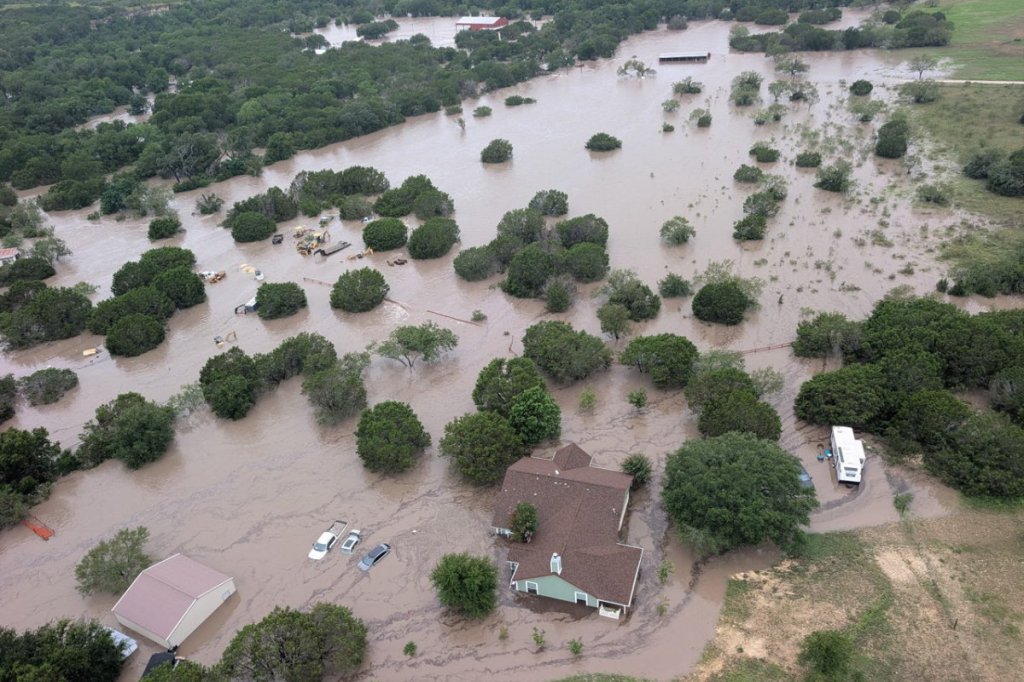
Credit: US Coast Guard, Wikipedia, Public Domain
When tragedy strikes, people often wonder why it happened. This quickly moves on to blaming someone, even the victims, for what took place.
I have done it. You may have done it.
Fox News reports that it happened after the flash flood hit central Texas on July 4, 2025 killing at last count 120 people including children at a girl’s Christian camp.
These deaths generated dozens of responses. Some even mocked the faith of those who died at the Christian camp.
Several, including professionals, responded to the tragedy on X stating that Texans voted for Trump, so they got what they deserved.
It’s highly unlikely that everyone who died in the flood voted for Trump or even the Republican Party.
But to be fair, I have been guilty of the same thing, where I thought that people got what they deserved because of their politics.
It reminds me of a rare time in the Gospels, when Jesus addressed a current event.
Some had approached Christ asking him to comment on Pontius Pilate’s killing of several Galileans in Luke 13:1-5.
The statement that their blood was “mixed with their sacrifices,” provides some background on what took place.
It seems that these Galileans had gone to the temple to make a sacrifice. However, they caused a disturbance and maybe even protested the Roman rule. It resulted in several dying when the soldiers moved in.
The ancient Jewish historian, Josephus, does not mention the Galilean incident in his books, the Jewish Wars and the Antiquities of the Jews. But, he does discuss several protests that took place during the Jewish sacrifices that turned violent.1
It seems that Jews used these sacred events to voice their displeasure with their Roman overlords.
It is uncertain why these men were asking Jesus about this particular incident. Perhaps, they were enticing Christ to publicly condemn Pilate.
But based on Christ’s response, it seems that their questions were not politically motivated.
“Do you think these Galileans were worse sinners than all the other Galileans, because they suffered these things?”, Jesus asked.
Obviously many wondered if God had judged these Galileans because of their sin.
Then Jesus brought up another tragedy that had taken place in Jerusalem. It involved the collapse of the Tower of Siloam, that killed 18.
It was a well known incident, that everyone in the crowd was familiar with. It appears that at one time there was a tower associated with the pool of Siloam (see John 9), located just outside the walls of Jerusalem. The tower may have even collapsed while under construction and was never completed.
“Do you think they were worse offenders than all the others who live in Jerusalem?,” Jesus asked again.
Jesus makes clear two points. First, the people who died were not judged for their sin. We live in a fallen world. Bad stuff happens, even to good people.
Secondly, Christ then says that just because it didn’t happen to them, does not mean they were morally superior to those who died.
“No, I tell you! But unless you repent you will all perish as well!” Jesus continued.
Simply put, none of us are without sin.
- The New English Translation provides this footnote on the passage: “several events similar to it are noted in Josephus (J. W. 2.9.2-4 [2.169-177]; Ant. 13.13.5 [13.372-73], 18.3.1-2 [18.55-62]; 18.4.1 [18.85-87]). It would have caused a major furor.” ↩︎




Leave a Reply