
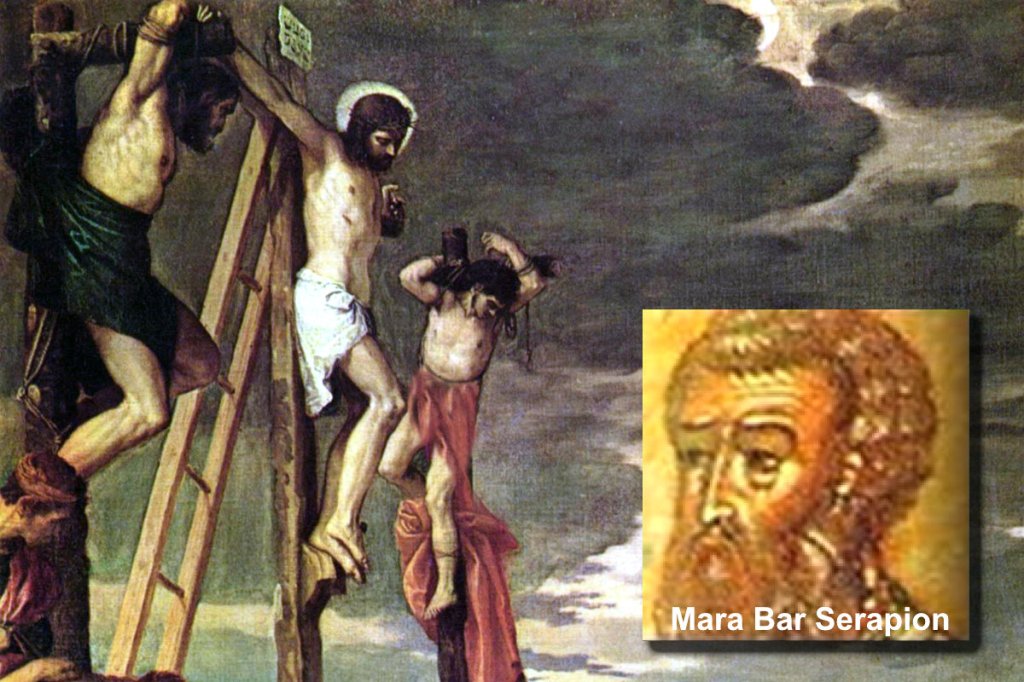

According to Bible Archaeology Report, one of the earliest references to Christ, from a non-Christian source, was made in 73 AD or about 40 years after the death and resurrection of Christ.
Mara Bar Sarapion was a stoic philosopher. He was actually in prison when he wrote a letter in Aramaic to his son Serapion where he encouraged him to embrace wisdom.
The Romans had conquered Mara’s homeland, Samosata (located in modern Turkey) in 72 AD. Historical records state that many were arrested. According to his letter, Mara was sent to a prison in Seleucia located along the Tigris river in modern Iraq.1
In his book, Jesus outside the New Testament: An Introduction to the Ancient Evidence, Robert Van Voorst provides the details of Mara’s letter.
Though he doesn’t directly mention Jesus, Mara refers to the Jews executing ‘their wise king’:
What else can we say, when the wise are forcibly dragged off by tyrants, their wisdom is captured by insults, and their minds are oppressed and without defense? What advantage did the Athenians gain by murdering Socrates, for which they were repaid with famine and pestilence? Or the people of Samos by the burning of Pythagoras, because their country was completely covered in sand in just one hour? Or the Jews by killing their wise king, because their kingdom was taken away at that very time? God justly repaid the wisdom of these three men: the Athenians died of famine; the Samians were completely overwhelmed by the sea; and the Jews, desolate and driven from their own kingdom, are scattered through every nation. Socrates is not dead, because of Plato; neither is Pythagoras, because of the statue of Juno; nor is the wise king, because of the new laws he laid down.
Most agree that this reference to a Jewish ‘wise king’ was undoubtedly speaking of Christ.
We come to this conclusion for a couple of reasons.
First, both Pilate and the Roman guards referred to Jesus as the “king of the Jews” (Luke 23:3; Matthew 27:27-29). The Romans also slapped a sign on Christ’s cross, stating “Jesus of nazareth, the king of the jews” (John 19:19).
So obviously, this is how many gentiles generally looked at Christ.
Secondly, there was the added insinuation that the Jews executed ‘their wise king.’ There was only one person in the first century who was referred to as both a king and faced execution by the Jews and that was Jesus.
Mara also tied the destruction of Jerusalem and the Jewish Temple in 70 AD to God’s judgment on the Jews for the execution of Christ. This may indicate that stories about how Christ prophesied the destruction of the temple in Matthew 24 were also in circulation.
Mara was not a Christian
Because of this obvious reference to Jesus, some have down played the letter’s significance by arguing that Mara was a Christian.
But it is apparent from his letter that he is not a believer or even a Jew as he talks about “our gods”:
“Thou hast heard, moreover, concerning our companions, that, when they were leaving Samosata, they were distressed about it, and, as if complaining of the time in which their lot was cast, said thus: “We are now far removed from our home, and we cannot return again to our city, or behold our people, or offer to our gods the greeting of praise.”
This is an obvious reference to the pagan gods that dominated the culture and the word ‘our’ indicates Mara shared the same beliefs:
We also see his stoic beliefs coming to the forefront. Stoics believed that the world operated according to logic and that God was embedded in the universe.
This is why Mara stated that the Athenians were also judged for their treatment of Socrates. This is not a belief that Christians would have held.
Mara’s theology was also a bit off. He stated that the believers lived their lives based on Christ’s new laws.
But it was Christ’s resurrection and the new life in Christ that was the driving force behind Christianity’s growth. Something, Mara would have been aware of if he was a believer.
But at the same time, Mara’s statement acknowledged that Christ was not dead because His views were still being spread by His followers in his day. This is a clear reference to the church’s growth.
It’s obvious from Mara’s letter that by 73 AD, Christianity was known across ancient Rome. Many secular people were also aware of its historical roots which included the crucifixion of Christ.
- There was also a mass arrest of Samosata citizens in 161 AD by the Parthians, but most scholars accept that Mara’s arrest took place in 73 AD. ↩︎

 OpentheWord.org
Leave a comment