
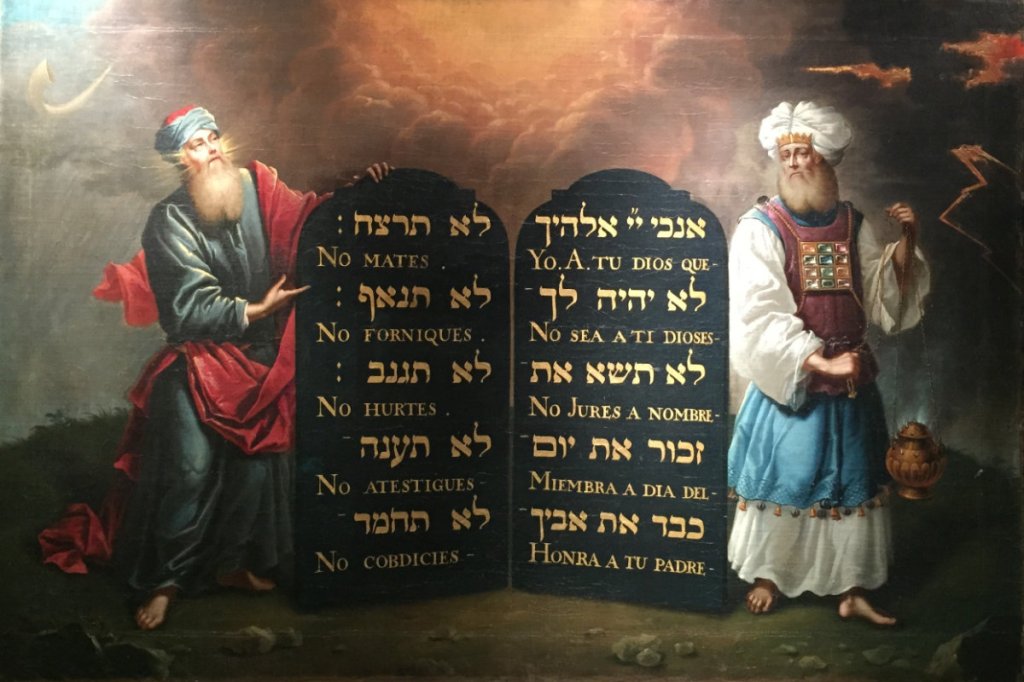

by Aron de Chavez, 1675, Wikipedia, Public Domain
A couple weeks back I watched an atheist attack Christianity. One of the things he pointed to was that Israel was ordered to execute anyone who broke the Sabbath.
But this assertion was based on a misunderstanding of Jewish law.
We have the first mention of not working on the Sabbath in the Ten Commandments listed in Exodus 20:
“Remember the Sabbath day by keeping it holy.9 Six days you shall labor and do all your work, 10 but the seventh day is a sabbath to the Lord your God. On it you shall not do any work, neither you, nor your son or daughter, nor your male or female servant, nor your animals, nor any foreigner residing in your towns.” (Exodus 20:8-10)
As you see in the highlighted section, they could not work on the Sabbath. Equally important, they could not force their servants or others to work the Sabbath as well.
Then in Exodus 31:14, Moses states that anyone who does this “is to be put to death.”
While this seems shocking at first read, modern societies hold to much the same principle today.
You wonder, what country executes people for not keeping the Sabbath?
Of course, no democracy does this.
But here is the curious fact, neither did Israel intend to execute anyone for breaking the Sabbath.
But doesn’t Exodus 31:14 say that a person who works on the Sabbath should be put to death? It does but it is based on a misunderstanding of how the Jewish legal system worked.
The Jewish law revolved around determining compensation.
We have a reference to this in Numbers 35:
“Moreover, you shall not take ransom for the life of a murderer who is guilty of death, but he shall surely be put to death.” (Numbers 35:31 NASV)
In this verse the law states that a ransom ‘could not’ be paid for first degree murder. By implication, this meant that a ransom could be paid for breaking other laws.
This meant that for the violation of every law, even those demanding the death penalty, a ransom or fine was paid. The only exception was first degree murder. A human life was too valuable to put a price tag on.
This is how Israel understood these laws. They were used to calculate payment.
This is the basis of eye for eye, tooth for a tooth that we read about in the Old Testament. The Law states that if I knocked out a person’s tooth, then my tooth would be knocked out. But I could avoid this by making a payment.
At this point, the person I hurt was holding my tooth as ransom. I had to figure out how valuable my tooth was to me, and offer compensation to keep my tooth.
A hand was more valuable than a tooth and required greater compensation. Death was the highest penalty, and of course required the greatest financial payout.
The Sabbath was a Form of Labor Law
The question we ask is why did breaking the Sabbath justify the highest penalty?
If we read the highlighted section in Exodus 20:10, it specifically says that sons and daughters, male and female servants and even the foreigners in the land must not work on the Sabbath.
This meant a King could not force his subjects to work seven days a week. A business man could not force his servants to work seven days a week. A father could not force his children to work seven days a week. Even foreigners could not be forced to work seven days a week.
This was a form of labor law that guaranteed everyone received at least one day off a week.
These rules are still in effect today and in fact have been expanded. Most countries require businesses to give their employees at least two days off a week or face significant fines.
In Israel, failure to give your servants the Sabbath day off resulted in the highest fine. This meant business owners would be reluctant to take advantage of their servants and force them to work seven days. It simply wasn’t worth it.
This is exactly the point Jesus made in Mark 2:27, when the Lord said that “The Sabbath was made for man, not man for the Sabbath.”
A day of rest was intended for our benefit.





Leave a comment