
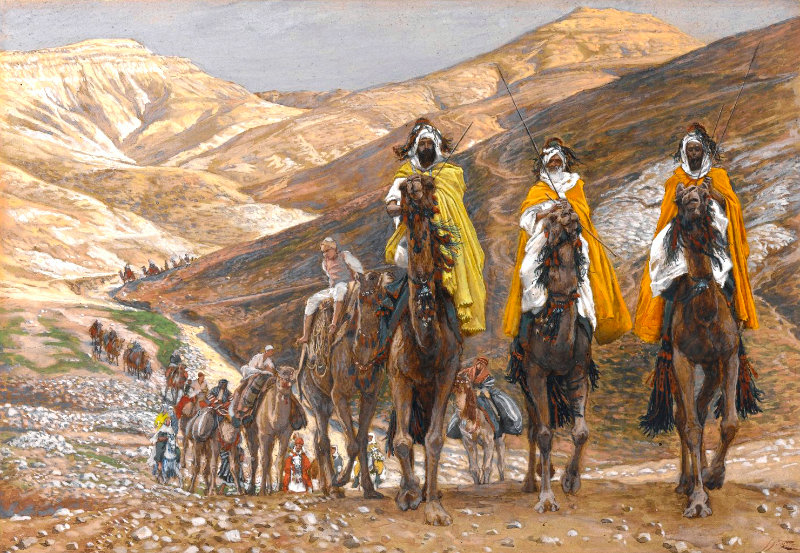
by Jame Tissot, 1890, Wikipedia, Public Domain
ESPAÑOL: ¿Qué año nació Cristo?
If Jesus was born on December 25, 1 AD, the risen Lord will be 2023 years old this Christmas. While that tradition has been around for several centuries, we know today that it is inaccurate.
We know for certain, Jesus wasn’t born on December 25th. Secondly, Jesus was probably not born in 1 AD, and some argue the Lord’s birth took place four to six years earlier, the Daily Mail reports.
Now there is absolutely nothing wrong with celebrating Christ’s birth because it is a momentous occasion. Since we have no idea when Jesus was actually born, Dec. 25 is as good as any. From the evidence we have, it seems most likely that Jesus was born in the spring:
So how did Jesus end up being born in the first century or 1 AD?
According to historians you can blame it on a Roman Monk, Dionysius Exiguus, who had been commissioned by Pope John I in 525 AD to devise a calendar outlining the future dates for the next 95 Passovers or Easters.
Up to this point, the world was using a calendar system devised by the Roman Emperor Diocletian (284 and 305 AD).
Because he had been such a horrific persecutor of the church, the monk decided to devise a new calendar system, based on AD, anno domini nostri Jesu Christi, the year of our Lord Jesus Christ.
This new system used Jesus’ birth as the start point and resulted in the development of the the BC and AD system that we are familiar with today.
Unfortunately, it seems that Exiguus miscalculated a couple of dates and it ended up being off a few years. Nevertheless, by the eight century, it was the standard being used throughout Europe.
So if this is the case, what year was Jesus actually born?
To decide that we need to look at one of the main figures in the Christmas story, King Herod the Great. He reigned as King of Judah from around 37 BC to 4 BC or 36 BC to 1 BC depending on who you talk to.
Since the Bible says that Herod the Great was clearly alive at the time of Christ’s birth, then Jesus was born at the latest in 4 BC or 1 BC.
But because Herod ordered the death of the baby boys in Bethlehem who were two years or younger (Matthew 2:16), some argue this implies that Herod believed Christ had been born at least a year or two earlier based on his conversation with the magi. (Note: he may have added an extra year, just to make sure, he killed the Messiah.)
Herod failed because God warned Joseph via a dream to flee to Egypt.
Josephus on King Herod’s Death
Since Herod was still alive at the time of Christ’s birth, knowing the year of Herod’s death would offer a clue to when Jesus was born.
In his book, Jewish Antiquties, Jewish historian Flavious Josephus provided some information on the death of King Herod. He stated that it took place after a lunar eclipse and just before the Jewish Passover.
The astronomical records reveal there was a lunar eclipse four times during the relevant time frame:
- September 15, 5 BC,
- March 13, 4 BC,
- January 10, 1 BC, and
- December 29, 1 BC.
Since the Passover occurs in the spring, the March 13, 4 BC is the most obvious candidate for the lunar eclipse that occurred before Herod’s death, with January 10, 1 BC as a long shot second option.
If we use the 4 BC date and factor in the killing of the babies, this tells us that Jesus was born sometime between 6 BC and 4 BC.
The Guiding Star
This leads to a second clue, the star which convinced the magi, astronomers and astrologers from Persia, to travel to Judea looking for the new born King.
Now after Jesus was born in Bethlehem of Judea in the days of Herod the king, behold, magi from the east arrived in Jerusalem, saying, 2 “Where is He who has been born King of the Jews? For we saw His star in the east and have come to worship Him.” (Matthew 2:1-2 NASV)
Were there any astronomical events during this period (6 BC to 4 BC) that would have caught their interest?
Actually two stick out.
The first took place in 5 BC, when according to Chinese astronomers a bright comet was visible in the night sky for 70 days. They referred to it as a ‘broom star.”
‘According to the Chinese records, the star appeared in the spring of 5 BC, consistent to the Gospel of Luke saying that there were shepherds out in the fields, watching their sheep by night, as they would be in the spring lambing season,‘ said University of Cambridge physics professor Colin Humphreys in an interview with the Daily Mail.
The second involves a unique astronomical event that had two planets, Jupiter and Saturn, coming close together and appearing as a single bright star in the night sky. That event took place three times in rapid succession in 6 BC.
While 5 BC seems the best candidate for the year of Christ’s birth, we can’t be adamant about it. All we know for sure is that it wasn’t 1 AD.




 OpentheWord.org
Leave a comment