
Credit: Museum of the Bible
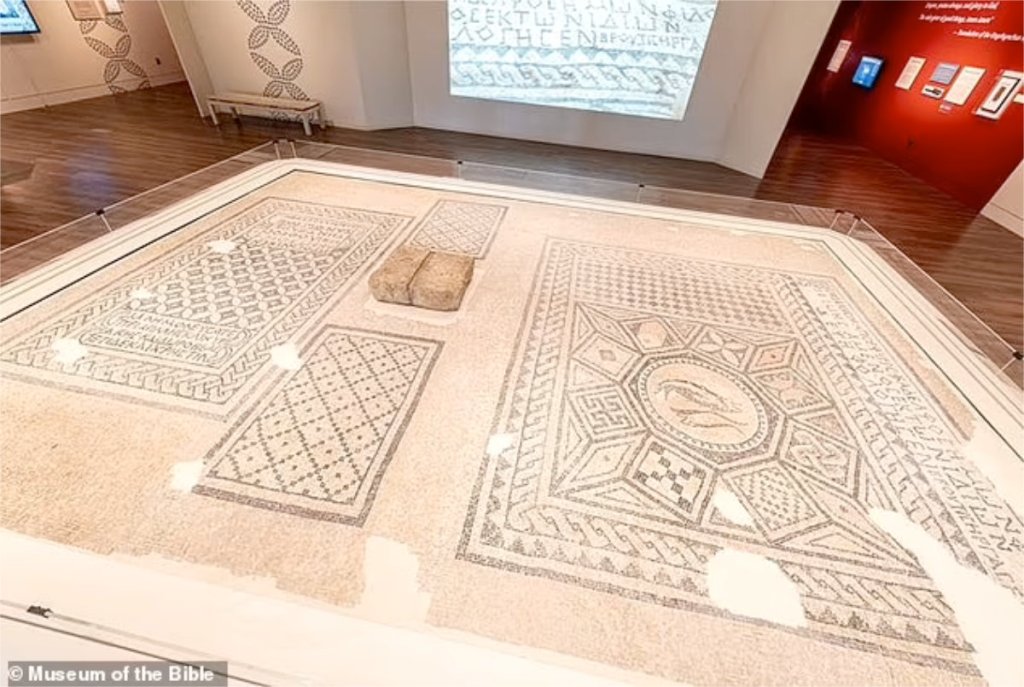
An ancient mosaic created in 230 AD is being lauded as one of the greatest Christian finds since the discovery of the Dead Sea Scrolls, the Daily Mail reports.
The mosaic was found by an inmate in 2005 beneath the floor of Megiddo prison located in Israel’s Jezreel valley and was part of the remains of the earliest Christian church ever discovered. Coincidentally, this valley is the location of the Apocalyptic battle of Armageddon prophesied in the Bible.
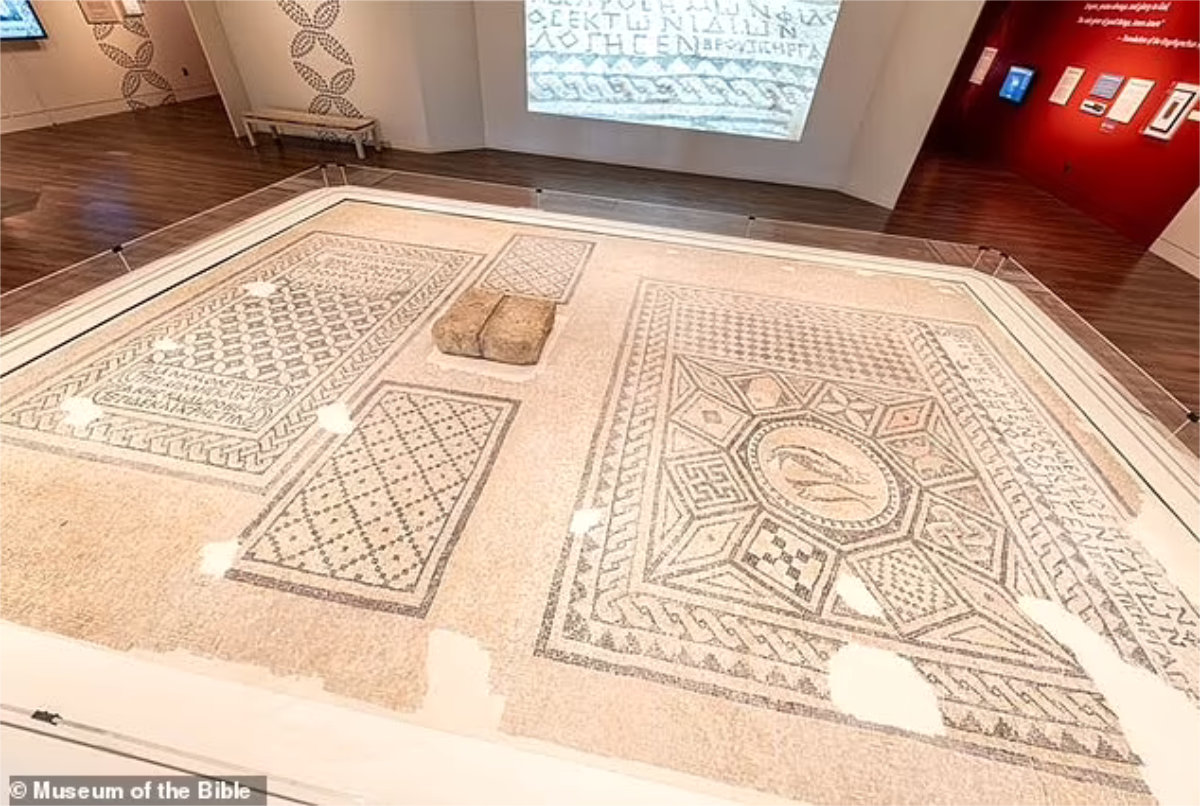
It took archaeologists five years to dig out and restore the mosaic which is now on display at the Museum of the Bible in Washington DC until 2025.
The Mosaic which was created by a craftsman named Brutius provides information about the beliefs and practices of the early Christians.
This includes:
Jesus is God
First was the mosaic’s declaration that Jesus is God, which was revealed in these words, ‘The God-loving Akeptous has offered the table to God Jesus Christ as a memorial.’
It shows that from its earliest days, that church believed that Jesus was God in the flesh.
Of course, this was well documented in the Gospels. In the opening line to his gospel, John wrote, “In the beginning was the Word, and the Word was with God, and the Word was God.”
It was also Thomas who confessed “My Lord and My God” (John 20:28), after he put his fingers in Jesus’s wounded side, when the Lord appeared to disciples after His resurrection.
The importance of women
The second thing the mosaic revealed was the importance of women in the early church as it had the names of five women inscribed on it. In fact, more women were named on the mosaic than men.
This included Akeptou, mentioned above, who had donated a table to the chapel.
Without explaining why, it also encourages God to “remember Primilla and Cyriaca and Dorothea, and lastly, Chreste.”
Obviously, these women had played important roles in this church. Since it was rare for the church to ask God to remember people, it is possible these last four women were martyrs.
We also see similar acknowledgments of women taking place in the Gospels:
Also, some women were with him. They had been cured from evil spirits and various illnesses. These women were Mary, also called Magdalene, from whom seven demons had gone out; Joanna, whose husband Chusa was Herod’s administrator; Susanna; and many other women. They provided financial support for Jesus and his disciples. (Luke 8:2-3 NASV)
Similarly the Apostle Paul acknowledged women including Mary (Romans 16:6), Tryphena, Persis and Tryphosa (Romans 16:12) who labored with Paul in the work of the ministry.
Christianity’s growing influence revealed
Thirdly the mosaic revealed Christianity’s growing influence in the Roman Empire as it credited an officer or centurion in the Roman Legion for contributing the money needed for the mosaic’s creation.
The officer is named and his contribution acknowledged with these words, ‘“Gaianus, also called Porphyrius, centurion, our brother, has made the mosaic at his own expense as an act of generosity.”
This was confirmed with the discovery of a Roman camp near the site. It is also suspected that the Mosaic was purposefully covered over when the Sixth Legion relocated to another area.
We saw similar stories of this in the Bible. Perhaps, the most infamous involved a Roman Centurion named Cornelius who was a part of the Italian regiment. It was at a gathering in his home of God-fearing gentiles, where the Holy Spirit fell (Acts 10).
While Christians were still suffering under the Roman Empire, even at the hands of the Legion, many of the soldiers and officers were becoming believers.
Some estimate that by the time Constantine, Rome’s first Christian emperor showed up in 306 AD, over 55% of the empire was Christian.
Portrayed fish as Christianity’s earliest symbol
Fourthly, the mosaic featured the images two fish, which some suggest was a reference to the feeding of the five thousand (Luke 9:16).
Since the two fish identified on the mosaic were a tuna and sea bass, neither of which were part of this Biblical story, these images may have represented fish as Christianity’s earliest symbol,
As the Museum of Bible explains:
The fish is the earliest symbol of Christianity. It predates the cross, which was not widely used until after the time of Constantine. Why? The Greek word for fish—ΙΧΘΥΣ (ICHTHYS)—is an acronym for “Jesus Christ, God’s Son, Savior.”
• I = Iesous = Jesus
• CH = Christos = Christ
• TH = Theou = God’s
• Y = Yios = Son
• S = Soter = Savior
The importance of this discovery was emphasized by Museum of the Bible Scholar, Bobby Duke, who described it as “arguably one of the most important archaeological discoveries for understanding the early Christian church.”


 OpentheWord.org
Leave a comment