
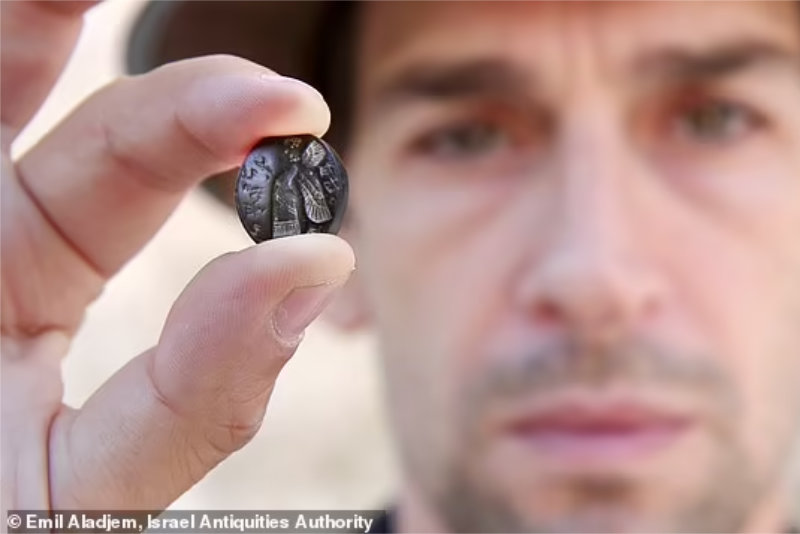

Credit: Emil Aladjem, Israel Antiquities Authority
Archaeologists working with the Israel Antiquities Authority (IAA) uncovered a small, dime-sized seal that is swinging above its weight when it comes to confirming the Biblical record, the Daily Mail reports.
The amulet was discovered near one of the foundations of the southern wall of Old Jerusalem and is 2,700 years old and dates to the first temple period.
The intricately carved seal has an image of a winged man, which is similar to a genie or demon often portrayed in Assyrian carvings that provided protection.
It also had two names carved on the seal written in Hebrew script, ‘LeYehoʼezer ben Hoshʼayahu,’ literally LeYeho’ezer the son of Hosh’ayahu. The names were carved in mirror form, so when it was pressed into clay or wax, they would be legible..
In its Facebook post announcing the find, IAA stated that “The name Yehoʼezer is familiar to us from the Bible (Chron. I 12:7) in its abbreviated form — Yoʼezer, one of King David’s fighters,”
The IAA added that the second name, Hosh’ayahu is also found in the Bible dated to this same time period as the seal.
“In the book of Jeremiah (43:2), describing the events of this very period, a person is mentioned with a parallel name, ʼAzariah ben Hoshʼaya,’” IAA’s news release stated.
While the image is intricately carved, the names were probably added later because they are very rough in comparison. IAA suspects that the son had added his and his father’s name to the valuable seal, after inheriting it on his father’s death.
A hole in the amulet indicates that it was attached to a string or chain and hung around the person’s neck.
Because of the intricacy of the carving, the amulet would have been expensive and belonged to an important person in Judah’s government.
“By virtue of his authority and status, this Hoshʼayahu allowed himself to ennoble himself and flaunt a seal with an awe-inspiring figure engraved on it – one embodying a symbol of authority,” IAA noted in its Facebook post.
The seal’s Assyrian connection is not that unusual as this confirms the Biblical record that Assyria had subjugated Judah in the seventh and eight centuries BC (II Kings 15:19–20).
Similar to past discoveries, the seal also revealed that reading and writing was widespread at this time.
“Contrary to what may be commonly thought, it seems that literacy in this period was not the realm only of society’s elite,” said Dr. Yuval Baruch who helped lead the excavation. “People knew how to read and write – at least at the basic level, for the needs of commerce.“
In an interview with Fox News, Ze’ev Orenstein, director of International Affairs for the City of David Foundation, said, ‘This singular find joins the list of countless archaeological discoveries in the City of David – the historic site of Biblical Jerusalem – affirming Jerusalem’s Biblical heritage.’
‘It similarly serves as yet another affirmation of the thousands-of-year-old bond rooting the Jewish people in Jerusalem – not simply as a matter of faith, but as a matter of fact.’




 OpentheWord.org
Leave a comment