

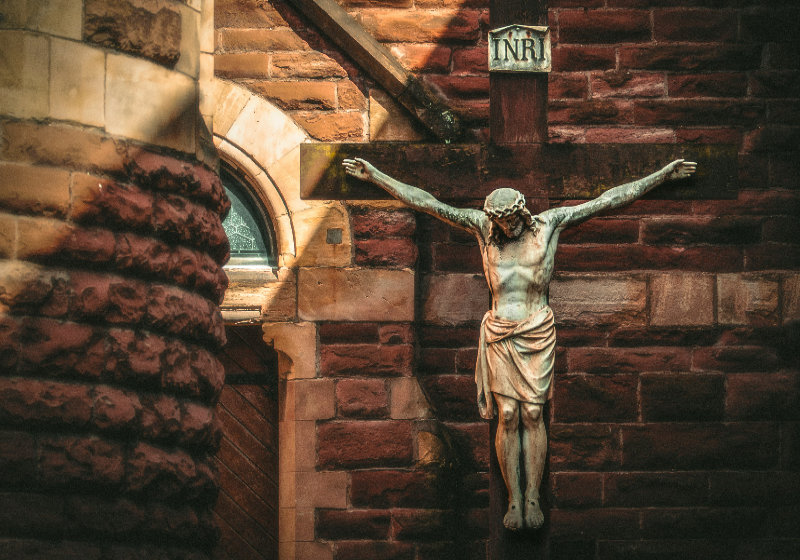
Credit: K Mitch Hodge, unsplash.com
In August 2003, the New York Times reported on a theft at the Church of the Holy Cross in Midtown Manhattan when caretakers noticed on Sunday morning that a 200-pound plaster rendering of Christ had been removed from a wooden cross near the church’s entrance.
The fact that a statue was stolen was less surprising than how it was stolen. The statue was about four feet long, with a steel core, and had been bolted to the cross in four places. The thieves had entered the church, unbolted the figure of Jesus and carried it off, leaving the cross behind.
One of the caretakers told the Times, “They just decided, ‘We’re going to leave the cross and take Jesus.’ We don’t know why they took just him. We figure if you want the whole crucifix, you take the whole crucifix.”
In effect, the thieves wanted Jesus but not the cross.
I suspect that many of us are guilty of something very similar. We want Jesus without a cross. We want discipleship without sacrifice, a walk with God of uninterrupted peace and tranquility.
As I have been engaged in the study of suffering over the last 15 years or so, it has become increasingly clear to me that the New Testament, in particular, is not overly concerned to answer the question of suffering in general (i.e. suffering due to living in a fallen world). This is assumed, of course, but most of the passages dealing with suffering in the New Testament had to do with suffering because of righteousness.
As I have studied many of the classic books on suffering, I could not help but notice that this is hardly ever stressed.
This is to be expected, I suppose, since Christians in the West have little or no experience with persecution per se. However, it seems to me that the rush of today’s preachers and teachers to find practical ways of applying the biblical text to modern day concerns (however well-intentioned) often gets in the way of serious biblical study and accurate understanding of the original intent of the authors.
Respected Lutheran scholar, Krister Stendahl worded it this way, “There is no greater threat to serious biblical studies than a forced demand for ‘relevance.’ We must have patience and faith enough to listen and seek out the original’s meaning. If this is not done, biblical study suffers and may, indeed, come up with false and faulty conclusion and interpretations” (Jesus Among Jews and Gentiles : 35).
Because the biblical texts on persecution cannot readily be applied to a setting where there was little or no persecution, the tendency, it seems to me, has been for teachers and preachers to misapply these passages to situations of general physical, psychological, and spiritual suffering.
This misapplication has subsequently been turned around upon the text itself. The application, hence, influences the interpretation, resulting in the typical Bible student in the West never even suspecting that the texts that deal with pain and suffering might be dealing with suffering for righteousness sake rather than suffering because of sin.
This misconception then is passed on to believers in other parts of the world where there is persecution, with the result that even the persecuted do not often know what the Bible teaches on this theme.
Hence, this new emphasis here at The Voice of the Martyrs on the theology of persecution (or as Richard Wurmbrand liked to called it “sufferology”). I hope you will find these studies helpful in understanding the Bible better.
____________
Glenn Penner was the Chief Executive Officer of The Voice of the Martyrs in Canada. Author of “In the Shadow of the Cross: A Biblical Theology of Persecution and Discipleship” (Living Sacrifice Books, 2004) which has been translated in ten languages including Farsi, Spanish, Chinese and Russian. He taught biblical theology of persecution and discipleship in numerous countries in North & South America, Africa, Europe, and Asia. He went to his eternal reward on January 26, 2010.
Used by Permission: The Voice of the Martyrs exists to glorify God by being an effective and reliable source of information and support of persecuted Christians around the world. www.persecution.net



 OpentheWord.org
Leave a comment