
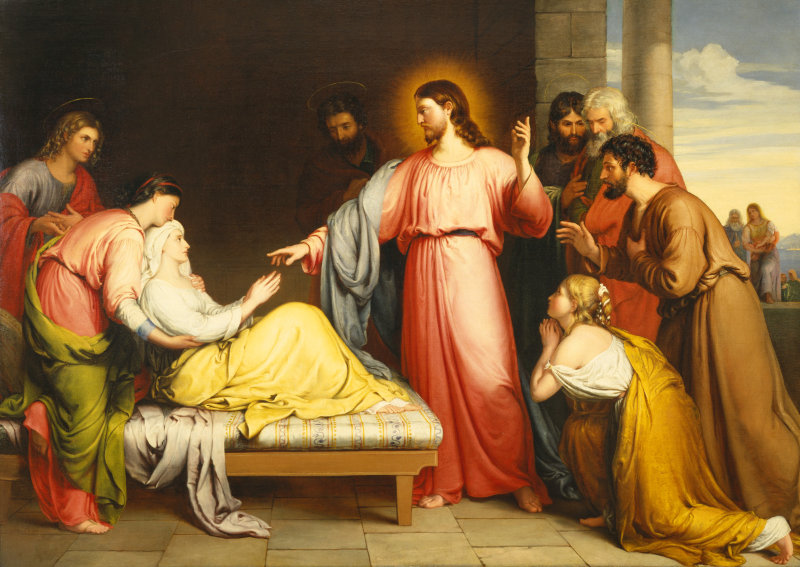
by John Bridges, 1839, Wikipedia, Public Domain
By C. Peter Wagner
When you fly to Maui, Hawaii, and approach the Kahalui airport, the most prominent landmark down below will be the huge structure of the first Assembly of God. What’s more, if you are sick, you can go into that building during any of their weekend or midweek services and know ahead of time that you can receive personalized healing prayer.
Where Healing the Sick is Routine
Pastor Jim Marocco is a long-time friend. I love the way that he forthrightly and unpretentiously obeys the Scripture: “These signs will follow those who believe: In My Name…they will lay hands on the sick, and they will recover” (Mark 16: 17-18).
Healing the sick, in his church, is not something that is done from time to time, nor is it a low-key invitation to those who might choose to stay late after the service. It is just as much a part of what the church usually does at its regular meetings as is worship, prayer, welcoming visitors, the sermon, the announcements, or taking an offering.
During the worship time, after singing a few songs, Pastor Marocco simply invites all those who need prayer for healing to come forward. Since all are standing anyway, it is not at all disruptive for twenty or thirty or more to slip out of their seats and to come up front. The entire pastoral staff is waiting there with small bottles of oil in their hands. While the band plays softly in the background, every person who comes forward is anointed with oil and prayed for according to their need. When that is over, the congregation resumes singing worship songs and the meeting goes on.
Normally any number of reports will come in during the following week of substantial, verifiable healings that have occurred as a direct effect of the healing prayer in the services.
In other words, miraculous healing is a regular part of the ministry of First Assembly, and everybody in town, believers and unbelievers, knows it. Little wonder that the church has been growing steadily for years.
Are “Faith Healers” on the Lunatic Fringe?
Praying for miraculous healing in church services is something that I did not learn in seminary. In fact I can recall that some of my professors would make reference to “faith healers” as if they should be included in the lunatic fringe.
Somehow the idea was planted in my mind that the reason we read in the Bible about Jesus and the apostles healing the sick was that medical science had not yet developed in those prescientific days, so miracles were more useful then than they would be now. Now that we have doctors and hospitals and health insurance and pharmacies, we have a much better way.
In fact, most of the theologians who taught me had been influenced, directly or indirectly, by renowned Princeton theologian Benjamin Warfield, whom I have referenced earlier. He, we may recall, was an influential proponent of cessationism. Here are Warfield’s observations about the biblical accounts of miraculous healings:
“My conclusion then is, that the power of working miracles was not extended beyond the disciples upon whom the Apostles conferred it by the imposition of their hands. As the number of these disciples gradually diminished, the instances of the exercise of miraculous powers became continually less frequent, and ceased entirely at the death of the last individual on whom the hands of the apostles had been laid.” 1
Most people these days who read this quote from Warfield will be totally amazed that such things were actually being taught in our finest seminaries a generation or two ago. It is so far from the thinking and experience of today’s cutting-edge pastors and other Christian leaders that it seems unbelievable. But it was certainly influential back then. During the first twenty years of my ministry, I myself honestly believed that Warfield’s position was true.
Preaching Against Miraculous Healing
Doris and I spent our first 16 years of ministry as field missionaries in Bolivia. I was strongly anti-Pentecostal at the time. I preached against the idea that God does miraculous healings today. I couldn’t have tolerated Jim Marocco’s healing services.
When faith healer Raimundo Jimenez came to our city from Puerto Rico, I strongly admonished my church members not to attend his open-air meetings where miracles were supposed to happen. My first disappointment came when I found that they attended anyway, and then I became extremely perplexed when some of them even testified to being healed! However, I was able to rationalize it all away as some sort of clever fake because that is what I had learned to do in seminary.
Now, of course, my whole way of theologizing and interpreting the Bible and practicing ministry, and teaching my students has turned around 180 degrees. I tell this story because to a large degree, my personal paradigm shift is the story of the Christian church in general over the last two or three decades.
Granted, there are still a few pockets of cessationism here and there, mostly in the Western world. But, generally speaking, most churches in most countries of the world pray for the sick and see miraculous healings on a regular basis. Many people choose to follow Christ because they have discovered that He cares for their bodies as well as for their souls.
Evangelism with Miraculous Healing
We now live in the period of the greatest spiritual harvest that the world has ever known. The widespread ministry of miraculous healing found in churches all over the globe has been one of the causes, not an effect, of this unprecedented wave of evangelism and church growth.
When Jesus ministered, He healed the sick as routinely and as predictably as does Jim Marocco. When Jesus sent out His disciples to preach the kingdom of God, part of their message was literally to demonstrate tangibly that God has power to heal the sick.
The Bible says that healing miracles actually validated the ministry of Jesus. Some might think that the ministry of the Son of the God would need no physical validation, but apparently, it did.
When Peter preached his famous sermon on the day of Pentecost, he told the crowd that Jesus of Nazareth was “a man attested to God to you by miracles and wonders and signs which God did through Him in your midst” (Acts 2: 22).
We can conclude that Jesus’ ministry was more powerful with miraculous healing than it would have been without it. And that is the reason that He equipped and sent out His apostles to do the same.
Miracles pave the road to effective and fruitful evangelism.
John, of course, was one of those apostles. Years later, when he wrote the Gospel of John, he organized the whole book around seven of Jesus’ miracles: changing water into wine, healing a young boy, healing a cripple, feeding 5,000, walking on water, healing a blind man, and raising a dead man. He also said that “Jesus did many other signs” (John 20: 30).
Why did Jesus do so many signs and wonders? According to John, there was one central reason: “[these signs] are written that you may believe that Jesus is the Christ, the Son of God, and that believing you may have life in His name” (John 20: 31).
In other words, miracles pave the road to effective and fruitful evangelism.
Signs and Wonders in China
To bring it up to date, the greatest evangelistic harvest in history is now taking place in China. It is reported that some 20,000 to 35,000 persons per day are being born again there. No one knows exactly, but some estimate the total number of Christians in China as 100 million, and I have even heard 140 million.
What role do signs and wonders play in this remarkable harvest? It is just as John said it should be. One of the top experts on China, Carl Lawrence, reports: “The single spark that started this prairie fire [China] were signs, wonders and miracles. A report form the conservative Lutheran China Study Center in Tao Fung Shan, Hong Kong, concludes that 80 to 90 percent of Christians in rural China are the result of a miracle of healing, casting out of evil spirits, or divine intervention, and of first-hand witness’ testimonies.”2
Greater Works?
Apostolic churches, by and large, take a literal interpretation of John 14: 12: “Most assuredly, I say to you, he who believes in Me, the works that I do he shall do also; and greater works than these will he do because I go to my Father.”
For example, Gary Greenwald, whom I mentioned in the last chapter, tells this remarkable story: “There was a boy by the name of Bree Farrow in one of my meetings. He was so skinny. He was yellow and jaundiced, and they told me that his liver was dead. He was twelfth on the national list to get a liver transplant, but they didn’t think he would live until one was available. I prayed for him, and God’s anointing came on me. The boy fell down crying. I walked out because I had to get to my next meeting.”
“His aunt later came to me and said, ‘Bree went out jogging and skate boarding the morning after you prayed for him. He had so much energy! When he got back, he rode his bike all the way down to the beach. His color is all back. When the doctors took the tests, they said that his liver had regenerated. There was a brand new liver, and he has been released.’ He is totally healthy today, and God gave him a new liver by His miraculous power.”3
Gary Greenwald told this story to around 500 or 600 apostolic leaders attending the National Symposium on the Postdenominational Church in 1996. I was very interested to note that the audience reacted with applause but without surprise. Virtually all of those leaders had seen miracles like this from time to time. Many could tell similar stories.
Healing Teeth
Not everyone agrees how “greater works” than Jesus did should be defined. Certainly raising the dead would be hard to top. Hardly anyone would say that there is anything greater than regenerating lost sinners and making them new creatures.
Nevertheless, for several years dental miracles have seemed to attract a good bit of attention. I first met people whose teeth had been supernaturally filled in Argentina in the 1970s when traveling with Omar Cabrera. Since then, it has become virtually commonplace in Argentine churches across the theological spectrum. In the 1990s the phenomenon spread to Brazil where, unlike Argentina, the preponderance of fillings and crowns were genuine gold!
I would not doubt that some readers could begin to question my authenticity because of statements like this. But I would assure them that I personally have visited Argentina and Brazil enough times over the past few years to be able to stake my reputation on affirming that dental miracles have truly been happening. A false report here and there, disproved by a dentist, is regrettable, but it must be seen as the exception, not the rule.
I mention this because, for many, it is more difficult to believe in reports of divine healing of teeth than reports of divine healing of cancer, especially if an ordinary silver filling is changed to gold which has happened frequently. I have a statement from a professional metallurgist, who is a Christian believer, stating: “Don’t underestimate this sign; if it can be verified, then it is more spectacular to the scientific community that a virgin birth, medial healing, or even the parting of the Red Sea.”
A Challenge to Science?
Why is this? It is because scientists are unanimous in agreeing that only a nuclear reaction can change metallic substances, and this is always in the direction from a more expensive metal to a cheaper one. This metallurgist says, “If it can be verified that mercury amalgam fillings have changed to gold, then this is a sign that God has taken off the gloves with regard to the world of science, and the world’s preoccupation with it as the source of truth.”
When I first read this, it occurred to me that this might well be what God has in mind. The Bible says that “God has chosen the foolish things of the world to put to shame the wise” (1 Cor. 1: 27).
We live in a day when miraculous healing is making a comeback. Seeing God’s power manifested in physical healings is just as important today as it was in Jesus’ time. It is common in other parts of the world, but I believe that churches like Jim Marocco’s church on Maui will also be multiplying here in America.
Notes:
- Benjamin Breckenridge Warfield, Miracles Yesterday and Today: Real and Counterfeit (Grand Rapids, MI: William B. Eerdmans Publishing Company, 1918, 1965), pp. 23-24.
- Carl Lawrence, The Coming Influence of China (Gresham, OR: Vision House, 1996), p. 67.
- Gary Greenwald in an unpublished address given at the National Symposium on the Postdenominational church, Pasadena, California, May 20-23, 1996.
_________________
C. Peter Wagner served as Chancellor of Wagner Leadership Institute and President of Global Harvest Ministries before he went to be with the Lord in 2016. He was a widely recognized authority in the fields of church growth and spiritual warfare, and authored more than 50 books. Excerpt from Seven Power Principles That I Didn’t Learn in Seminary, published by Wagner Publications, Colorado Springs, CO, (2000). Used by permission www.globalharvest.org.


 OpentheWord.org
Leave a comment