

Credit: Angel Studios
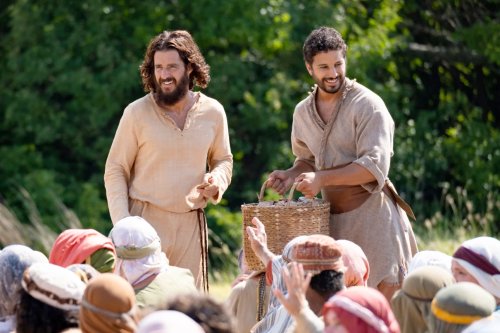
A controversial scene in season 4, episode 3 of The Chosen has many people asking some serious questions about divine healing, Christian Headlines reports.
The popular series dramatizes the life of Jesus and the apostles. This particular scene towards the end of the episode involves a situation, that does not actually occur in the Biblical record.
Quintus, an officer in the Roman army, has been charged with capturing Jesus. He is in a large crowd, sword drawn, and when he is unable to capture Christ in frustration he swings his sword striking Ramah, who is the fiancé of Thomas, the doubting disciple.
Unconcerned about what he has done, Quintus leaves and Ramah is left lying on the ground, dying from her wound.
Jesus then appears on the scene and Thomas pleads with the Lord to heal his fiancé, but Jesus refuses.
The episode ends with Jesus saying, “It is not her time. I love you, Thomas. He loves you. I’m so sorry.”
The reaction to the scene was immediate, with some stating that the incident did not portray the heart of Christ.
However, at the start of episode 3, there was a hint of the point that the producers were trying to make, when they played a flashback involving King David’s son conceived during his adulterous relationship with Bathsheba (2 Samuel 12:16–23).
After the prophet Nathan exposed David’s sin of arranging the killing of Bathsheba’s husband and committing adultery, the prophet said that David would experience judgment, which included the death of the son conceived through Bathsheba.
The boy fell sick and though David fasted and prayed for seven days for God to heal his son, he died.
After hearing of his son’s death, David ends his fast and finishes with these words, “I am going to him, but he will not return to me.”
It seems that the point, the producers were trying to make, is that there are times in the purposes of God when people are not healed.
Throughout the Bible, we see examples of healing not taking place for a variety of reasons.
When God doesn’t heal
Jesus was unable to heal many in Nazareth because of their unbelief and rejection of Christ’s ministry (Matthew 13:56-58).
When Philip was in Samaria, it seemed that he was only able to heal those who had been “paralyzed or limped on crutches” (Acts 8:7) as there is no mention of the blind, deaf, or sick being healed.
Some suggest that when Paul writes about gifts of healing in the plural (1 Corinthians 12:9), this implies that there are multiple kinds of healing gifts, that focus on certain types of afflictions.
Even today, we have surgeons and medical specialists who concentrate on specific ailments, such as orthopedic surgeons, cardiologists, and oncologists.
Philip’s particular healing gift seems to have specialized in people who were lame or paralyzed.
Though the Apostle Paul was involved in several outstanding healing miracles (Acts 19:11-12, Acts 28:8), some including close friends and associates were not healed under the Apostle Paul’s ministry.
This included Trophimus (2 Timothy 4:20), Epaphroditus (who was near death — Philippians 2:27), and even Timothy who was having stomach issues (1 Timothy 5:23). Paul undoubtedly prayed for their healing, but it didn’t happen.
Paul even prayed for his own condition which he described as a ‘thorn in the flesh’ suggesting it may have been some type of physical ailment, which Satan used to torment him (2 Corinthians 12:7). Even though Paul prayed, this affliction was allowed to remain as a way of keeping Paul humble.
Though gifts of healing are still functioning today, the Holy Spirit is the one who administers the gift. God ultimately is the one who decides if and when people are healed, and there could be multiple reasons factoring into this.



 OpentheWord.org
Leave a comment