
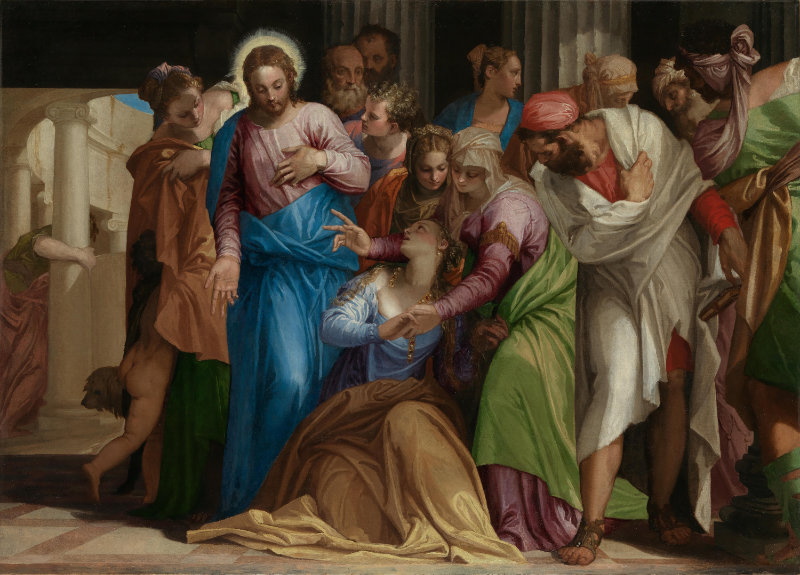

by Paolo Veronese, 1548, Wikipedia, Public Domain
If I were to ask you who the richest man in the world was, most of us would throw out such contenders as Elon Musk or Jeff Bezos and you would certainly be in the ballpark. According to the latest report, Musk with a net worth of $210 billion is on top, followed by Bernard Arnault from France at $179 billion. (It is not an exact science because some list Arnault at the top.)
But if I were, to ask who is the world’s richest woman, many of you, like me, would probably be stumped.
According to the Daily Mail, it is none other than a French woman by the name of Francoise Bettencourt Meyers, 70, who is the granddaughter of Eugene Schueller who founded L’Oreal in 1909.
The company that Meyer owns, holds a 33% share in L’Oreal beauty corporation, which also includes Prada and Yves Saint Laurent among its holdings. A recent run on L’Oreal’s stock pushed Meyer’s wealth over the $100 billion mark, making her the 12th richest person in the world.
But the article also mentioned some interesting facts about Meyer. She is a Roman Catholic and in addition to pledging £173 million to help rebuild the Notre Dame Cathedral that was destroyed by fire in 2019, she has also written a five-volume series entitled, “A Look At The Bible”.
I don’t know what other Catholic causes Meyer funds, but her role as a major financial benefactor to the Roman Catholic Church reminds me of three key women who provided critical financial support to Christ’s three-year ministry.
Luke actually cites them by name, Mary, Joanna, and Susanna:
“Soon afterward, Jesus began going around from one city and village to another, proclaiming and preaching the kingdom of God. The twelve were with Him, 2 and also some women who had been healed of evil spirits and sicknesses: Mary who was called Magdalene, from whom seven demons had gone out, 3 and Joanna the wife of Chuza, Herod’s steward, and Susanna, and many others who were contributing to their support out of their private means.” (Luke 8:1-3 NASV)
Mary Magdalene, out of whom Jesus cast seven demons, was labeled a prostitute by Pope Gregory I around 600 AD, and that has stuck. But there is no Biblical evidence to support this.
In the previous chapter, Luke 7, many suspect Mary was the unnamed woman who poured the extremely expensive alabaster of perfume on Jesus’ head at the home of a Pharisee.
If that indeed was Mary, she was extremely wealthy, but just because the pharisee called this woman a sinner, it does not mean she was a prostitute. The Pharisees routinely called everyone they didn’t like, including Christ, a sinner (John 9:24-26).
Joanna was the wife Chuza, Herod’s steward. This would have been Herod Antipas who ran the region of Galilee which he inherited after the death of his father, Herod the Great.
Because of her husband’s position, which included looking after Herod’s personal affairs and running his palace, Joanna was also financially well off and is mentioned again in Luke 24:10 as being among the group of women who went to Jesus’ empty tomb.
We don’t know anything about Susanna, who is only mentioned once by name in the Gospels. But being listed as one of Christ’s major financial benefactors tells us that she was obviously a woman of means.
These three women played a major role in the success of Christ’s ministry and without their financial help, it would have been severely limited.


 OpentheWord.org
Leave a comment