
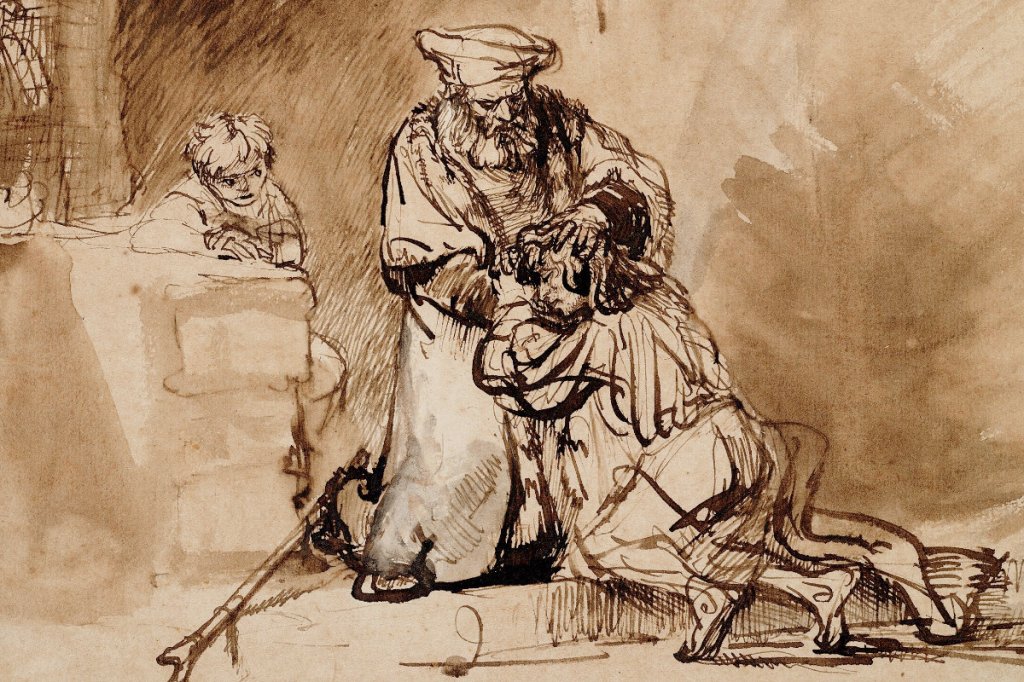
By Rembrandt, 1650, Wikipedia, Public Domain
FOLLOW OUR PODCAST ON (search opentheword):
PODCAST
Hi, my name is Dean Smith and in this podcast, I want to talk about the fathers of atheism. I won’t be discussing the key leaders of atheism, but rather I will be focussing on what may be one of the reasons they became atheists.
Several years back, I wrote an article on a book written in 1999 by Catholic psychologist Paul Vitz titled Faith of the Fatherless: The Psychology of Atheism.
At the time, he wrote his book, Vitz was a professor at the Institute for the Psychological Sciences based in Arlington, Virginia, a Catholic graduate school,
In his book, Vitz argued that as much as atheists like to claim their refusal to believe in God is due to a lack of scientific evidence God exists, Vitz states it may actually be due to a broken relationship with their father or father figures in their life.
His book caused quite a stir among atheists.
And so did my article on opentheword.org. Shortly after the article was posted, I received an email from a self-professing atheist stating that he had a great relationship with his father and this had nothing to do with his atheistic beliefs.
I responded, thanking him for his email and added that I was just reporting on the conclusions of Vitz’s book, which was based on his personal experience and research.
Then over the next couple of hours, I received another five or six emails from this fellow, none of which I responded to, telling me in no uncertain terms that I was wrong.
By the sixth email, I was thinking of that line from Shakespeare’s Hamlet which reads, “The lady doth protest too much, methinks,” which speaks of an overreaction that causes a person to doubt the sincerity of the truth behind a person’s strong denial.
I think my article and particularly Vitz’s book had struck a nerve in this man’s life.
Vitz came to this conclusion about atheism after studying the biographies of several radical atheists such as Madalyn Murray O’Hair, Voltaire and Nietzsche and he noticed that many of them had one common denominator, they had a broken relationship with their father.
It wasn’t just abusive. There were also instances that they had lost their father at an early age either through death or simple abandonment.
Vitz added that not all atheists came from these type of homes, but so many did, that Vitz believed that this was no longer a coincidence.
He concluded that many atheists had been spiritually impacted by what happened to them in childhood.
In an updated version of his book, Vitz cited the example of one of the world’s most infamous atheists, German philosopher, Friedrich Nietzsche, who died in 1900. Nietzsche’s father was a Lutheran pastor. In fact, the family tree was full of pastors.
He didn’t come from an abusive home, but his father died of a brain disease when Friedrich was just five years old.
His father had been sickly for the year prior and experienced what many believe were epileptic seizures.
His death had a profound impact on Nietzsche, One biographer wrote that Nietzsche was “passionately attached to his father and the shock of losing him was profound.”
At this age, Vitz adds that children believe death is a choice and when a parent dies, they are blamed for the hurt it causes. It is the parent’s fault.
Perhaps not coincidentally, Nietzsche would begin to aggressively oppose Christianity later in life, and develop what became known as the ‘God is dead” movement, eerily paralleling his own experience as a child.
And then there was Madalyn O’Hair, a modern atheist, who died in 1995. It was her lawsuit in the 1960s that resulted in prayer being banned from American schools.
Though we don’t have a lot of information on her upbringing, Vitz points to the memoir written by her son that described the relationship between O’Hair and her father, the son’s grandfather.
He wrote:
“We rarely did anything together as a family, the hatred between my grandfather and mother barred such wholesome scenes.”
Vitz goes on to describe one incident recorded by O’Hair’s son when he saw his mother try to kill her father with a ten-inch knife. Though she failed in her assault, she screamed “I’ll see you dead. I’ll get you yet. I’ll walk on your grave.”
O’Hair had a horrific, hate-filled relationship with her father, which Vitz believes explains her vitriolic hatred of God and Christianity.
Now to be fair, as Vitz points out there are atheists who seem to have a good relationship with their father. But even in those instances, we sometimes don’t have the full picture.
In a podcast interview with Patrick Coffin, Vitz told the story of an encounter with a well-known atheist psychologist, Albert Ellis who died in 2007.
Both he and Vitz were speaking at the same conference on the topic of psychology. Vitz presented a theistic approach and touched on how a person’s relationship with their father can impact their spiritual life.
Ellis whose presentation immediately followed spoke on the same subject and presented an atheistic perspective.
As Vitz was leaving the session, he ended up walking out with Ellis who said in response to Vitz’s presentation that he had gotten along fine with his father.
Vitz responded, “well, it’s a psychological hypothesis” and it appears to be valid in upwards of 50 to 60% of the cases.
After returning to New York, Vitz sent a copy of the presentation he had made to a friend who worked as an editor for a book publisher.
Out of the blue, the man shocked Vitz by telling him his thesis fit perfectly with what happened to Albert Ellis, whose biography the editor just happened to be proofing.
T he biography revealed the parental neglect that Ellis experienced while growing up.
At five years of age, he was hospitalized for nearly a year and was rarely visited by anyone in the family during his stay in the hospital.
Then his father abandoned the family, and Ellis, along with his younger brother, had to take on the responsibility of looking after the family both financially and maternally because their mother was mentally and physically unfit.
Though the father popped into the neighbourhood from time to time, he avoided the family home and ignored his family responsibilities forcing Ellis to carry the load.
He had been abandoned by his earthly father and perhaps not surprisingly concluded there was no God either.
If Vitz is right, this would suggest that being an atheist is as much an emotional decision as it is a mental one.
And this emotional connection shows up in an interesting study conducted by researchers from Harvard University and the University of Wyoming.
We often hear people expressing a common sentiment that our thoughts and prayers are with those who are going through extremely difficult times.
But how much do people receiving these thoughts and prayers actually value them.
In the follow-up to Hurricane Florence which slammed into the state of North Carolina in 2018 causing massive flooding and damage, the researchers asked 482 people from that state how much they would pay for people to pray or think of them during a time of crisis.
The 482 people ranged from atheists to Christians and everything in between. As part of this study, each participant was given $5 and told to use it to get people to either pray for them or think of them during this time of crisis.
They found that those on the Christian side of the spectrum were willing to pay up to $7.17 for a priest to pay for them. This meant that in some instances they were actually chipping in money from their own pocket. They were also willing to pay on average $4.36 for a stranger to pray for them.
But what shocked the researchers was the strange thing that happened on the other side of the religious spectrum, those who were closer to atheism.
They were willing to pay Christians $3.54 NOT, I repeat ‘not’ to pray for them and $1.66 for a priest NOT to pray for them.
This is puzzling because if atheism is solely an intellectual decision why would you pay someone NOT to pray for you. At best an atheist should be indifferent. If God doesn’t exist, why would you care if a person prays for you or doesn’t pray for you, much less go to the extreme extent of paying them not to pray.
University of Wyoming economics professor Linda Thunström summed up their study this way, stating:
“The last result is surprising because one might expect that atheists/agnostics would be indifferent to people praying for them — why care if you don’t believe in the gesture.”
Instead of being an intellectual issue, is it possible that atheism is an issue of the heart?
This leads us to an interesting verse in the book of Genesis that may explain the curious connection between the relationship we have with our parents and our perceptions about God.
In Genesis 1:26, we read that God said, “Let us make man in Our image, according to O ur likeness.”
The Hebrew word translated ‘likeness’ — demuwth — means to model or shape. Though fashioned in flesh, God created us with a mind and emotions giving us the ability to have a relationship with our Heavenly Father.
The second word —‘image’ (tselem) — means to be a representation or representative figure. The writers and prophets of the Old Testament used the same Hebrew word to describe idols as we see in 2 Kings 11:18, where the word was used to describe a Baal idol.
It would seem that God intended men and women to be the idols that represented Him, not chunks of rock or carved wooden figures.
But it begs the question — who were we supposed to represent God to? If we were all created in the image of God, it would be fruitless walking around and telling everyone we meet, “ ” because we all look divine.
I believe God intended husbands and wives to be a representative — or an idol of sorts — of what God was like to their children.
As children interacted with their parents, they gained an intimate understanding of who God was. This perception would be a natural bridge leading children into a personal relationship with their true spiritual Father as they mature.
But then came man’s catastrophic fall into sin. In an instant, these perfect idols were scarred and disfigured leaving all children with a flawed impression of what God was really like.
In extreme cases, it would easy to see how a person’s perception of God would be so flawed, he or she would simply reject God’s existence altogether.
But does this distortion only impact atheists?
Smack in the middle of the Ten Commandments, we are told to honour our mothers and fathers (Exodus 20:12).
This commandment is strangely directed at those who believe in God. As believers, we are commanded to honour our parents.
Because of man’s fall into sin, parents are not perfect and believers are equally impacted by parental failures. But even so we are commanded to honour them.
Depending on how bad the abuse was, this may be a bridge too far, even as Christians. How can we honour a father who was a drunk, belligerent, demeaning and even violent?
However, I wonder if unresolved issues between us and our parents can potentially hinder our relationship with God. Can these family struggles potentially become spiritual barriers?
I wonder if our flawed perceptions of God such as He loves others more than you may be based on your perception that your parents loved your brother and sister more than you.
Maybe you don’t feel you can ever meet God’s expectations. Could that be based on the feeling that you could never please your parents? That no matter what you did, it was never good enough.
We all have flawed parents who unfortunately are the byproduct of their parents.
God deeply desires to have a personal and trusting relationship with you and one of the blockages that could be hindering this from happening are resentments that you may hold against your parents.
We need to resolve these heart issues by forgiving our parents. They may even be dead and if so then you need to finally bury them by forgiving them.
Thanks for joining me on this podcast, and we will catch you again.
READ: Did your absentee father make you an atheist? AND The sins and neglect of fathers leads to atheism, says author AND Study: Atheists, agnostics dislike prayers from Christians so much they’re willing to pay money to avoid them: The Blaze


 OpentheWord.org
Leave a comment