

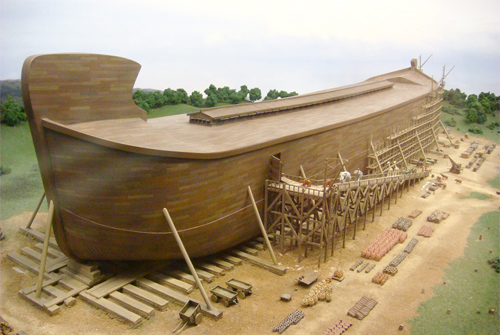
[by Dean Smith] Irvin Finkel works at the British Museum based in London. He is also an expert on the ancient scripts used by the Babylonians, Sumerians and Assyrians.
While exploring the cuneiform texts of the Ancient Sumerians, he came across one that describes a great flood. In some significant ways it is very similar to the Biblical flood account, but in other ways different.
The account holds to the same basic theme. God destroyed the world with a massive flood, but a handful of humans and a representative of all the animals were saved by an ark that rode out the flood. According to the Finkel the text is old dating to about 1750 BC.
After studying the cell phone sized cuneiform text, Finkel concluded the animals entered the ark two-by-two, just as the Bible recorded (Genesis 7:8-9).
Here is what Finkel said::
“What gave me the biggest shock in 44 years of grappling with difficult lines in cuneiform tablets, however, what came next … My best shot at the first two signs beginning line 52 came up with sa and na, both incompletely preserved. On looking unhopefully for words beginning sana- in the Chicago Assyrian Dctionary S Park I SA-SAP, I found the following entry and nearly fell off my chair as a result of the words.’Sana (or Sana) adv. Two each, two by two; OA*; cf. Sina (Finkel, The Ark before Noah, p. 187)”
Perhaps the biggest difference is that the Sumerian account stated the ark was round, not rectangular like Noah’s. In 2014, Engineering students at the University of Leicester in England undertook a project to decide if Noah’s ark — based on the information provided in the Bible — could hold all the known animals in the world. They concluded it could, with room to spare.
The Sumerian text is just one of dozens of accounts of a catastrophic flood stories found in the history of cultural groups around the world. It doesn’t matter if you visit aborigines in Australia or a tribal group in South America, they have a story of a great flood that took place generations earlier.
Because of these stories and after finding human settlements at the bottom of the Black Sea and massive forests on the floor of the North Sea, archaeologists are grudgingly admitting there was a massive flood at some point in history. They of course don’t believe it was world-wide, but how could tribes at every corner of the world have a flood account?
The Tower of Babel the key
To understand what is happening here, we need to give a Biblical view of Ancient history. One of the defining moments occurs in Genesis Chapter 11 — the Tower of Babel.
Because of man’s desire to build a huge tower to heaven, God implemented language — dividing humans into different cultural groups based along family lines.
God did this purposefully to slow man’s development (Genesis 11:6-7).
This marked the beginning of cultures and nations. From this point on, each group would develop its own unique history.
But every group still had one thing in common. They all had a common history — everything from Genesis chapter one through 11. This included the flood and the ark and this is why every group from one end of the world to the other has a story of a great flood.
As they were farther removed from the original events, the stories changed, but still remained fundamentally the same. The Bible provides the accurate rendering of the original account.
But the flood wasn’t the only thing that was common. As they developed their own religions and worshiped different gods, they still understood that sacrifice was necessary for sin and we see some type of sacrificial systems implemented in nearly every religion. Again, it was a concept God introduced in the first 11 chapters of Genesis. We see it in the sacrifices Abel and Cain brought to God (Genesis 4:2-4), and in the sacrifices made after the flood (Genesis 8:20).
There is also marriage. Every culture has marriage. It may be different but the basic principle is the same. Again, it was a practice God instituted in Genesis chapters two and three.
Read more:



 OpentheWord.org
Leave a reply to Ray Davis Cancel reply